
 The Standard Group Plc is a multi-media organization with investments in media
platforms spanning newspaper print
operations, television, radio broadcasting, digital and online services. The
Standard Group is recognized as a
leading multi-media house in Kenya with a key influence in matters of national
and international interest.
The Standard Group Plc is a multi-media organization with investments in media
platforms spanning newspaper print
operations, television, radio broadcasting, digital and online services. The
Standard Group is recognized as a
leading multi-media house in Kenya with a key influence in matters of national
and international interest.

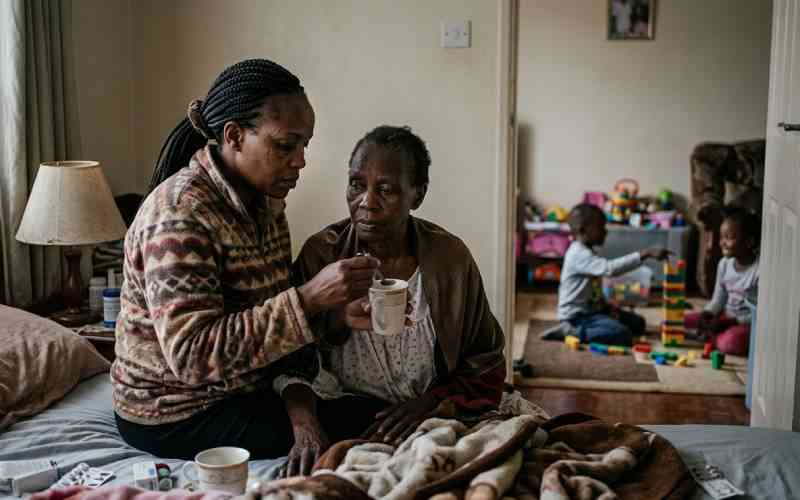
As life expectancy rises and families become smaller, more mothers are carrying the weight of being both caregiver and daughter. They become the thread holding families together, navigating school runs, hospital appointments, medication schedules, and household responsibilities, all while grappling with the heartbreak of watching a parent slowly change before their eyes.
“When we first noticed our mother’s tendency to forget, I started to worry. I knew something was amiss,” explains 43-year-old mother of two, Lydia Nyamweya.
“She would go off topic during conversations, too. It was so heartbreaking. She is my friend and I have shared almost everything with her. I kept asking myself, what am I going to do?” Lydia says.
“I did not want to admit it, but after several hospital visits and a specialist’s recommendation, I have come to terms with it. I am taking care of her. It is a very difficult journey, but we thank God. As four siblings, each of us takes one month to stay and care for her. Dementia is no joke,” she adds.
“Issues of mental and cognitive health are often poorly understood because many people do not understand the brain,” explains Dr Kinoti Ndege, a consultant neurologist. “As the population ages, there will be an increase in dementia cases. Together with the rise in negative lifestyle habits such as alcohol abuse, drug abuse, and environmental pollution, the cases may increase further.”
He notes that the stigma surrounding mental and cognitive illness is largely unwarranted.
“The misunderstanding stems from a lack of conversation. It is a discussion that needs to start happening. In the past, village life allowed communities to look after the elderly. In smaller modern families and with increased migration, it becomes a much bigger problem,” reiterates Dr Esther Cege Munyoro, a pain and palliative care specialist and Managing Director of Alpine Pristine Home.
“Taking care of an elderly parent is a task. She is now like another child I have to look after. I need to remind her to take her medication daily, ensure she is clean, well-fed, relaxed, and attends therapy sessions. I have two preschoolers and one adult child. All the shouting I sometimes find myself doing takes a toll on me,” says stay-at-home mother Elida Anyango.
- How worried should I be about my child lying?
- When the back-to-school glow fades and real life begins
- Small habits that quietly shape a child's character
- Why raising independent children is not enough
Keep Reading
For many women in this role, earning flexibility is limited. Some are forced to give up formal employment and shift into informal work, part-time jobs, or home-based income activities that can accommodate care demands, often resulting in reduced earnings.
Yet the impact goes far beyond finances. Though often invisible, the emotional labour is equally heavy. It can leave caregivers feeling vulnerable, guilty, overwhelmed, or even angry.
This is where grief quietly sets in. It arrives in stages; sorrow for the parent who is slowly changing, and anxiety about the future, including the possibility of one day becoming a caregiving burden for their own children.
There is also guilt: guilt for not doing enough, guilt for losing patience, and guilt over difficult compromises, such as leaving a sick parent with a neighbour to attend a school meeting or missing a child’s activity because of a hospital visit.
Over time, this unspoken guilt can turn into a quiet belief that the struggle is a personal failure rather than a systemic issue.
“Taking care of an elderly mother while dealing with anticipatory grief, depression, and emotional exhaustion is an incredibly heavy burden,” explains psychologist Josephine Waithiru of the Kenya Institute of Professional Counselling. “This cycle of mourning and burnout is common among caregivers, but it can be managed with the right support.”
She notes that caregivers often experience mixed emotions of sadness and anxiety, particularly in anticipation of loss, resulting in what feels like mourning two losses: the person their parent once was and the eventual loss of their life.
She also emphasises that practical caregiving challenges, such as mobility difficulties requiring lifts, rails, and constant supervision to prevent falls, should be recognised and supported by families and communities.
Creating a more accommodating home environment can also have a positive ripple effect on children. It allows them to learn compassion and responsibility early, even before fully understanding what is happening, while also helping them develop empathy for a mother caring for their grandmother.
However, this reality is not without strain, especially for younger children.
“Sometimes during school holidays, I really want to go out with my friends, but chores prevent me. I help my parents care for our dani (grandmother),” says 13-year-old Everline Atieno.
“I help Mum wash Grandma’s clothes and bedding, clean her room and give her medication, especially when Mum and Dad are busy with hospital visits. I love my dani, but I can see it is taking a toll, especially on Mum. She spends the most time with her,” the Grade Nine student adds.
“I won’t lie. The first time my wife told me her elderly mother would be coming to stay with us, I was not thrilled. But I had to be supportive. The financial and emotional toll is not easy. I work longer shifts sometimes just to make ends meet,” says James Olima.
“In many communities, public eldercare facilities are scarce or unaffordable, and cultural expectations place the primary responsibility on family members, most often daughters. However, that does not mean such facilities do not exist,” says Dr Esther Cege Munyoro.
“Currently, there are about 20 eldercare facilities that I know of. Although attracting clients remains a challenge, options for daycare and long-term care are available,” she adds.
Dr Kinoti Ndege further explains that Kenya’s young population structure partly explains the limited number of such facilities.
“Kenya has a young population. The population pyramid shows a large base of young people and fewer elderly citizens. Resources tend to be allocated where demand is highest, hence the limited number of eldercare facilities,” he says.
However, he notes that the availability of unemployed relatives often leads families to rely on home-based care.
While this reflects strong family bonds and cultural respect for elders, it can also unintentionally trap women and mothers in unpaid caregiving roles that limit education, career progression, and personal wellbeing.














 join
join