
 The Standard Group Plc is a multi-media organization with investments in media
platforms spanning newspaper print
operations, television, radio broadcasting, digital and online services. The
Standard Group is recognized as a
leading multi-media house in Kenya with a key influence in matters of national
and international interest.
The Standard Group Plc is a multi-media organization with investments in media
platforms spanning newspaper print
operations, television, radio broadcasting, digital and online services. The
Standard Group is recognized as a
leading multi-media house in Kenya with a key influence in matters of national
and international interest.


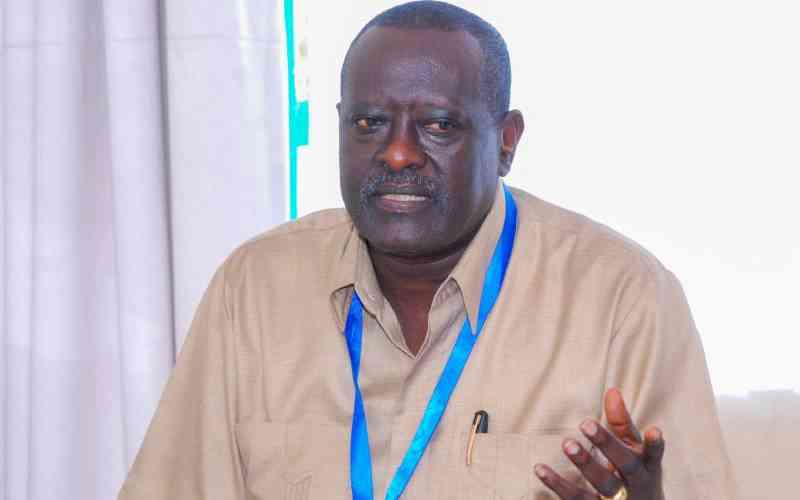
Omer Mohammedelhadi receives certificates from KNRA Director General James Keter (left) and Kenyatta University’s Dr Evans Changamu and Prof Raphael Nyenge in Nairobi, on February 26, 2026. [Courtesy]
Kenya is keen on deepening collaboration with international agencies to grow its pool of nuclear and radiation safety experts to support industrial growth and safeguard public safety.
This was highlighted during a ceremony at Kenyatta University on Thursday marking the completion of a five-month regional postgraduate course in radiation, transport and waste safety.
Twenty-eight students from 15 African countries, including The Gambia, Sudan and Eswatini, completed the programme, which was facilitated by the International Atomic Energy Agency (IAEA) in partnership with the Kenya Nuclear Regulatory Authority (KNRA) and Kenyatta University.
Kenya, South Africa and Ghana have been hosting the course on a rotational basis for English-speaking African countries. Kenya first hosted the course in 2023. Based on the IAEA’s standard syllabus, the course is designed to equip participants with critical skills in radiation protection, regulatory policy development, and the safe use of radioactive sources. It targets graduates in physics, chemistry, life sciences or engineering who have practical experience in radiation protection and the safe use of radiation sources.
KNRA Director General James Keter said sustained cooperation with global institutions such as the IAEA has strengthened Kenya’s technical capacity by providing critical resources and expert guidance. “The government firmly supports efforts aimed at engaging stakeholders in a unified global approach to safety and security,” Mr Keter said.
At the same time, the Director General said that while nuclear technology and radioactive materials offer immense socio-economic benefits, they also pose serious risks if they fall outside regulatory control, potentially threatening public safety and security.
- Nuclear power can light up Kenya but radioactive waste disposal poses risks
- Agency seeks to retain mandate over nuclear and radiological e-waste
- Women experts lead push for nuclear security
Keep Reading
“We are happy that this programme is gaining momentum at a crucial time when KNRA and other regulatory authorities across the region are reviewing and reinforcing regulatory frameworks to keep pace with emerging challenges,” Mr Keter said, adding that African countries should harmonize their policies and laws to tighten regulatory control.
Members of the academia present underscored the value of international collaboration. Speaking on behalf of Vice-Chancellor John Okumu, Dr Evans Changamu, the Dean of the School of Pure and Applied Sciences, said the IAEA-led course reflects the strength of partnerships in advancing research and regulatory excellence.
“Kenyatta University is proud to have partnered with KNRA and the IAEA. It demonstrates our commitment to research and regulatory excellence,” he said. The forum was addressed remotely by Mr Gashaw Wolde, the Acting Director, Division for Africa, Technical Cooperation at the IAEA. Also present were course coordinators, Prof Nadir Hashim of Kenyatta University and KNRA’s Isaac Mundia.
Mr Mundia, who’s the Director of Nuclear Security at the regulator, said the high-level practical-oriented post-graduate course was ‘getting better by the day’, building on experiences from the first cohort in 2023.
Course participant Christine Edna Emong from the Uganda Atomic Energy Council termed the course an eye-opener. “The programme is one of a kind. We are returning to our countries well-equipped with knowledge and more professional networks,” she said.
Beyond the postgraduate course, the IAEA runs other capacity-building initiatives, including an Internet Reactor Laboratory that allows students from Kenya, Tanzania, Tunisia and South Africa to access facilities of a research reactor in Morocco for nuclear education and practical training.









 join
join