
 The Standard Group Plc is a multi-media organization with investments in media
platforms spanning newspaper print
operations, television, radio broadcasting, digital and online services. The
Standard Group is recognized as a
leading multi-media house in Kenya with a key influence in matters of national
and international interest.

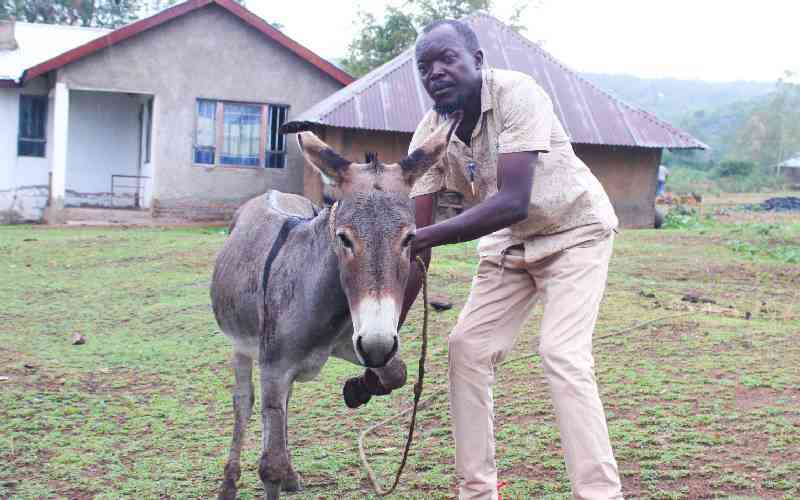
Alex Opiyo takes care of his donkey in Nyakach, Kisumu County. The animal once hit him while he was intoxicated, an incident that became a turning point in his struggle with alcoholism. [Rodgers Otiso, Standard]
For nearly 26 years, Alex Opiyo watched alcohol consume his earnings, damage his relationships and strip him of the ability to provide for the people who depended on him. Repeated attempts to quit ended in disappointment, leaving him trapped in a cycle of drinking, regret and dependence.
The 45-year-old father of three from Nyakach, Kisumu County, had tried to turn his life around several times since he started drinking in 1998, but each attempt to stop proved difficult. What began as a habit gradually became a problem that affected almost every aspect of his life, from his health and personal dignity to his responsibilities as a father and son.
“I had tried to stop drinking several times, but I kept going back. All my money went to alcohol,” he says.
For years, the consequences were not enough to keep him away from alcohol. Even when he recognised that drinking was hurting his family and consuming the money he worked hard to earn, he struggled to maintain his resolve to stop.
“I was not productive. Sometimes I would sleep by the roadside when I was drunk, then wake up the following morning and continue drinking. I would quarrel with people and even fight with them. At times, the same problems would follow me home,” he says.
The children depended on him. His mother was also unwell and needed assistance with food, medicine and other basic needs. Yet he was struggling to take control of his own life.
A painful encounter forced him to reconsider the direction his life was taking. He was attending to a donkey while drunk when he was kicked in the chest by the animal. He fell to the ground.
“That incident made me look at my life differently. I asked myself why I could not use my time to do something productive instead of drinking and becoming a burden to my family,” he says.
He began to earn a living transporting water, timber, farm produce and other goods using donkeys. The income has given him another opportunity to be a provider.
“I can now eat properly, earn money and take care of my mother. I am also helping my family, and there is a house I am building for my mother. When I look at where I came from, I see that my life has changed,” he says.
He has named the donkey that kicked him ‘Tx’. It reminds him of the morning he started looking at his life differently.
Agnes Opiyo, his mother, feels relief after years of worry. She says her son’s drinking had become so serious that she feared he would become mentally ill.
Agnes says the change has been evident in the way her son now approaches his responsibilities. “I am proud to see him doing something for himself and the family,” she says.
She hopes his transformation will encourage other young people struggling with alcohol to seek a different path before their drinking causes harm.
Opiyo’s experience comes against the backdrop of a wider alcohol-use challenge in Kenya, where harmful drinking has implications for public health, household finances and community wellbeing.
The National Authority for the Campaign Against Alcohol and Drug Abuse (NACADA) has reported that approximately one in eight Kenyans aged 15 to 65 currently uses alcohol, translating to about 3.2 million people.
The figures are contained in the 2022 National Survey on the Status of Drugs and Substance Use in Kenya, released in September 2026.
The survey identifies the Western region as having the highest prevalence of alcohol use at 23.8 per cent, followed by the Coast region at 13.9 per cent and Central Kenya at 12.8 per cent.
The use of chang’aa was highest in the Western region at 11.4 per cent, followed by Nyanza at 6.3 per cent and the Rift Valley at 3.6 per cent. Traditional liquor consumption recorded a prevalence of 12.9 per cent in Western, 7.4 per cent at the Coast and 2.2 per cent in Nyanza.
Nairobi recorded the highest prevalence of manufactured legal alcohol consumption at 10.3 per cent, followed by Central Kenya at 10 per cent and Eastern Kenya at 8.4 per cent.
Alcohol misuse is associated with a range of health risks, including liver disease, cardiovascular conditions, some cancers, mental health challenges and injuries. Other effects can include domestic violence, child neglect, road crashes and lost productivity, placing additional pressure on families and communities.
The World Health Organisation estimates that alcohol consumption is linked to approximately 14,000 deaths annually in Kenya.
Irene Mbori, a therapist based in Kisumu County, explains that alcohol dependence may develop through different pathways, including emotional distress, financial difficulties, unemployment, family conflict and peer pressure. Some people begin drinking socially, while others turn to alcohol in an attempt to cope with painful experiences or circumstances they feel unable to manage.
“Men, in particular, may bottle up a lot of pain. When that pain becomes overwhelming, some choose to remain silent while others turn to alcohol, believing that drinking will make them feel better. But when the effects wear off, the underlying pain is still there, and they may drink again to escape it,” Mbori says.
She says this cycle can make it difficult for someone to stop drinking without addressing the circumstances that contributed to the habit in the first place.
A person may recognise that alcohol is damaging their health, finances or relationships but still struggle with cravings, emotional distress and the desire to drink again. Mbori says the reasons people develop alcohol dependency varies, making it important to understand each individual’s experience.
The difference matters because recovery may require more than simply telling someone to stop drinking.
“The first step is acceptance. The person needs to recognise that they have a problem and that they need help. Family members should also accept the person and offer support. When someone decides that they want to stop drinking, that decision becomes important in their recovery,” she says.
Mbori cautions that forcing a person into treatment without involving them in the decision may undermine their willingness to participate. She says families should encourage people struggling with alcohol dependence to seek appropriate help while avoiding humiliation, rejection or constant confrontation.
In Opiyo’s case, the frightening encounter with a donkey prompted him to reflect on his circumstances and strengthen his resolve to change.
Mbori says such incidents can become psychological turning points. She explains that repeated warnings from family members may sometimes be met with resistance, particularly when a person feels judged or attacked. An unexpected experience, however, may prompt a different kind of reflection.
“Sometimes something happens that makes a person stop and examine their life. Instead of focusing only on why the incident happened, they begin asking themselves what needs to change. In his case, the encounter became a turning point that helped him recognise the direction his life was taking,” she says.
However, Mbori cautions against assuming that a frightening experience alone can resolve alcohol dependence. Recovery may require sustained support, counselling and medical care, depending on the severity of the problem.
Recovery process can involve cravings, withdrawal symptoms, loneliness and the risk of returning to alcohol use. People who have spent years drinking may also need time to rebuild relationships and regain the confidence to participate in family and community life.
Mbori urges relatives to avoid constantly reminding recovering individuals of the mistakes they made while drinking, saying this can undermine their efforts to move forward.
“Just embrace them. Do not keep reminding them of everything they did when they were drinking. Allow them to work on themselves and encourage them to move forward,” she says.
Mbori says family members must continue offering guidance and encouragement even after someone begins to change, rather than assuming that one decision will resolve every challenge.
Pamela Opiyo, chief executive officer and team leader at the Support for Tropical Initiative in Poverty Alleviation, says access to training and a livelihood opportunity helped Opiyo redirect his time towards productive work.
She says he received a re-homed donkey after joining the programme and undergoing training, giving him an opportunity to earn an income.
According to Pamela, the intervention was not simply about providing an animal but helping him identify a practical way to support himself and his family.
“Alex has been able to reclaim his sense of identity. Through the training he received, he returned to a productive life,” she says.
She adds that Opiyo’s progress has influenced some of his peers, who are beginning to recognise the value of productive work and personal responsibility.
For Opiyo, the livelihood opportunity has become part of a broader effort to rebuild his life. The most significant change, however, is that he now has a source of income and a renewed sense of responsibility towards himself and his family.










 join
