
 The Standard Group Plc is a multi-media organization with investments in media
platforms spanning newspaper print
operations, television, radio broadcasting, digital and online services. The
Standard Group is recognized as a
leading multi-media house in Kenya with a key influence in matters of national
and international interest.
The Standard Group Plc is a multi-media organization with investments in media
platforms spanning newspaper print
operations, television, radio broadcasting, digital and online services. The
Standard Group is recognized as a
leading multi-media house in Kenya with a key influence in matters of national
and international interest.

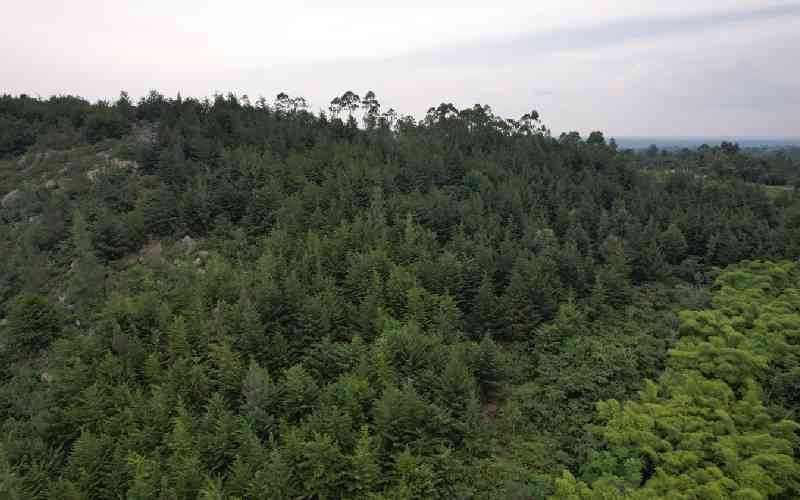
Dense Maragoli Hills Forest in South Maragoli Ward, Vihiga County that is boosting livelihoods after restoration. [Nanjinia Wamuswa, Standard]
Kenya's ambitious plan to grow 15 billion trees by 2032 is increasingly being viewed as more than an environmental initiative, and beyond restoring degraded landscapes and strengthening climate resilience, the programme is creating a new economic ecosystem that spans seedling production, agroforestry, forest restoration services, eco-tourism, beekeeping, carbon projects and other nature-based enterprises.
Across the country, counties are discovering that restoration can generate jobs, support small businesses, improve agricultural productivity and create new income streams for rural communities.
The economic stakes are significant. Kenya's National Landscape and Ecosystem Restoration Strategy estimates that land degradation affects approximately 38.8 million hectares, and results in socio-economic and ecological losses of about $1.3 billion (Sh5 billion) annually.
The strategy identifies restoration as a pathway for environmental recovery and livelihood creation, improved productivity and employment generation across multiple sectors of the economy.
Few places illustrate this shift more clearly than Vihiga County.
Its rehabilitation of Maragoli Hill Forest is demonstrating how environmental restoration can evolve into an economic asset, offering a glimpse into what a restoration-driven rural economy could look like as Kenya scales up one of Africa's most ambitious landscape recovery programmes.
- Vihiga's fight to save mothers gets boost
Keep Reading
The 15 billion tree-growing programme seeks to restore 10.6 million hectares of degraded landscapes while increasing Kenya's national tree cover and strengthening climate resilience.
The strategy's local economic engine is agroforestry. Government targets call for three million hectares of agroforestry systems to be established on farms by 2032, embedding restoration directly into agricultural production systems rather than relying solely on public forests.
That means millions of farming households could become participants in the restoration economy through seedling purchases, tree management, fruit production, fodder systems, timber, honey and other tree-based enterprises.
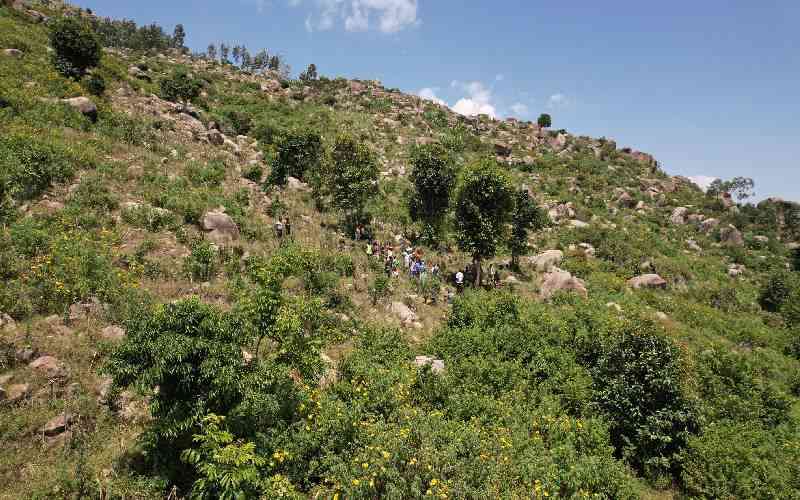
In effect, Kenya's restoration agenda is increasingly being designed not only as a conservation programme, but as a household-level rural enterprise strategy.
But according to the National Coordinator of the 15 billion trees initiative, Susan Boit, the programme should not be viewed solely through an environmental lens. "The programme is a nature economy rather than solely a tree-planting exercise," she says.
“Restoration activities across forestry, agroforestry, watershed protection, timber, bamboo, fruit trees and ecosystem services have the potential to create a multi-billion-shilling sector.”
The scale of the opportunity is significant. According to the Secretariat, Kenya will require about 1.5 billion seedlings annually to meet its 2032 target, with about one billion seedlings expected from public nurseries and another 500 million supplied by private nurseries, community groups, county governments and development partners.
Using prevailing prices of between Sh10 and Sh30 per seedling in Kenya Forest Service (KFS) nurseries, particularly when supplying other government institutions, the Secretariat estimates the national seedling market could be worth between Sh15 billion and Sh45 billion annually.
In the open market, prices vary considerably depending on species, maturity and location. In the commercial market, pricing varies considerably across species and regions.
While many indigenous seedlings retail at between Sh50 and Sh100, premium segments such as grafted fruit trees, ornamental species and other high-value planting materials can fetch between Sh150 and Sh350 or more.
In some ASAL counties, higher logistics costs and constrained supply can push prices even further, illustrating the emergence of a diverse and increasingly sophisticated seedling market.
Turning Restoration into an Economic Asset Years of deforestation and unsustainable land-use practices had left sections of Maragoli Hill severely degraded, contributing to soil erosion, declining water availability and biodiversity loss.
Earlier rehabilitation efforts achieved limited success, with many planted trees.
failing to survive. In 2019, Vihiga County adopted a performance-based restoration model that required contractors not only to plant trees but also to nurture them to maturity.
Payments were tied to verified survival rates, creating stronger incentives for long-term restoration outcomes.
According to the Director in Charge of Climate Action in Vihiga, Winston Atamba, the county has since restored about 300 acres of degraded forestland and planted more than 500,000 trees.
Partners supporting the initiative include Equity Bank, Kenya Airways, the Kenya Forest Service, the Ministry of Environment, the Ministry of Energy, the Ministry of Defence and the Catholic Justice and Peace Commission.
While the environmental gains are visible, county officials say the economic benefits are becoming increasingly important.
Water and productivity gains
One of the most immediate returns has been improved access to water. County officials report that streams which had previously dried up are now flowing more consistently, reducing pressure on households and supporting agricultural production.
According to Atamba, climate resilience investments have improved water access for 15,000 households across Vihiga County, with the Maragoli Hills catchment alone benefiting roughly 3,000 households.
Improved water availability reduces vulnerability to drought, lowers the costs associated with water scarcity and strengthens farm productivity. The restoration effort is also helping address soil erosion, one of the major drivers of agricultural losses in the region.
Atamba says improved vegetation cover, increased soil moisture retention and enhanced water availability are supporting the production of maize, fodder crops and indigenous vegetables.
Globally, agricultural research has shown that severe soil erosion can reduce crop productivity by 20-50 per cent, depending on the extent of degradation.
For counties whose economies depend heavily on agriculture, restoration therefore represents not only an environmental intervention but also an investment in productive land.
The connection is particularly important in Kenya, where agriculture contributes 33 per cent of GDP directly and a further 27 per cent indirectly through agro-based industries and services, while employing more than 40 per cent of the population and about 70 per cent of rural residents.
New forest-based enterprises
The restored forest is creating economic opportunities beyond farming. Maragoli Hill Forest has become an increasingly popular destination for hiking, birdwatching and nature walks.
Visitors pay Sh1,000 for guided tours, generating income opportunities for local youth working as guides and support staff.
The site currently attracts at least 50 visitors each month, with some months exceeding 100 visitors, creating a modest but growing eco-tourism economy around the restored landscape.
A beekeeping initiative established within sections of the forest is generating an additional income stream. The county has installed about 150 beehives, each producing around 10 kilograms of honey per harvest, with harvesting conducted twice annually.
At current prices of about Sh1,000 per kilo, the initiative has the potential to generate roughly Sh3 million annually in honey sales. According to county officials, about 350 people participate in the honey value chain, including hive manufacturers, beekeepers, harvesters, processors, packagers and traders.
Together, these activities demonstrate how restoration can create multiple revenue streams from a single landscape while improving environmental outcomes.
The business of growing trees
Perhaps the clearest economic signal emerging from the programme is the rapidly expanding market for seedlings and restoration services. According to Vihiga County officials, more than 500 people currently earn income through tree planting, nursery operations and forest rehabilitation activities linked to restoration projects.
In the commercial market, pricing varies considerably across species and regions. While many indigenous seedlings retail at between Sh50 and Sh100, premium segments such as grafted fruit trees, ornamental species and other high-value planting materials can fetch between Sh150 and Sh350 or more.
In some ASAL counties, higher logistics costs and constrained supply can push prices even further, illustrating the emergence of a diverse and increasingly sophisticated seedling market.
According to the 15 Billion Trees Initiative Secretariat, demand for seedlings is expected to remain strong throughout the implementation period, creating opportunities for private nurseries, youth enterprises, women's groups, community-based organisations and farmer groups/farmer service centres.
Boit identifies commercial seedling production, agroforestry enterprises, and bamboo value chains, beekeeping, restoration services, GIS monitoring and nature-based tourism as some of the most promising areas for entrepreneurs.
Participation is already expanding rapidly.
The Secretariat notes that thousands of private and community nurseries registered through the Kenya Forest Service and the Kenya Forestry Research Institute are supplying seedlings to restoration projects across the country.
Private-sector engagement is also growing through corporate sustainability commitments and restoration partnerships involving financial institutions, telecommunications companies, manufacturers, agricultural firms and energy companies.
For investors, the opportunity extends well beyond tree planting. The restoration economy is creating demand across seedling production, environmental monitoring, restoration services, agroforestry, honey processing, eco-tourism and sustainable forestry products.
Several counties, including Kiambu, Kakamega, Meru, Nakuru, Nyandarua and Garissa, are already demonstrating strong growth in restoration-related enterprise activity, according to the Secretariat.
While many of the economic benefits are still emerging, and long-term returns are still developing, restoration is increasingly being viewed as a productive asset capable of generating both environmental and economic value.
The experience of Maragoli Hill suggests that when restoration is designed around community participation, enterprise development and long-term stewardship, environmental recovery can become a platform for local economic growth.
The significance of Maragoli Hill extends beyond the recovery of a single forest. It offers evidence that restoration can generate measurable economic value through improved agricultural productivity, stronger water security, enterprise development, tourism and new livelihood opportunities.
For Vihiga County, restoration is increasingly becoming both an environmental and economic strategy. For Kenya, the bigger question is whether the lessons emerging from projects such as Maragoli Hill can be replicated at scale.
As the country pursues its 15-billion-tree target, restoration is evolving from a conservation activity into a potential engine of rural development, enterprise creation and green economic growth.
The challenge now is ensuring that the investment, policy support and private-sector participation unlock that opportunity and keep pace with the ambition of the programme.
That question matters because forests already provide direct employment to more than four million Kenyans and serve as a livelihood base for more than 80 per cent of households, according to government data.
Expanding restoration could significantly deepen those economic benefits.










 join
join