×

The Standard e-Paper
Home To Bold Columnists
 The Standard Group Plc is a
multi-media organization with investments in media platforms spanning newspaper
print operations, television, radio broadcasting, digital and online services. The
Standard Group is recognized as a leading multi-media house in Kenya with a key
influence in matters of national and international interest.
The Standard Group Plc is a
multi-media organization with investments in media platforms spanning newspaper
print operations, television, radio broadcasting, digital and online services. The
Standard Group is recognized as a leading multi-media house in Kenya with a key
influence in matters of national and international interest.

Audio By Vocalize
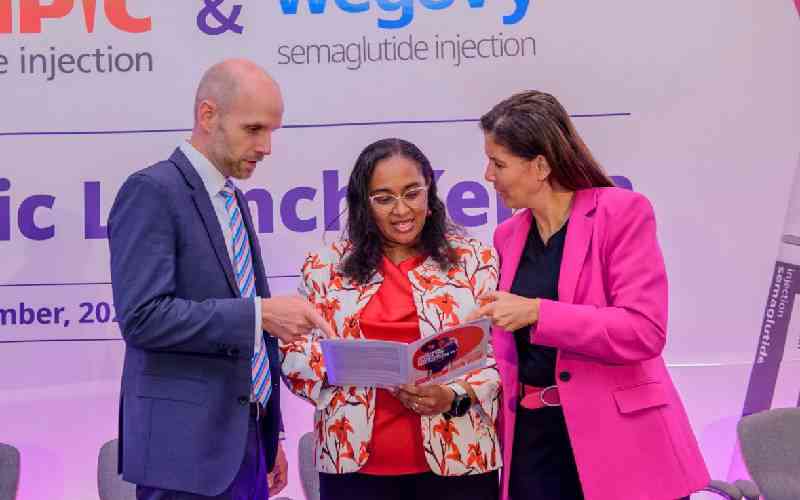
Head of Novo Nordisk Business Area Africa Malika De Maillard chats with consultant physician Dr Roseline Ngugi and Novo Nordisk Middle Africa GM Jakob Mollerup. [Ryan Kerubo, Standard]
A new prescription aimed at easing the burden of type 2 diabetes has been introduced to the Kenyan market.
Novo Nordisk introduced Ozempic and Wegovy as the country confronts a growing burden of type 2 diabetes, obesity and related cardiovascular and metabolic conditions.
The pharmaceutical company officially unveiled the prescription during a scientific launch event in Nairobi on Saturday, bringing together healthcare professionals, policymakers, medical experts and other health-sector stakeholders.
While Ozempic will manage type 2 diabetes, Wegovy is intended for people living with obesity or those who are overweight and have associated health conditions.
Both medicines contain semaglutide but are prescribed for different purposes and at different doses.
Their introduction expands the treatment options available to eligible patients in Kenya, although experts stressed that the medicines must be prescribed following proper medical assessment.
The launch comes amid concern that many Kenyans living with diabetes remain unaware of their condition, delaying treatment and increasing their risk of developing serious complications.
Many diabetes cases remain undiagnosed.
Consultant physician and endocrinologist Dr Roseline Ngugi said diabetes prevalence across Africa had risen sharply over the past decade, placing additional pressure on health systems.
“Africa alone has seen a rise in the prevalence of diabetes of over 142 per cent in the last ten years,” Ngugi said.
She noted that the challenge extends beyond people who have already been diagnosed, with a significant proportion of the population believed to be living with diabetes without knowing it.
Undiagnosed or poorly managed diabetes can contribute to severe complications affecting the heart, kidneys, eyes, nerves and blood vessels. Ngugi said expanding screening and promoting early diagnosis would be critical to changing the course of diabetes care.
Stay informed. Subscribe to our newsletter
The launch also drew attention to the close relationship between diabetes, obesity, hypertension and other chronic conditions.
Ngugi urged the public and healthcare system to stop treating obesity solely as the result of individual lifestyle decisions, saying it should be approached as a complex medical condition.
“Obesity is not a lifestyle disease. It is a metabolic condition closely causing cardio-metabolic diseases,” she said.
She added that obesity was increasingly being observed across different age groups, including among children, creating health risks that could extend across generations.
The changing disease pattern requires health facilities to move beyond treating individual conditions separately and instead adopt an integrated approach to obesity, diabetes and cardiovascular health.
Access and affordability
While the introduction of Ozempic and Wegovy offers additional treatment choices, speakers at the Nairobi event said their impact would depend on whether eligible patients could access and afford them.
Ngugi said cost and limited availability had historically prevented many patients from receiving appropriate treatment for chronic conditions.
“One of the problems we had is accessibility. However, I am excited to announce that the price they are offering is affordable,” she said.
The exact retail prices of Ozempic and Wegovy in Kenya were not provided during the announcement.
Ngugi called on the government, health insurers and other stakeholders to consider how broader access to appropriate treatment could help reduce the long-term cost of managing diabetes, obesity and their complications.
Patients living with poorly controlled chronic conditions can require repeated hospital visits, emergency treatment or long-term care for complications. Experts at the launch said early intervention could improve patient outcomes and reduce pressure on families and health facilities.
They also stressed that improved availability should be accompanied by responsible prescribing, proper assessment and continued medical supervision.
Ozempic and Wegovy are prescription medicines and should only be used under the direction of a qualified healthcare professional. Treatment decisions should consider a patient’s medical history, condition, eligibility and potential risks.
The medicines are not intended to be used interchangeably or without professional guidance simply because they contain the same active ingredient.
Novo Nordisk Business Area Africa Head Malika De Maillard said the scale of diabetes and obesity across the continent demonstrated the need for stronger health responses and continued medical innovation.
“There is a great medical need for diabetic patients,” De Maillard said.
She highlighted the relationship between diabetes and other cardio-metabolic conditions, including cardiovascular and kidney disease, and said healthcare systems needed treatment models capable of addressing interconnected health risks.
The company said healthcare professionals would receive information on patient eligibility, prescribing and the appropriate use of the medicines.
Novo Nordisk also said the launch was intended to improve understanding of the science behind the treatments and the patient-support programmes available.
Danish Ambassador to Kenya Stephan Schonemann said the arrival of additional diabetes treatments could give patients and healthcare professionals more options.
“We are giving people with diabetes a better option,” Schønemann said.
He highlighted the longstanding relationship between Kenya and Denmark and said the two countries could deepen cooperation in healthcare, innovation and knowledge exchange.
The ambassador also pointed to differences in health outcomes, including life expectancy, and underscored the importance of addressing the conditions contributing to those disparities.
His remarks broadened the conversation beyond the availability of medicines to the partnerships required to strengthen healthcare systems.
Participants said tackling diabetes and obesity would require cooperation between the government, medical professionals, researchers, insurers, pharmaceutical companies, development partners and communities.





Subscribe to our newsletter and stay updated on the latest developments and special offers!







 join
join