
 The Standard Group Plc is a multi-media organization with investments in media
platforms spanning newspaper print
operations, television, radio broadcasting, digital and online services. The
Standard Group is recognized as a
leading multi-media house in Kenya with a key influence in matters of national
and international interest.

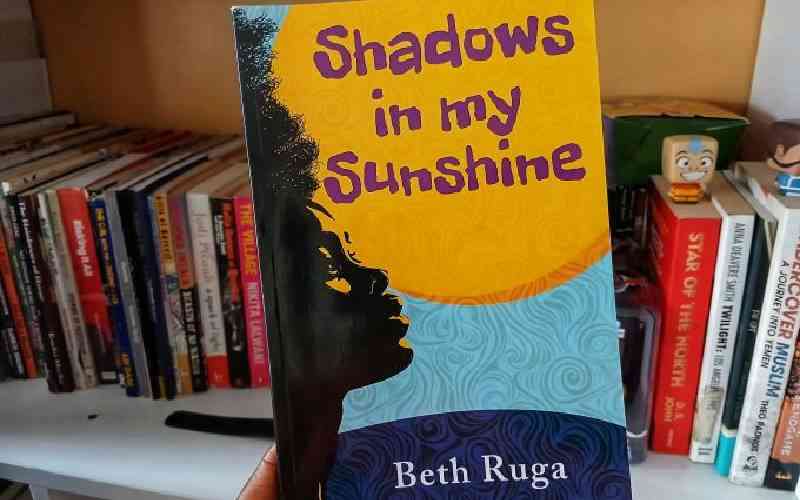
Beth Ruga says self-publishing is more of a necessity than an option for many Kenyan authors, who have stories to tell, but the traditional publishing route is hardly accessible to them.
Tell us about the award your book recently won and how it came about.
It is an award presented by Peace League Africa, dubbed ‘Excellence in Literature & Social Awareness’. It recognises the use of literature to promote social cohesion and positive change. Recognition of any kind is satisfying, but I am much more pleased by the positive impact Shadows in My Sunshine has made.
It has been a year since your book, Shadows in My Sunshine, was published. How has the reception been?
I would say it has been very well received by a wide cross-section of readers across different age groups. It explores a range of themes, including romance, crime, betrayal, culture and, of course, HIV.
How did the idea of writing this book come about, particularly the decision to address HIV/AIDS?
Like Kenya’s first Caine Prize winner, the late Binyavanga Wainaina, when the AIDS scourge hit Kenya in the early 1990s, I made a mental note that one day I would write about it. Many years later, that idea became a book.
What message did you hope to convey, particularly regarding the disease?
I wanted to address the stigma experienced by people living with HIV, as well as sensitise the public to the fact that the fight to achieve zero new infections is far from over, given the worrying trends reflected in current statistics.
Do you feel that HIV/AIDS has received less attention from the Government and NGOs in recent years?
Absolutely! More needs to be done to educate the public, particularly those aged 15–24, among whom many new infections occur. If we fail to address this as a country, we risk having a staggering number of people living with HIV in the future. With the medical interventions currently available for prevention, including PrEP, PEP, the twice-yearly injection and condoms, surely, new infections should be minimal, if not a thing of the past.
After reading the book, I got the feeling that you treated Ndanu, Wangeshi’s friend, rather unfairly towards the end. Did she deserve to be portrayed as a villain after everything she had sacrificed for her friend?
Haha! The world, and life itself, is not fair. Betrayal often comes from those closest to us. In Kenyanese, Ndanu was just chilling, then boom!
What is the most interesting feedback you have received from readers?
One reader thinks the book is a romantic thriller, with HIV being one of its minor themes. Another reader, who confided that they were living with HIV, related to the struggles of disclosing their status as a young person navigating today’s dating scene. That was very humbling. Another reader particularly enjoys the cultural aspects of the book.
The most shocking feedback came from a potential buyer who insisted that HIV was old news and needed to be given a rest. I found that rather disturbing. See why we still have new infections? I mean, we still talk about the Holocaust. Heck, we still talk about Sodom and Gomorrah!
By and large, as an author, I appreciate the diverse ways in which readers interpret the same piece of literature and how differently it speaks to them.
Why did you decide to self-publish? Would you advise other authors to take the same route?
Self-publishing is more of a necessity than an option for many Kenyan authors. We have stories to tell, but the traditional publishing route is hardly accessible to many. Manuscripts have been known to remain on shelves for years while writers are left in limbo, uncertain about the fate of their work. The issue of earnings and payouts is a whole new Pandora’s box that we shall not open today.
What lessons have you learnt from marketing your book?
I have learnt that marketing is really where the hard work lies. To reach the market, authors are better off collaborating with players in the sector to achieve meaningful sales, distribution and visibility. Fortunately, more players have recently started working with self-published authors to address these challenges. Social media also offers considerable potential for sales and marketing.
The responsibility in self-publishing rests heavily on the author. And yes, more authors should self-publish. We would like production costs to be lower, but as we wait for interventions from stakeholders, stories must be told and history must be documented.
Based on your experience, what advice would you give aspiring authors?
Go and write that story, then get out there and tell the world about it through marketing. The world will read. Along the way, use AI as a tool, not a co-author. Give your readers credit; they can tell the difference.
Where are we going wrong with AI?
We are using it to write on our behalf instead of treating it as a tool to enhance our writing, for example, as a spellchecker. And have you seen some of the AI-generated book cover designs? The human feel of a story, in my opinion, dies when it is told using AI.
In your view, does the Government have a role to play in promoting authors and authorship?
Yes, it does. Is it happening? Not in the least. The last I remember was a motion proposing that authors be required to submit electronic copies of their work to the Senate, in addition to the two mandatory hard copies submitted to the Kenya National Library Service (KNLS). Electronic copies! That says a lot about a country with virtually no budgetary allocation for the sector, if any at all.
What interventions would you like the Government to make?
Interventions should include tax waivers, promoting Kenyan books as class readers in public schools and increasing the visibility of local literature at home and abroad. To the ordinary mwananchi, art encompasses almost everything except books. Kenyans can readily name musicians and actors but struggle to identify authors beyond those associated with set books.
What are you currently working on?
I am working on an investigative piece addressing the infiltration of drugs into schools.











 join
