
 The Standard Group Plc is a multi-media organization with investments in media
platforms spanning newspaper print
operations, television, radio broadcasting, digital and online services. The
Standard Group is recognized as a
leading multi-media house in Kenya with a key influence in matters of national
and international interest.
The Standard Group Plc is a multi-media organization with investments in media
platforms spanning newspaper print
operations, television, radio broadcasting, digital and online services. The
Standard Group is recognized as a
leading multi-media house in Kenya with a key influence in matters of national
and international interest.

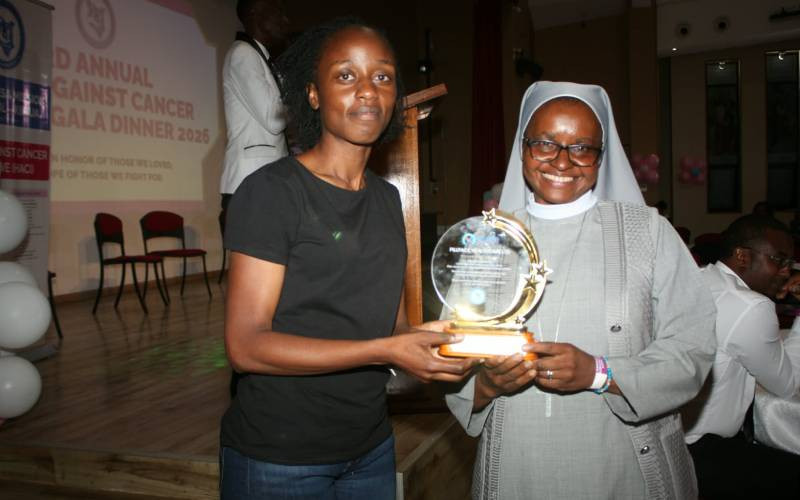
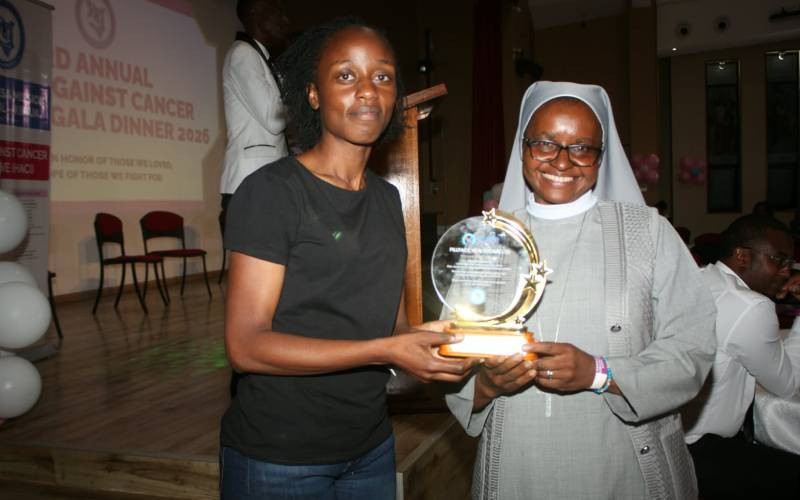
St Theresa Mission Hospital – Kiirua CEO Sr Agnes Mukulu awards director Pillpack Healthcare Limited Dr Kairo for their long partnership with the program on October 16, 2026. [Jenipher Wachie, Standard]
The growing burden of cancer in Meru County has prompted St Theresa Mission Hospital, Kiirua, to call for greater political goodwill, public support and stronger partnerships to ensure that financial hardship does not deny patients access to life-saving treatment.
Speaking during a fundraising dinner in Nairobi, the hospital’s Chief Executive Officer, Sr Theresa Mukulu, said the fight against cancer required a collective commitment from the government, private sector, development partners and members of the public, warning that many families were struggling to sustain treatment after exhausting their medical insurance benefits.
“Looking ahead, our priorities remain clear: to expand cancer awareness and screening, strengthen access to diagnosis and treatment, improve clinical care, develop research that responds to regional needs and build strong partnerships,” said Sr Mukulu.
Through its Hope Against Cancer Initiative (HACI), the Catholic mission hospital is seeking to bridge the financial gap facing vulnerable patients by supporting diagnosis, treatment, screening, home visits and palliative care.
She added that early diagnosis could significantly improve the chances of successful treatment noting that initiative's success would be measured not merely by the money raised but by the number of patients reached, treatments supported and families given renewed hope.
“Our kindness must remain beyond tonight. Your support is not merely a financial contribution; it is an investment in human equity and a chance to restore hope to families who might otherwise face these challenges alone,” she said.
According to her, for the last three years, the initiative had recorded 396 active oncology patients, approximately 90 of whom were experiencing financial difficulties.
- MPs call for overhaul of cancer treatment access and funding
- Nairobi targets system gaps as late cancer diagnoses strain care capacity
- Kenyan researcher wins Sh446m award for advancing oesophageal cancer diagnosis
- New non-drug therapy transforms cancer care
Keep Reading
Through awareness and screening activities, the hospital had reached 10,456 people, supported 549 patients through diagnostic procedures and identified 24 people diagnosed with different types of cancer.
Since its establishment, HACI has also provided medication support to more than 86 patients who had exhausted their insurance benefits.
The programme continues to offer treatment assistance, home visits and supportive palliative care to patients whose families cannot adequately meet the cost of managing the disease.
According to Sr Mukulu, eight patients had exhausted their recurrent benefits, with an estimated monthly treatment requirement of Sh1.56 million.
The initiative had extended screening, awareness, diagnosis and treatment support valued at Sh3.4 million, with Sr Mukulu calling for support to sustain the programme and expanding its reach to more vulnerable households.
The hospital's efforts come amid growing concern over cancer cases in Meru and neighbouring counties, where access to specialised healthcare remains difficult for some communities, particularly those living far from referral facilities.
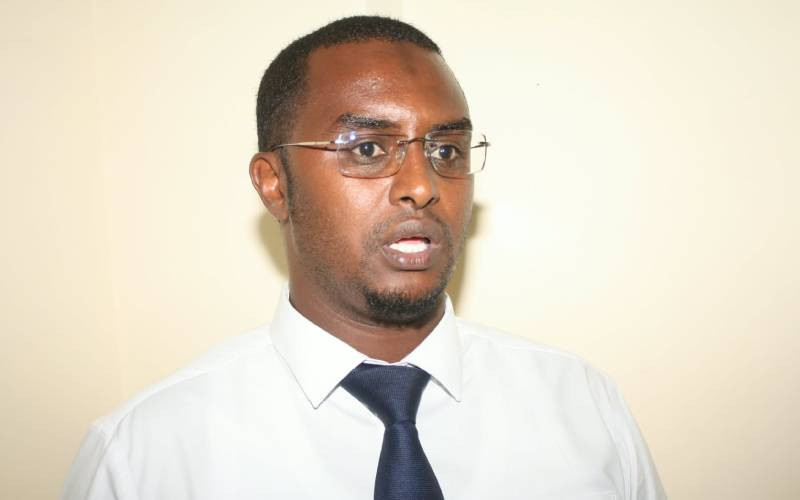
Dr Gonjobe Salat, a clinical and radiation oncologist said the region was experiencing a significant cancer burden, with gastrointestinal malignancies, including oesophageal and stomach cancers, alongside prostate cancer, among the major concerns.
He noted that the initiative is designed to provide a safety net for patients whose medical insurance could no longer meet the cost of treatment.
“Much as the Social Health Authority (SHA) covers these patients, there are some who use expensive drugs, such as immune checkpoint inhibitors, which can quickly deplete their cover. They eventually have to pay out of pocket to continue treatment,” Dr Salat said.
He explained that the initiative pools contributions to support patients after their insurance benefits are exhausted, while also facilitating home visits and helping patients reach hospitals for appropriate care.
Dr Salat urged the government to invest more in community-based screening and early detection, particularly in remote areas where many residents struggle to access health facilities.
“Healthcare providers are at the forefront of cancer management, but the government must come in to do much more screening and early detection at the local level and in the interior parts of the country, where the majority of people are suffering and unable to access health centres,” he said.
He noted that a diagnosis can plunge entire families into financial distress as they sell property, exhaust savings and turn to relatives, friends and community fundraising groups to finance treatment.
“Cancer could drain an entire household financially and psychologically, forcing families to begin planning how to meet treatment costs almost immediately after diagnosis,” he added.
He raised concerns over reported increases in gastrointestinal and dermatological malignancies in Meru.
He noted that the county's heavy agricultural activity raised questions about possible environmental exposures, including agricultural chemicals, that warrant further investigation.
He said improved awareness, diagnostic capacity and hospital-based cancer registries were helping health professionals identify and record more cases.
Dr Salat emphasised the importance of early diagnosis and stronger referral systems, noting that persistent symptoms, including recurrent infections, should prompt further medical assessment rather than repeated treatment without investigation.
He cautioned that cancer has multiple risk factors and that suspected environmental links require scientific research.
Central Imenti MP Moses Kirima has previously raised concerns in Parliament over families selling land to pay for cancer treatment, with household savings wiped out and livelihoods disrupted by the cost of care.






 join
join