
 The Standard Group Plc is a multi-media organization with investments in media
platforms spanning newspaper print
operations, television, radio broadcasting, digital and online services. The
Standard Group is recognized as a
leading multi-media house in Kenya with a key influence in matters of national
and international interest.
The Standard Group Plc is a multi-media organization with investments in media
platforms spanning newspaper print
operations, television, radio broadcasting, digital and online services. The
Standard Group is recognized as a
leading multi-media house in Kenya with a key influence in matters of national
and international interest.


Motorcycle taxi drivers during a motorised caravan organised by the WHO to promote Ebola virus disease prevention in Bunia on June 10, 2026. [AFP]
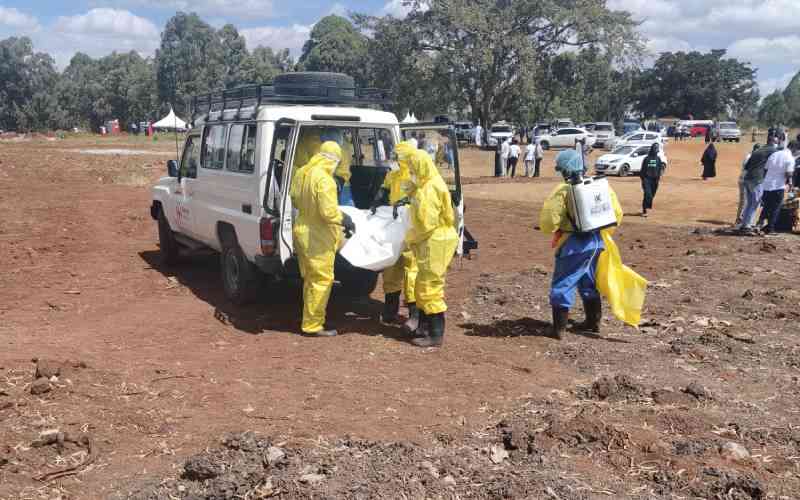
The Africa Centres for Disease Control and Prevention (Africa CDC) has expressed concern over gaps in contact tracing and funding, saying that the Ebola outbreak in the Democratic Republic of Congo (DRC) and Uganda could worsen if urgent action is not taken.
At the Africa CDC's weekly Ebola situation briefing, Director General Jean Kaseya warned that the outbreak is spreading rapidly and one case is reported every 10 days since it was officially declared on May 15, 2023.
The Bundibugyo virus has become one of the most serious Ebola crises in recent years. More than 635 confirmed cases and 127 deaths have been reported in the DRC as of today (24 September 2023) and more than 60,000 contacts have been reported in neighbouring Uganda.
Ituri Province has received more than 90 per cent of the confirmed cases and almost three-quarters of the death toll.
Dr Kaseya warned that the response is not able to keep pace with the outbreak due to the absence of surveillance and contact tracing systems in DRC and also in Africa mainly.
“One confirmed Ebola case should generate about 40 contacts that should be monitored. At present, we have over 6,022 contacts on our list, but based on the number of confirmed cases we should be tracking close to 24,000 contacts,” he said.
- WHO declares international emergency as Ebola kills over 80 in DR Congo
- Duale: No Ebola in Kenya as DRC outbreak kills 88, reaches Uganda
- Duale: Three suspected Ebola cases tested negative, surveillance upped
- WHO warns of rising Ebola threat as Kenya tightens response efforts
Keep Reading
“This is a major indicator for us. There are still low contact lists in Ituri and North Kivu and even among those identified the monitoring is inadequate. We are working at 17 to 30 per cent of the expected coverage. If we don’t identify and monitor these people, we’re at a high risk of transmission in the communities,” Dr Kaseya said.
Africa CDC estimates that only about 57 per cent of identified contacts are currently under active follow-up, far short of the needed level to halt transmission. Health experts have emphasized that the successful containment of Ebola needs to monitor at least 90 per cent of all contacts.
Dr Kaseya said this was in part a result of insecurity in the affected communities and community distrust. “We do not have control over the outbreak because we still have people who are infected and not getting treatment.”
Trace of contact has been difficult in most of the worst affected places. He called on local authorities in affected areas to make available health workers and relief teams.
"We are asking countries and local authorities in affected areas to help us and make access easier. We are in a climate of mistrust, insecurity and limited resources.”
The Africa CDC chief also expressed concern over the lack of financing for the response.
The European Union this week announced a further €11.5 million in support, taking its total to some €18 million, yet health agencies say much more funding is needed to end the outbreak and to better prepare the region. Earlier this month, Africa CDC and the World Health Organization launched a continental preparedness and response plan seeking US$518 million for outbreak control, surveillance, laboratory capacity and border preparedness across Africa.
So far the initiative has received 212 million dollars. But while Ebola is still a priority, African countries are faced with multiple disease outbreaks.
“Today Africa is not only dealing with Ebola. We are also dealing with Cholera, Mpox and Measles outbreaks in several countries,” said Dr Kaseya. “We want to reduce outbreaks all across the region."
He stressed the need to build stronger and more resilient health systems that are able to prevent and respond to a broader range of infectious diseases.
“If we can build resilience in countries, not only to prevent Ebola but also other outbreaks like measles we can save many lives,” he said.
“Vaccines are available for measles but uptake is low. We need to strengthen our routine immunisation and public health systems. The outbreak is mainly affecting young people aged 15 to 44, but health officials say the highest burden of illness has been recorded among children aged zero to four,” Dr Kaseya said
Medical doctors are concerned about international spread but Dr Kaseya said there is no evidence so far that broad travel restrictions on unaffected areas are mandatory. Health care is not only about monitoring or screening but also about community input and quick response measures.
“The priority right now is finding contacts, monitoring them and getting those infected people treated as soon as possible. That is how we stop transmission,” he said.
Without better surveillance and funding gaps in the epidemic, health officials say, the current outbreak may become one of the largest Ebola epidemics in Africa. Overall, it ranks 3rd among all other 21 Ebola outbreaks in Africa in the region. All Africa, Heads of State are due to gather for an emergency meeting on Tuesday next week on how to respond and manage Ebola in the region.





 join
join