
 The Standard Group Plc is a multi-media organization with investments in media
platforms spanning newspaper print
operations, television, radio broadcasting, digital and online services. The
Standard Group is recognized as a
leading multi-media house in Kenya with a key influence in matters of national
and international interest.
The Standard Group Plc is a multi-media organization with investments in media
platforms spanning newspaper print
operations, television, radio broadcasting, digital and online services. The
Standard Group is recognized as a
leading multi-media house in Kenya with a key influence in matters of national
and international interest.

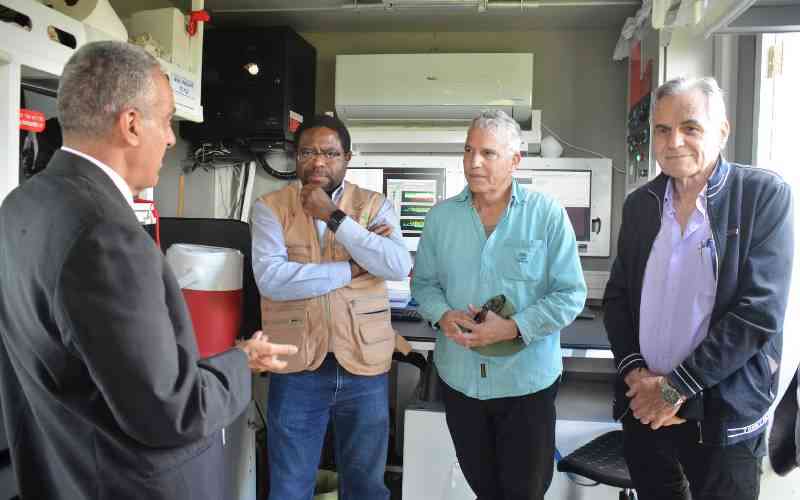
Israel Ambassador to Kenya Gideon Behar, ILRI Director General Appolinaire Djikeng and Dr Eyal Rotenberg inside the mobile scientific laboratory truck at the ILRI conservation in Kapiti, on April 30, 2026. [John Muia, Standard]
Kenya continues to experience the severe effects of climate change, including erratic rainfall patterns, devastating floods and prolonged droughts. Despite being among the most vulnerable regions globally, Kenya and Africa at large still face a major gap in climate data availability.
Climate data is essential for understanding environmental trends, predicting risks, informing policy, and developing solutions that help communities adapt to and mitigate climate change impacts.
Against this backdrop, Israel has deployed a mobile climate laboratory in Kenya to help address Africa’s long-standing data deficit and improve the accuracy of environmental decision-making across the continent.
Israel is a global leader in climate research and innovation, particularly in water management, agriculture, renewable energy and smart transportation.
The mobile lab, operated by the Weizmann Institute of Science, a leading research institution in the natural sciences, is hosted at the International Livestock Research Institute (ILRI) site in Kapiti, Machakos County.
This is the first mobile climate laboratory of its kind, not only in Kenya but on the African continent.
The facility is equipped with more than 30 scientific instruments measuring variables such as carbon exchange, solar radiation, water use and vegetation dynamics. It has sensors placed both deep in the soil and up to 28 meters above ground to monitor atmospheric conditions.
Israel’s Ambassador to Kenya, Gideon Behar, reflected on the eight-year journey to bring the mobile unit to Kenya. He was serving as head of the Africa Bureau at Israel’s Ministry of Foreign Affairs when, Professor Dan Yakir approached him with the idea of establishing a climate laboratory in Africa.
Recognizing the importance of the initiative, he supported it. Behar says, Africa faces a significant gap in climate data and knowledge, leaving the continent highly vulnerable to climate change and with limited capacity to respond effectively.
“Africa faces a significant gap in weather forecasting and reliable climate change data across the continent. Though Africa is probably the region most affected by climate change in the world, it also has the fewest resources available to adapt to the climate crisis,” he explains.
He reveals, the lab helps bridge this gap by providing scientific data needed for evidence-based climate action, benefiting not only Kenya but also countries such as Tanzania, Botswana and the entire Africa.
Director General of ILRI, Dr Appolinaire Djikeng, welcomed the project, saying it will help close Africa’s climate data gap.
“We live in a time when decisions must be driven by data. We can no longer rely on trial and error. The pressures created by climate change demand precision and informed decision-making,” he emphasizes.
He says, mobile laboratory complements over a decade of research at Kapiti, a 32,000-acre ‘living laboratory’ that supports studies on livestock health, nutrition, genetics and sustainable rangeland management. Unlike permanent systems, the mobile lab enables the collection of additional data across different ecosystems and regions.
Dr Appolinaire reveals, they have also established the Livestock and Climate Solutions Hub, which brings together integrated solutions for farmers.
This research, he says, helps farmers identify suitable livestock breeds under changing climatic conditions, disease patterns, and feed availability, particularly in regions such as Machakos County.
“For farmers in places like Machakos, this research helps determine which livestock breeds are most suitable under rising temperatures, changing disease patterns and feed shortages,” he explains.
Kapiti also supports small-scale farmers in transitioning from subsistence farming to sustainable, commercial agriculture that enhances resilience and income stability.
Eyal Rotenberg, one of the project’s lead scientists explains the lab was specifically designed for Africa and houses a central operational system managing over 30 instruments.
He says that many measurements are used to improve satellite calibration and climate modelling, which are often limited by insufficient ground-based data from Africa.
“A key feature of the lab is its mobility, allowing it to collect data across diverse ecosystems. This is expected to improve global climate models and enhance understanding of regional climate patterns,” he says.
Rotenberg discloses, planned research sites include Kapiti, Nanyuki near Mount Kenya, and forest ecosystems in different regions. The project will later expand to other African countries, including Tanzania, South Africa and Namibia.
Rotenberg explains, “We chose to begin at Kapiti because similar measurements have already been conducted there over the past eight years. Our goal is to build on this pioneering work through close collaboration with the local research team.”
He emphasizes that the goal is not only scientific advancement but also practical impact, supporting farmers, pastoralists, policymakers and local communities through improved climate understanding and decision-making tools.
Behar explains that the project also focuses on knowledge transfer, capacity building, and collaboration with local researchers. It aims to integrate African expertise into global climate science while strengthening long-term research capacity on the continent.
Ultimately, the initiative seeks to improve land management, enhance climate resilience, and generate high-quality environmental data that supports both regional development and global scientific research.






 join
join