 The Standard Group Plc is a multi-media organization with investments in media
platforms spanning newspaper print
operations, television, radio broadcasting, digital and online services. The
Standard Group is recognized as a
leading multi-media house in Kenya with a key influence in matters of national and
international interest.
The Standard Group Plc is a multi-media organization with investments in media
platforms spanning newspaper print
operations, television, radio broadcasting, digital and online services. The
Standard Group is recognized as a
leading multi-media house in Kenya with a key influence in matters of national and
international interest.

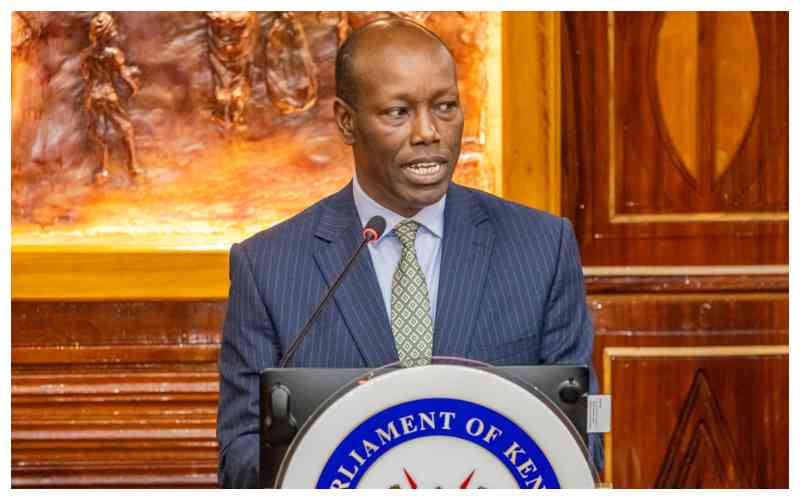
Cabinet Secretary for Investments, Trade, and Industry Lee Kinyanjui answers questions on the floor of the Senate Plenary, Parliament, Nairobi. May 6th,2026 [Elvis Ogina, Standard]
Trade Cabinet Secretary Lee Kinyanjui has defended the government’s decision to reintroduce higher-sulphur fuel into the Kenyan market, saying the country relied on the same fuel standards for years many years before cleaner standards were adopted in 2025.
Kinyanjui who appeared before Senate plenary to answer questions said Kenya had only moved from 50 parts per million (ppm) sulphur fuel to the cleaner 10ppm standard in August last year, dismissing concerns the current change would expose motorists to unsafe fuel.
The Cabinet Secretary was responding to concerns raised by Migori Senator Eddy Oketch, who questioned the justification behind the government’s decision to lower fuel standards despite Kenya’s recent push toward cleaner energy products.
“I would like to inform the Senate that the same fuel that is mentioned has got the same standards has the fuel that the country has been using for the last 10 years until August last year when there were some improvements to achieve some environmental goals,” said Kinyanjui.
The Government decision has attracted criticism from environmental advocates and consumers who argue that reverting to 50ppm fuel could undermine gains made in reducing harmful emissions and improving air quality in the country raising cases of pollution.
Kinyanjui told Senators that the government had no other option due to escalating troubles in global fuel supply chains arguing that refinery damage and operational challenges in the Middle East which had significantly affected Kenya’s ability to source cleaner 10ppm fuel.
The Cabinet Secretary comments suggested the return to higher-sulphur fuel may last much longer than previously indicated by the Energy Ministry, which had earlier signalled that the adjustment would only be temporary and could last about six months.
“I would like to inform Senators that refineries across the Middle East have been affected due to the current crisis being witnessed in the region, this is a situation that remains unpredictable for the next few years,” said Kinyanjui.
He told the house that Kenya’s fuel import options had been “methodically compromised forcing authorities to prioritise fuel availability over maintaining stricter environmental standards and that between having perfect quality and availability they chose availability.
Kinyanjui told the house that government had introduced the cleaner 10ppm fuel standard in August 2025 as part of efforts to align Kenya with countries adopting lower-emission fuel systems with the shift viewed as a step toward improving public health outcomes by reducing vehicle emissions associated with respiratory illnesses.
The Cabinet Secretary told Senator that most countries in Sub-Saharan Africa still use the 50ppm standard without major impediments and that the government just wanted to be ahead in the areas of environmental protection among other nations.
The government now faces increasing scrutiny over whether the rollback could slow Kenya’s environmental ambitions and expose consumers to prolonged use of dirtier fuel as supply pressures persist globally.
Kisumu Senator Tom Ojienda asked Kinyanjui to provide details on forms of support the Ministry extends to County Governments to build capacity for sustainable market management and ensure uninterrupted operations in key markets and explain how it monitors effectiveness of such support.
“The Ministry of Investment, Trade and Investment is Providing Business Development Services market intelligence and advisory services to support market operators and Micro, Small and Medium Enterprises,” said Kinyanjui.
He said the ministry was supporting capacity building through institutions such as Kenya Industrial Research and Development Institute which conducts feasibility studies, market assessment, technology needs assessment and enterprise development training with these initiatives help County Governments improve efficiency in the management of local trading spaces.
Kinyanjui said the Ministry is collaborating with County Governments in developing infrastructure such as County Aggregation and Industrial Parks (CAIPs) that provide facilities for aggregation, processing, storage and marketing of agricultural produce.
The Cabinet Secretary told Senators that for CAIPs and other market support initiatives, the Ministry is keen in undertaking baseline studies and market assessments, periodic progress reviews and field monitoring.
“The State Department for Trade formulates and reviews domestic trade policies in collaboration with County Governments. Supports Counties with market planning, legal and regulatory frameworks and advisory on sustainable trade practices,” said Kinyanjui.
Ojienda sought to know the oversight mechanisms that exist to facilitate the National Government intervention whenever recommendations for operational improvements are not implemented fully and promptly or whenever county-level decisions adversely impact local economic activity, and could the Cabinet Secretary provide details on any instance where such mechanisms were invoked.
Kinyanjui told the house there are several existing key oversight mechanisms that facilitate the National Government intervention whenever recommendations for operational improvements are not implemented fully and promptly.
He told the house that in collaboration with Council of Governors (CoG), the Ministry has finalized development and is soon launching the Investment, Trade and Industry Sector Inter-Governmental Coordination Framework (Trade-IGCF).
“The Trade-IGCF is a structured, co-owned platform anchored in the Constitution (Articles 6(2), 10, 174, 175, and 189), the Intergovernmental Relations Act (2012), and principles of subsidiarity, mutual accountability, and cooperative governance,” said Kinyanjui.




