 The Standard Group Plc is a multi-media organization with investments in media
platforms spanning newspaper print
operations, television, radio broadcasting, digital and online services. The
Standard Group is recognized as a
leading multi-media house in Kenya with a key influence in matters of national and
international interest.
The Standard Group Plc is a multi-media organization with investments in media
platforms spanning newspaper print
operations, television, radio broadcasting, digital and online services. The
Standard Group is recognized as a
leading multi-media house in Kenya with a key influence in matters of national and
international interest.


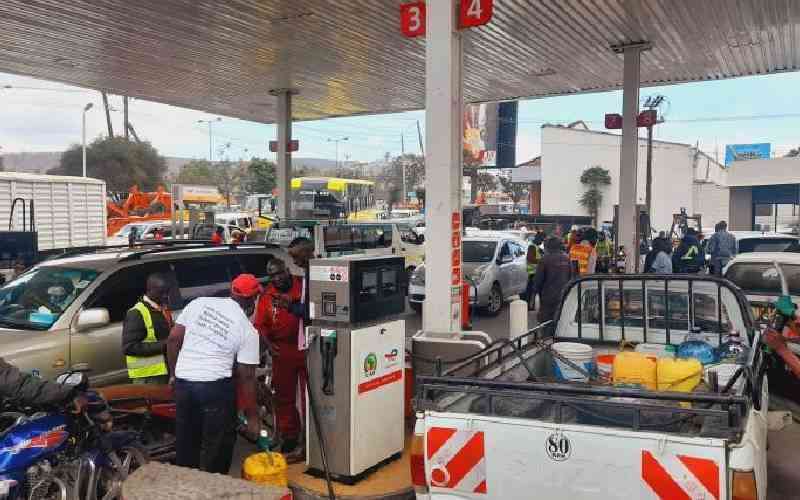
Fuel shortages experienced this week have left many Kenyans on edge, unsure about the country’s security of supply of fuel, but also the impact higher costs will have on the economy.
Many petrol stations have reported stockouts even as oil marketing companies were accused of hoarding products with plans to release the fuel after the April-May price review, when the prices are expected to go up significantly.
Major oil firms have additionally been accused of setting exorbitant wholesale prices for independent dealers, which are typically small-scale marketers that serve vast rural markets and rely on multinationals for products.
Despite analysts' warning that Kenya’s security of fuel supply is no longer guaranteed, the government yesterday tried to calm the frayed nerves but also warned oil marketing companies to stop hoarding products.
Energy and Petroleum Cabinet Secretary Opiyo Wandayi yesterday said Kenya's energy security is sound and warned oil marketers to quit creating artificial shortages, warning that the government would deal ruthlessly with firms found to be engaging in unethical behaviour.
“We note with concern reports of product hoarding and speculative withholding of stocks by some oil marketing companies in anticipation of price movements. This conduct is commercially opportunistic, contrary to the public interest and in direct breach of licensing obligations,” said the CS at a press briefing held shortly after a meeting he held with the oil firms.
“All licensed OMCs are reminded of their legal obligation to maintain continuous supply and to release products at Epra-gazetted prices.”
Numerous petrol stations across the country, including outlets run by multinational firms, have this week reported stockouts.

It has been a dire situation for independent dealers, who claim they have been denied access to petroleum products by the multinationals.
In instances where they are able to buy the products, they say the large firms are selling it to them at high prices, at times matching the Epra-gazetted retail prices, making their retail operations unsustainable.
“They must not engage in any unethical practices to take advantage of the current situation, the crisis that is currently unfolding in the world… If you dare engage in activities that would result in the creation of an artificial shortage of petroleum products, we are going to deal with you ruthlessly and in accordance with the law,” said Wandayi.
“The government of Kenya will not allow you… to use this crisis to create an artificial shortage of petroleum products with a view to maximising profits. Regardless of who you are in the supply chain, we have got adequate systems and mechanisms to allow us to deal with you.”
This is even as he insisted that “there is no shortage of fuel in the country”.
Wandayi also said the country has adequate fuel supplies, with the Kenya Pipeline Company (KPC) holding enough fuel to last the country about a month.
According to data the CS gave yesterday, there is about 415 million litres of fuel within the KPC storage system against a monthly consumption of about 460 million litres.
Kenyans on average consume about 165 million litres of super petrol every month, about 300 million litres of diesel and 75,000 litres of jet fuel, according to data by the Kenya National Bureau of Statistics showing consumption patterns in 2024.
"Kenya's petroleum reserves are at the required levels, meeting its national stockholding obligations across all major products. KPC is currently holding 102 million litres of petrol, 146 million litres of diesel and 167 million litres of dual-purpose kerosene (that comprises Jet A1 and kerosene),” he said.
“These are volumes that meet the country's stipulated stockholding requirements… for the April fuel cycle, supply replenishment is fully on track. Petrol vessels are confirmed to deliver a combined 330 million litres.”
“A diesel vessel is currently discharging, with further vessels scheduled to deliver 288 million litres. A dual-purpose kerosene vessel has just completed discharge, with another cargo expected towards the end of April 2026. These stocks are sufficient to meet national demand, benchmarked against average daily consumption.”
He further said the Middle Eastern oil companies contracted to deliver fuel under the Government-to-Government system have assured the government that they will meet their contractual obligations.
This is despite the companies experiencing operational and logistical constraints due to the escalating conflict, with their operations compromised either due to direct strikes on some of their facilities or logistical blockade of the Strait of Hormuz.
While the three firms – Saudi Aramco, the Emirates National Oil Company (Enoc) and the Abu Dhabi National Oil Company (Adnoc) – have not declared force majeure on oil exports, their peers in the region, including Qatar Energy, Kuwait Petroleum Corporation, and Bapco Energy of Bahrain, have declared force majeure on some contracts.
Wandayi said the G2G companies have not indicated they have a problem meeting their contractual obligations.
“Our G-to-G supply partners remain fully engaged, with all contracted volumes on track. We are confident our G-to-G arrangement is robust enough to manage any near-term uncertainties,” he said.
He also ruled out the possibility of Kenya looking for alternatives to the G2G arrangement, noting that the contract it has with the Gulf oil companies requires them to deliver fuel to Kenya without binding them to a specific source. He noted that the firms could source fuel produced in other regions.
“The agreements that Kenya has with these IOCs do not restrict them to source petroleum from a particular part of the world. The Strait of Hormuz is just one pathway through which the world moves products,” he said.
“These IOCs are well-established entities with the capacity to source fuel from anywhere in the world and have it delivered fast.”
While seemingly confident that Kenya would have an adequate fuel supply in the coming weeks and months, the CS skirted around the issue of pricing, refraining from giving any promise that Kenyans and industries would be able to afford the fuel.
“We have a very robust pricing mechanism in Kenya underpinned by a robust legal regime. Let us not jump the gun in terms of the pricing of products,” he said, but added that “there's no cause for alarm” and “we shall cross that bridge once we get there.”
Analysts say pump prices will significantly go up over the April-May pricing cycle, unless the government applies a significant subsidy.
The cost of oil surged in March, with Murban crude oil prices increasing to $146 last weekend before retreating to $100 per barrel yesterday. This is up from about $74 a barrel on March 1. The price movement is expected to be seen in the cost of imported petroleum products. Murban is the benchmark for Middle East crude oil.
“The landed cost of fuel for Kenya has effectively doubled,” said Ngatia Ndungu, analyst at SM-Intel in an analysis on the war on Iran and the impact it will have on Kenya.
“Kenya must prepare for sustained fuel rationing, significant pump price increases in April and May 2026, and intense pressure on foreign exchange reserves as the import bill doubles.”
The inevitable increase in fuel prices beginning mid next month has revived calls for Kenya to review its taxation regime for petroleum products. Currently, at Sh80.94, taxes and levies account for nearly half of the pump price of a litre of petrol that is retailing at Sh178.28 in Nairobi. Taxes are also higher than the landed cost of Sh75.42, which is the cost of products when they reach Mombasa before being loaded with taxes and margins for oil marketers and transport.
Kiharu MP Ndindi Nyoro on Tuesday called for a reduction of taxes, including halving VAT to eight per cent and reducing the Road Maintenance Levy (RML) by Sh7 to Sh18 per litre of diesel and petrol. RML was increased to Sh25 in August 2024. The government has used future collections as collateral for borrowing some Sh170 billion that it said would be used to clear pending bills for road contractors.
“The government must intervene. Consumers have done their bit by paying additional VAT and fuel levy when prices were coming down; now it is time for the government to reciprocate by removing the eight per cent additional VAT and the Sh7 fuel levy,” said Nyoro, who noted that despite being more than 1,000 kilometres from Mombasa, retail prices were cheaper in Kampala and Kigali compared to Kenya, which is on account of a higher tax regime.
“Our economy cannot afford to shoulder all these levies and taxes at this time in consideration of the global dynamics. Kenyans must be shielded. The economy must be supported.”




