 The Standard Group Plc is a multi-media organization with investments in media
platforms spanning newspaper print
operations, television, radio broadcasting, digital and online services. The
Standard Group is recognized as a
leading multi-media house in Kenya with a key influence in matters of national and
international interest.
The Standard Group Plc is a multi-media organization with investments in media
platforms spanning newspaper print
operations, television, radio broadcasting, digital and online services. The
Standard Group is recognized as a
leading multi-media house in Kenya with a key influence in matters of national and
international interest.

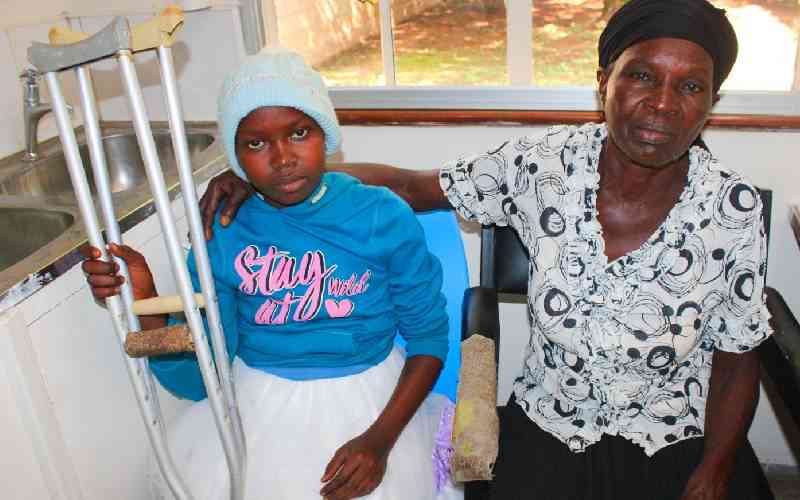
Margaret Arango and her granddaughter Victorina Achieng at JOOTRH in Kisumu, on January 12, 2026. [Rodgers Otiso, Standard]
On a quiet Monday morning at Jaramogi Oginga Odinga Teaching and Referral Hospital (JOOTRH) in Kisumu, soft laughter drifts along the oncology clinic corridor. Seated on a wooden bench is an elderly woman with a warm, reassuring smile. Beside her sits a young, cheerful girl, her eyes carrying curiosity and hope.
From a distance, nothing seems unusual. Grandmother and granddaughter chat freely, occasionally laughing. But a closer look reveals a detail that shifts the scene: wooden crutches leaning against the bench.
They belong to the child.
Her name is Victorina Achieng, and at such a tender age, she is learning to navigate life with one leg after surviving osteogenic sarcoma, also known as osteosarcoma, the most common childhood bone cancer.
Naturally, questions arise. Was she involved in an accident? Was she born with a disability? Why is a school-going child spending a Monday morning in a referral hospital instead of a classroom?
As her grandmother gently introduces herself, the answers begin to unfold. “This is my granddaughter,” says Margaret Arango. “She is suffering from a condition I never imagined could affect a child, let alone one so young.”
First symptoms
Victorina was once a healthy, active schoolgirl. She loved going to school, playing with friends, and walking home in the evenings like any other child. But in January 2025, her normal life was abruptly interrupted. “She came back from school, and even before removing her uniform, she complained of pain in her knee.”
At first, the pain seemed harmless. “I thought maybe she had hurt herself while playing at school,” she says.
Margaret did what most caregivers would do: she warmed some water, soaked a cloth, gently massaged the knee, gave Victorina supper, and put her to bed. But the pain returned the following day, and then again. “Every evening, it was the same complaint. The pain was not going away,” Margaret recounts.
She bought over-the-counter painkillers, hoping the discomfort would subside. Instead, the pain worsened. Soon, Victorina began limping, and her knee started swelling. “That is when I sensed something was not right,” Margaret says.
After gathering a few coins, Margaret took Victorina to a hospital in Kakamega County. Doctors examined her and decided to conduct further tests, including a biopsy. “They took a sample of tissue from her knee and sent it for testing,” Margaret recalls. The results were shocking.
“They told us they had found cancerous cells,” she says quietly. “I knew about cancer, but I never knew it could come to a child, and so close home.”
Victorina was immediately started on treatment and sent home. But her condition did not improve. The swelling increased, and the pain became unbearable. “We decided to come to JOOTRH in Kisumu because we felt we needed better care,” Margaret says. At JOOTRH, Victorina underwent advanced diagnostic tests, MRI, CT scans, and X-rays. The diagnosis was confirmed: osteogenic sarcoma.
Doctors explained that it is the most common primary bone cancer, typically affecting children, adolescents, and young adults, often starting in the long bones near joints.
Victorina was started on chemotherapy, with hopes that the tumour would shrink. But after several months, the response was slow. Doctors then delivered the most painful news. “They told us amputation was the only way to save her life,” Margaret recalls.
The family was devastated but resolute. “We asked ourselves what was more important, the leg or the life of our child,” she says. Victorina underwent a successful amputation surgery at JOOTRH. Tests confirmed her cancer was at Stage Two, and all cancerous tissue had been removed.
Much of 2025 was spent within hospital walls. “The ward became our second home,” Margaret says. “We stayed in hospital longer than we stayed at home.”
Before surgery, Victorina struggled to eat, sleep, or sit due to pain. After treatment, her condition improved significantly. “Now she eats well, she sleeps peacefully, and she can smile again,” Margaret says.
Victorina walks with crutches today. She has not been back to school since January 2025. What she needs now is an artificial limb to regain mobility and return to class.
Her voice is calm, thoughtful, and mature beyond her years. “I never had an accident. Sometimes I still cannot believe my leg was amputated.”
But she remains hopeful; “I can move with crutches, and that gives me hope. What makes me sad is missing school.”
“When I see my friends going to school, I feel sad, but I comfort myself. I believe everything happens for a reason, and one day I will go back to school and live a normal life.”
National statistics
According to Kenya’s National Cancer Control Programme, osteosarcoma is the most common bone cancer, originating from bone-forming cells. It mainly affects teenagers and young adults but can also occur in younger children.
Cancer is the third leading cause of death in Kenya, after infectious and cardiovascular diseases. In 2022, GLOBOCAN estimated 44,726 new cancer cases and 102,152 five-year prevalence cases in Kenya.
The International Agency for Research on Cancer (IARC) reports that one in five people worldwide will develop cancer in their lifetime and that at least 40 per cent of cancers are preventable through effective prevention and early detection.
The World Health Organisation (WHO) estimates that Kenya records more than 44,000 new cancer cases every year, while approximately 32,000 people die annually from the disease. These figures point to a growing national burden and highlight the urgent need for increased awareness, early diagnosis, and improved access to quality cancer care.
Statistics from the National Cancer Institute of Kenya (NCI-Kenya) further illustrate the scale of the crisis. With a population of over 54 million, the country reports about 47,000 new cancer cases each year and nearly 32,000 cancer-related deaths. An estimated 86,000 Kenyans are currently living with cancer, having survived for five years or more, underscoring the need for long-term treatment, follow-up care, and strong support systems for patients and survivors alike.
Dr Brenda Misore, a paediatric haematologist and oncologist at JOOTRH, has treated Victorina and many other children with cancer. “My role is mainly to take care of children with cancer, including both solid tumours and blood cancers, such as leukaemia,” Dr Misore explains.
“In this facility, we are seeing an increased incidence of childhood cancer. This increase is most likely due to improved awareness in the community and among healthcare workers. Previously, many of these children were never diagnosed, and they died without receiving treatment. Currently, treatment is available, and we are encouraging healthcare workers in peripheral facilities and the community to bring these children to hospital early because most childhood cancers are curable.”
Dr Misore notes that survival rates in high-income countries are significantly higher. “In Western countries, childhood cancer survival rates are around 70 to 80 per cent. In Africa and other low- and middle-income countries, survival is still low, around 30 to 40 per cent.”
She attributes this gap mainly to delayed diagnosis. “Our biggest challenge is delayed diagnosis. Many children stay in the community for too long before coming to hospital, because many healthcare workers are not yet adequately equipped to identify childhood cancers early and refer patients on time. The other factor is the belief within the community that children do not get cancer.” “When parents are told their child has cancer, many go into denial. They seek alternative treatments, prayers, or traditional healers. This delays treatment, and delayed treatment leads to poor outcomes.”
“Children with osteosarcoma often present with persistent bone pain, swelling, or occasionally a fracture. Pain is usually unrelieved by common analgesics and worse at night,” Dr Misore explains.
She warns that early X-rays can be misleading, often appearing normal, leading to misdiagnosis as infections like osteomyelitis. She says, “If the pain persists and worsens, cancer should be suspected.”
Delayed diagnosis has serious consequences; even a one-month delay can allow the cancer to advance, causing malnutrition, organ involvement, and making treatment more difficult.
Treatment options
She says osteosarcoma is not sensitive to radiotherapy. The main treatment is chemotherapy and surgery. In advanced countries, limb-sparing surgery is common, but in our setting, we still rely on amputations because of limited expertise and resources. “Before amputation, we give chemotherapy to reduce the tumour burden. Once the tumour is controlled, surgery is done to remove the primary source of disease. This prevents further spread, especially to the lungs.”
Victorina responded well to treatment. “She completed her treatment successfully. After amputation, tests confirmed there were no remaining tumour cells,” Dr Misore says.
Victorina is now on a survivorship follow-up plan. The focus has shifted to rehabilitation, psychosocial support, and mobility. “She is a school-going child, and she needs to return to school,”
Kenya is steadily strengthening its fight against cancer, marking a shift from the past when the country relied heavily on foreign datasets to inform its cancer control strategies. This dependence often resulted in policies that were poorly aligned with Kenya’s unique disease burden and healthcare realities. The establishment of the NCI-Kenya cancer database has transformed cancer planning, enabling evidence-based policies grounded in local data and lived realities.
In July, NCI-Kenya successfully convened the National Cancer Summit, bringing together key stakeholders to align priorities in prevention, diagnosis, and treatment. Building on this momentum, the Institute is preparing to host a Global Cancer Summit in 2027, which will unite medical experts, researchers, and policymakers worldwide. The initiative aims to strengthen African–international partnerships, advance research collaboration, promote technology transfer, and accelerate innovation in cancer care and treatment. “Cancer is not a death sentence. Early diagnosis is equal to cure. If a child has persistent pain lasting more than two weeks, they should be seen by a specialist or referred to a higher-level facility. Treatment is available in Kenya, and these children can survive and live normal lives.”
For Victorina, the pain has eased, and hope now walks beside her on crutches, firmly toward a future still full of promise.




