 The Standard Group Plc is a multi-media organization with investments in media
platforms spanning newspaper print
operations, television, radio broadcasting, digital and online services. The
Standard Group is recognized as a
leading multi-media house in Kenya with a key influence in matters of national and
international interest.
The Standard Group Plc is a multi-media organization with investments in media
platforms spanning newspaper print
operations, television, radio broadcasting, digital and online services. The
Standard Group is recognized as a
leading multi-media house in Kenya with a key influence in matters of national and
international interest.

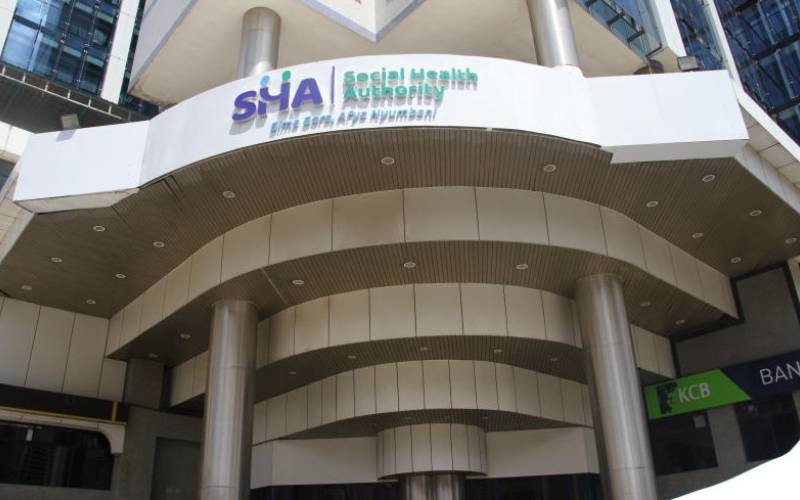
The Social Health Authority building located at Upper Hill in Nairobi. [Edward Kiplimo, Standard]
Teachers across the country are raising alarm over difficulties in accessing healthcare under the Social Health Authority (SHA), even as the government insists the scheme is working.
Barely four months into implementation, teachers under the Kenya Union of Post-Primary Education Teachers (KUPPET) now claim they were duped into signing up for a comprehensive medical cover that is not being fully honoured.
In an interview with The Standard, the union said teachers, through the Teachers Service Commission (TSC), negotiated for a robust healthcare package, but what is being offered is short of their expectations.
KUPPET Deputy Secretary General Moses Nkurima said the situation has left many teachers digging into their pockets to access essential medical services.
“Only public hospitals are attending to teachers, but unfortunately, they have no drugs and specialists are not available. There is a lot of desperation among teachers,” said Nkurima.
Speaking during a Thanksgiving ceremony for teachers in Chetambe, Webuye East, KNUT National Vice Chairperson Agrey Namisi said the union is dissatisfied with the scheme following the lapse of a three-month trial period.
Namisi noted that the union will convene a crucial meeting next week to deliberate on the matter and chart a new course regarding teachers’ health cover.
“We cannot sit back and watch our teachers suffer and struggle to access healthcare,” Namisi noted.
He described the SHA scheme as a strain on both teachers and the union, adding that the initial expectations have not been met.
According to Namisi, the transition from the previous Aon Minet medical cover to the SHA arrangement was not entirely voluntary, alleging that teachers were pressured during a meeting at State House last year.
“The move from Aon Minet is something we now view as regrettable,” the official noted.
Teachers were transitioned to the SHA scheme on December 1, 2025, under the Mwalimu Cover, marking the end of the long-standing Medical Administrators (K) Limited (MAKL) arrangement.
Under the new cover, a teacher is allowed to include one spouse and up to five children aged below 21 years, or up to 25 years if they are still in school.
The package, on paper, includes both inpatient and outpatient services, chronic illness management, maternity care, as well as optical and dental services. Teachers are also entitled to access care at more than 9,000 SHA-accredited facilities across the country.
Additional benefits include inpatient cover of up to Sh3 million annually, outpatient limits ranging between Sh150,000 and Sh450,000, maternity cover of Sh10,000 for normal delivery and up to Sh30,000 for caesarean section, as well as overseas treatment capped at Sh2 million.
Currently, the scheme covers at least 413,577 teachers and 807,426 dependants.
However, despite the extensive benefits outlined in the cover, the union claimed that teachers claim that what is on the paper is different from what they are offered while accessing care.
For instance, many hospitals are allegedly turning away teachers, while others are demanding out-of-pocket payments for services such as dental care and stillbirth management.
Some benefits, including group life cover, according to the union, are also said to be unclear or inaccessible.
Nkurima accused SHA of lacking sincerity in service delivery, saying teachers are struggling to access services despite making regular contributions.
Teachers are subjected to monthly deductions averaging Sh4,000 as a medical allowance, in addition to 2.75 per cent of their monthly income.
“We have cases of teachers involved in accidents who cannot access cover. Some bodies of deceased teachers are being held in hospitals over unpaid bills, yet we have the SHA. How?” he posed.
Although the previous Minet-managed cover had its limitations, the union maintains it was more reliable and accessible compared to the current arrangement, and efforts to seek redress through the TSC have also proved futile, according to the union.
“When we call TSC, they say they are helpless, and nobody picks up calls. Teachers were duped,” said Nkurima.
The union official added that even when teachers manage to see a doctor, they are often referred to purchase drugs and medical supplies outside hospitals.
“It is as if SHA is not human. When you call and no one answers, it is like greeting a stone,” he said.
Nkurima further warned that the newly introduced medical cover for police and prison officers may face similar challenges, despite its having attracted a better package.
“The package for the police is what we have. Let us wait and you will see them complain. Their document is only good on paper,” claimed the unionist.
But even as the union complain of a weaker cover, a section of teachers accuse it of failing to demand a better package under the Mwalimu Cover, unlike police and prisons officers who engaged the National Police Service Commission (NSPC).
On December 1, 2025, during the transition, a section of teachers accused the union of signing the SHA package without their consultation.
Teachers have also been complaining of failure to include interns and retired teachers, yet they are not entitled to the SHA benefits.
At least Sh6.1 billion was cap for SHA, Sh15 billion for the Teachers Service Commission and Sh8.7 billion for police and prison officers.
Despite the mounting complaints, SHA has maintained that teachers are entitled to comprehensive healthcare benefits and should not be denied services.
In a quick rejoinder, SHA Chief Executive Officer (CEO) Dr Mercy Mwangangi said no teacher should be turned away from a contracted facility due to system or administrative challenges.
She told The Standard that cases of denied access are being treated as isolated implementation gaps requiring immediate correction, rather than a withdrawal of benefits.
According to the Authority, teachers remain entitled to their negotiated healthcare benefits under the Public Officers Medical Scheme Fund (POMSF), which is anchored within the broader SHA framework.
These benefits include outpatient and inpatient care, diagnostics, maternity services, surgery, emergency care, chronic disease management, oncology, mental health services, last expense cover, overseas treatment, and critical care support within approved benefit structures and referral pathways.
“The Ministry’s position is that teachers should receive quality, seamless, and affordable care under the enhanced POMSF arrangement,” said Dr Mwangangi.
She added that access under SHA is tied to empanelled and contracted facilities, making provider network readiness a critical component of implementation.
“That is why the Ministry is working with TSC, SHA and the Digital Health Agency to strengthen systems, improve provider coordination, and ensure teachers can access services nationwide,” she said.
Dr Mwangangi noted that recent engagements between the Ministry, TSC and KUPPET had resulted in several interventions aimed at addressing emerging challenges.
These include the formation of a joint technical team, establishment of county-level implementation committees, a 24-hour toll-free support line, continuous member education, quarterly utilisation reviews, and a digital incident reporting system to address billing abuses, fraud and service complaints.
“This is the practical response to any gap between policy and patient experience,” she said.
On concerns that police and prison officers appear to enjoy a better package, Dr Mwangangi clarified that different employee groups have historically been served under employer-managed arrangements, with benefits shaped by negotiated contractual terms.
“This is not a question of one group being placed on a better SHA package, but rather different employment-based administrative arrangements with distinct benefit designs,” she explained.
Police and prison officers are set to benefit from an enhanced medical package under the Usalama cover, which was signed last week.
The package includes evacuation services, inpatient and outpatient care, emergency services, specialised surgeries, optical and dental care, as well as chronic and critical illness management.
Officers will also have access to maternity services, specialised treatment, and fertility care, including in vitro fertilisation (IVF).
Additionally, the package provides for annual medical check-ups and overseas treatment for specialised healthcare needs.
A police or prison officer is allowed to include one spouse and up to five dependants under the scheme.
Unlike the defunct National Health Insurance Fund (NHIF), which limited access to about 800 hospitals, the new arrangement expands access to more than 6,000 facilities, including private, faith-based and public hospitals.




