×

The Standard e-Paper
Smart Minds Choose Us
 The Standard Group Plc is a
multi-media organization with investments in media platforms spanning newspaper
print operations, television, radio broadcasting, digital and online services. The
Standard Group is recognized as a leading multi-media house in Kenya with a key
influence in matters of national and international interest.
The Standard Group Plc is a
multi-media organization with investments in media platforms spanning newspaper
print operations, television, radio broadcasting, digital and online services. The
Standard Group is recognized as a leading multi-media house in Kenya with a key
influence in matters of national and international interest.

Audio By Vocalize

The government's online marriage services platform. [File, Standard]
Across Africa, governments are digitizing almost everything. From welfare payments and health records to national identity systems, technology is steadily becoming part of how citizens access public services. Kenya is no exception. Mobile money has transformed financial inclusion, digital IDs continue to shape public debate and more government services are moving online. Yet amid all this excitement, one question receives far less attention. What happens to the people who fall through the digital cracks?
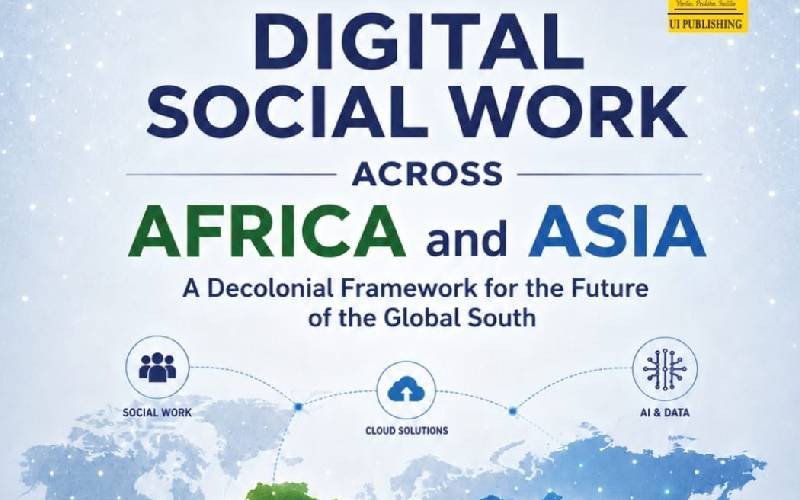
That is the question at the heart of Digital Social Work Across Africa and Asia, a new book by Siddhartha Paul Tiwari, Adi Fahrudin and Fentiny Nugroho. Rather than focusing on technology companies or government policy, the authors place social workers at the centre of the conversation. These are the people working every day with families facing poverty, displacement, disability and other forms of vulnerability. As governments digitise welfare systems, they are often the first to witness both the promise and the shortcomings of technology.
The book arrives at a time when many countries across the Global South are embracing digital transformation as a pathway to more efficient public services. Governments are investing in online platforms, digital payments and biometric identification systems with the hope of reaching more citizens at lower cost.
The assumption is straightforward: better technology leads to better services. The authors argue that reality is far more complicated.
Drawing from experiences across Africa and Asia, they show that social workers rarely use technology exactly as it was designed. Instead, they modify existing tools, rely on locally developed solutions and constantly adapt digital platforms to suit communities where electricity is unreliable, internet access is inconsistent and smartphones are often shared among several family members.
That perspective is one of the book's greatest strengths. Much has been written about Africa's digital revolution, but far less attention has been paid to the professionals working quietly behind welfare programmes. The book gives those practitioners a voice.
Some of its strongest examples come from Africa. The discussion on digital cash transfers is particularly relevant for countries like Kenya, where mobile money has fundamentally changed how financial services are delivered. The authors illustrate how digital payments have enabled governments and humanitarian agencies to reach households that previously remained outside formal banking systems.
They also examine community mapping initiatives that have helped place informal settlements on official maps. Areas that once existed largely outside government planning frameworks are increasingly becoming visible through digital technologies, improving the targeting of social services.
These are practical examples rather than theoretical arguments, making the discussion accessible even to readers with little background in social work.
Equally compelling is the chapter on digital ethics. Much of the world's conversation around online privacy assumes an individual owns a smartphone, controls personal passwords and can decide who accesses their information.
For many households across Africa, that assumption simply does not hold. A single smartphone may serve an entire family. Internet bundles are purchased only when finances allow. Private conversations become difficult when several people share the same living space.
The authors describe this as communal digital safeguarding, arguing that international standards on digital privacy often overlook the realities of low-income communities.
It is a thoughtful observation because it challenges the tendency to export Western digital policies into contexts where social and economic conditions differ significantly.
Stay informed. Subscribe to our newsletter
Another memorable discussion centres on what the authors call the shared screen dilemma.
As more counselling and welfare services move online, confidential conversations become increasingly difficult. A social worker may be speaking to a client over video, unaware that family members are sitting just outside the camera's view. Technology may have expanded access to services, but it has not necessarily protected privacy.
These examples demonstrate why digital transformation cannot simply be measured by internet coverage or smartphone ownership. Human circumstances still matter. Where the book becomes less convincing is in its attempt to cover two continents within a single volume.
Africa and Asia share many development challenges, but they are also remarkably diverse. Welfare systems differ. Political environments differ. Levels of digital infrastructure differ.
A community health volunteer in northern Kenya operates under conditions that bear little resemblance to those of a social worker in Indonesia or India.
By moving rapidly between countries, the book occasionally sacrifices depth for breadth.
The research itself also deserves careful interpretation.
The authors interviewed 234 social workers across Africa and Asia. Their experiences provide valuable qualitative insight into how technology is changing frontline social work.
However, readers should be cautious about extending those findings across two continents containing dozens of countries, each with unique welfare systems and policy environments.
The sample provides important stories.
Whether it provides sufficient evidence for broader conclusions is a different question.
The book is also noticeably stronger at identifying problems than proposing solutions.
It correctly points out that digital welfare depends on functioning infrastructure, affordable internet access and public trust. Yet it offers relatively limited guidance on how governments should strengthen those foundations.
For policymakers looking for practical recommendations, this may feel like a missed opportunity.
Still, the authors deserve credit for avoiding the common temptation to treat technology as a cure for every social problem.
Instead, they acknowledge that poorly implemented digital systems can create new forms of exclusion. An inaccurate database, failed biometric scan or missing digital identity.
Any of these can prevent vulnerable families from accessing food assistance or other essential services.
That warning feels particularly relevant as African governments continue investing in digital public services. Technology undoubtedly has the potential to improve efficiency, accountability and access.
But it can also deepen inequality if implemented without considering the realities of the communities it is meant to serve.
Perhaps that is the book's most important lesson.
Digital transformation is not ultimately about software, artificial intelligence or biometric systems.
It is about people.
The success of any welfare system will continue to depend not only on technological innovation but also on trust, empathy and human relationships.
Digital Social Work Across Africa and Asia does not answer every question it raises, nor does it claim to.
Its ambition occasionally exceeds the evidence presented, and some readers may wish for stronger policy recommendations.
Even so, it succeeds in shifting the conversation in an important direction.
For too long, discussions about technology in developing countries have focused almost exclusively on infrastructure, investment and innovation.
This book reminds us that the real measure of progress is not how sophisticated our digital systems become, but whether they make life better for the people who need them most.Some of the proposed solutions also deserve further discussion. The authors encourage developing countries to strengthen their own digital infrastructure and reduce dependence on foreign technology.
While this is an important long-term goal, the book gives less attention to the financial and practical challenges many countries face, especially where basic infrastructure and public services remain under pressure.








Subscribe to our newsletter and stay updated on the latest developments and special offers!








 join
join