×

The Standard e-Paper
Fearless, Trusted News
 The Standard Group Plc is a
multi-media organization with investments in media platforms spanning newspaper
print operations, television, radio broadcasting, digital and online services. The
Standard Group is recognized as a leading multi-media house in Kenya with a key
influence in matters of national and international interest.
The Standard Group Plc is a
multi-media organization with investments in media platforms spanning newspaper
print operations, television, radio broadcasting, digital and online services. The
Standard Group is recognized as a leading multi-media house in Kenya with a key
influence in matters of national and international interest.

Audio By Vocalize
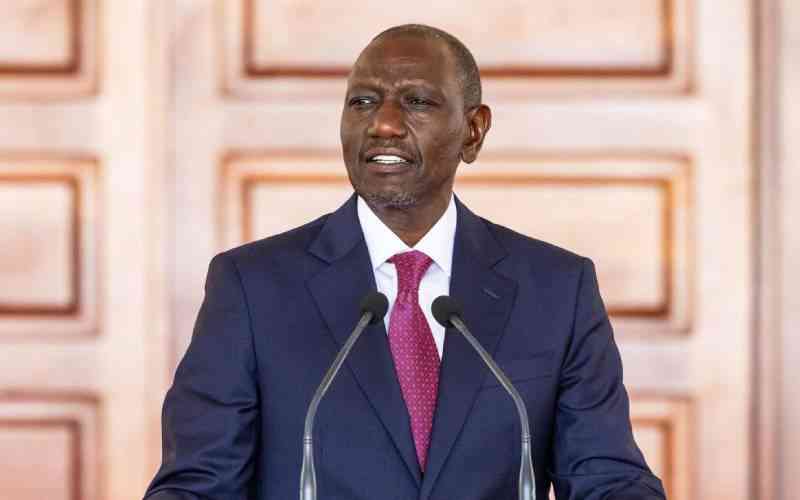
President William Ruto's recent address inviting Kenyans to begin crafting a new national development vision beyond Vision 2030 immediately sparked political debate.
As expected, supporters welcomed the proposal as a bold step towards shaping Kenya's future, while critics dismissed it outright.
Such reactions are hardly unusual in a vibrant democracy, where governments propose, the opposition scrutinises, and citizens evaluate, illustrating how democracy works.
Yet beneath the political exchanges lies a far more important national concern. There is a growing tendency to view almost every public issue through a political lens, reducing national conversations to partisan contests.
As a result, issues that matter most to politicians often dominate public attention, while equally important ideas and initiatives that could advance Kenya's long-term development receive far less consideration.
In the process, the national interest risks becoming subordinate to partisan interests. A healthy democracy requires a strong and vigilant opposition, as it is their responsibility to question government proposals, demand accountability, and offer alternatives.
At the same time, the government must be prepared to defend its policies and embrace constructive criticism, as robust debate strengthens democracy and improves public policy.
It is important to differentiate between constructive scrutiny and automatic rejection. Mature democracies assess ideas based on their merit instead of the political identity of the proposer.
Not every government proposal is necessarily good, just as not every opposition criticism is right, and when every idea is judged primarily through partisan lenses, valuable opportunities that could benefit the country are often overlooked simply because of their origin.
The proposal to begin thinking beyond Vision 2030 should, therefore, be assessed not through partisan lenses but on its national significance, as the question of what Kenya should become over the next 30 years is too important to be confined to political contestation.
History offers valuable lessons, revealing that virtually every country that has successfully transformed itself from a developing to a high-income economy has been guided by a long-term national vision.
For instance, Singapore became one of the world's most competitive economies not through five-year political promises, while South Korea's industrial transformation was built upon decades of consistent economic planning.
Similarly, China, Malaysia, and Rwanda have all pursued long-term development strategies that transcend political cycles.
Long-term national visions are typically initiated by the government in office at the time as part of its constitutional responsibility for national planning.
Stay informed. Subscribe to our newsletter
Kenya's Vision 2030, Malaysia's Vision 2020 and Rwanda's Vision 2050 all began this way. Their success, however, depended on evolving beyond government initiatives into nationally owned development agendas through broad consultation and sustained commitment. Similarly, the international community has already begun discussions on the development framework beyond the Sustainable Development Goals (SDGs), demonstrating that planning for the future should begin well before existing frameworks expire.
The proposed national dialogue, as initiated by the President, emphasises inclusivity by engaging a diverse range of participants, including government officials, professionals, academics, and civil society.
This initiative underscores the importance of collaboration in national development, moving beyond political rivalries and drawing on the insights of various stakeholders.
By fostering open conversations about Kenya's future, it aims to generate a wealth of ideas for a collaborative path forward. Unfortunately, public debate often focuses on the identity of those proposing ideas rather than their merit, leading to entrenched perspectives and hindering compromise.
This dynamic jeopardises not only governmental relations but also Kenya's long-term development agenda.
This does not mean suspending criticism or accepting every government proposal uncritically.
On the contrary, any new national vision should undergo rigorous public scrutiny. Kenyans should debate its assumptions, interrogate its governance arrangements, examine its financing and demand measurable outcomes.
Universities, professional bodies, businesses, civil society and county governments should all contribute to strengthening it. Constructive criticism improves policy, while blanket rejection weakens national discourse.
The President's address highlighted the need for Kenya to critically assess why it has not fully benefited from global economic changes, unlike South Korea, China, and Vietnam. While the specifics can be debated, the essential question remains about what Kenya must change over the next generation to unlock its full economic and social potential.
The key challenge lies not in a lack of ideas but in sustaining implementation through political transitions, strengthening enduring institutions, and fostering a national consensus around long-term priorities.
Politics is indispensable to democracy, but it should not dominate every national conversation. Governments will come and go, political parties will rise and fall, and elections will be won and lost. Yet the aspirations of our children and grandchildren remain constant. They deserve a nation capable of distinguishing between political competition and the national interest.
The countries that transformed themselves did not succeed because they eliminated politics. They succeeded because they recognised that some issues, such as education, human capital, industrialisation, infrastructure, innovation, and long-term economic planning, are simply too important to become casualties of partisan competition. Kenya's future deserves the same wisdom. If we can rise above politics when discussing our long-term development, we will have taken an important step towards building not only a stronger democracy, but also a more prosperous nation.
- The author is a TVET and Human Capital Development Expert



Subscribe to our newsletter and stay updated on the latest developments and special offers!