×

The Standard e-Paper
Smart Minds Choose Us
 The Standard Group Plc is a
multi-media organization with investments in media platforms spanning newspaper
print operations, television, radio broadcasting, digital and online services. The
Standard Group is recognized as a leading multi-media house in Kenya with a key
influence in matters of national and international interest.
The Standard Group Plc is a
multi-media organization with investments in media platforms spanning newspaper
print operations, television, radio broadcasting, digital and online services. The
Standard Group is recognized as a leading multi-media house in Kenya with a key
influence in matters of national and international interest.

Audio By Vocalize
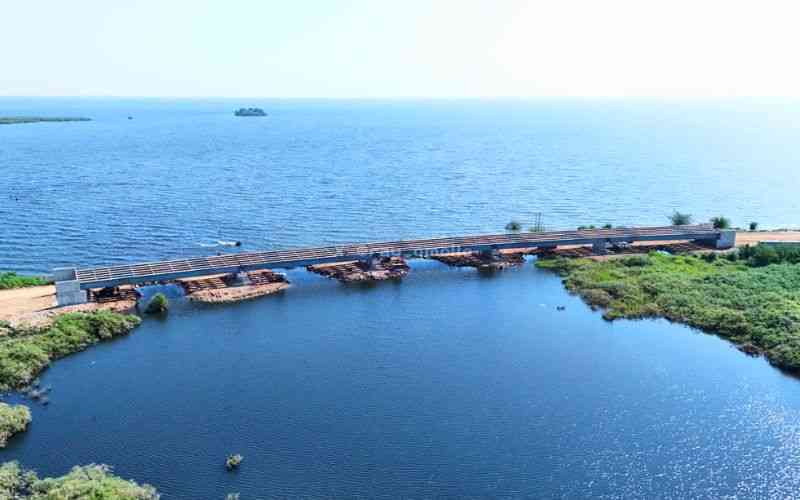
Should I have the opportunity to have a one-on-one conversation with you about what transforms a nation, you may likely point to the grand symbols of development: roads and expressways, skyscrapers, airports, stadiums and much more. But what if I told you that a bridge crossing a swamp or river could transform a people’s lives?
For many Kenyans, such a bridge is simply a structure that allows vehicles and people to cross from one side to another. But for the communities that depend on it, a bridge can mean the difference between isolation and opportunity. Case in point, the Dhogoye Bridge in Siaya County.
Stretching approximately 200 metres across a water channel near the shores of Lake Victoria, within Alego Usonga, Siaya County, the bridge may not easily break engineering records or dominate news headlines. Yet its impact can be felt every day by ordinary citizens whose lives and livelihoods depend on reliable connectivity between villages. It means a lot to the residents.
For a fisherman heading to market before sunrise, every extra kilometre travelled translates into higher costs and less profit. For a farmer transporting produce, delays can mean spoilage and lost income.
For a mother seeking healthcare services, a longer and more difficult journey can mean the difference between timely treatment and unnecessary hardship. A resident, Julie Achieng, observes, “During rainy seasons, this muddy causeway becomes impassable, expectant mothers lose babies, and our girls miss dowry ceremonies from able men across the lakeshore. We ask the government to complete this modern bridge like yesterday.”
Infrastructure is often discussed in terms of kilometres and structures constructed, budgets allocated and contracts awarded. But more so, its greatest value lies in the opportunities it unlocks – impact felt on the ground.
The story of transformative development is, in many ways, the story of reducing distance. Distance between farms and markets. Distance between homes, hospitals and schools. Distance between citizens and essential services. Every time these distances are shortened, productivity increases, opportunities expand, and communities become more connected to the wider economy.
This principle is not unique to Kenya. Around the world, successful economies like Singapore have invested consistently in infrastructure that removes barriers to movement and commerce. The goal has never been simply to build roads and bridges. The goal has been to create conditions in which people can participate more fully in economic life.
Dhogoye Bridge embodies this idea. Situated along the Kisian–Usenge–Osieko corridor, the project is expected to improve connectivity across the region, facilitate trade, support growth in blue economy, support local enterprise, improve security, and strengthen access to essential services. More importantly, it demonstrates a broader understanding of inclusive growth: that progress is not only about flagship projects in major cities but also about investments that improve daily life in communities across the country.
This understanding lies at the heart of the Bottom-Up Economic Transformation Agenda (BETA) under President William Ruto’s stewardship. At its core, BETA recognises that economic growth must be felt not only in major urban centres, but also in the rural communities where millions of Kenyans live, work and build their futures.
A farmer cannot access larger markets without reliable roads. A fisherman cannot maximise earnings if transport remains costly and unpredictable. Small businesses cannot thrive when connectivity remains a challenge.
By investing in projects such as Dhogoye Bridge, the government is not merely constructing physical infrastructure. It is strengthening the foundations upon which local economies grow. It is creating conditions for enterprise, improving access to services and ensuring that opportunity reaches communities that have historically faced geographical barriers.
The same case justifies the recent revival of the historic Mwachande Bridge in Msambweni, Kwale County. It crosses the risky River Ramisi along the Milalani-Kikoneni-Mwanguu Road, which has claimed many lives and disrupted livelihoods during rainy seasons. And many more examples across the country.
In this way, the bridge becomes more than a crossing point. It becomes a practical expression of BETA's promise to unlock opportunity from the bottom up. It connects people to the possibility and benefits of shared prosperity. And that is the true purpose of infrastructure – to secure livelihoods, reduce the cost of doing business, and facilitate job creation through labour mobility, thus increasing household incomes (Pesa Mfukoni).
Stay informed. Subscribe to our newsletter
Subscribe to our newsletter and stay updated on the latest developments and special offers!