×

The Standard e-Paper
Home To Bold Columnists
 The Standard Group Plc is a
multi-media organization with investments in media platforms spanning newspaper
print operations, television, radio broadcasting, digital and online services. The
Standard Group is recognized as a leading multi-media house in Kenya with a key
influence in matters of national and international interest.
The Standard Group Plc is a
multi-media organization with investments in media platforms spanning newspaper
print operations, television, radio broadcasting, digital and online services. The
Standard Group is recognized as a leading multi-media house in Kenya with a key
influence in matters of national and international interest.

Audio By Vocalize
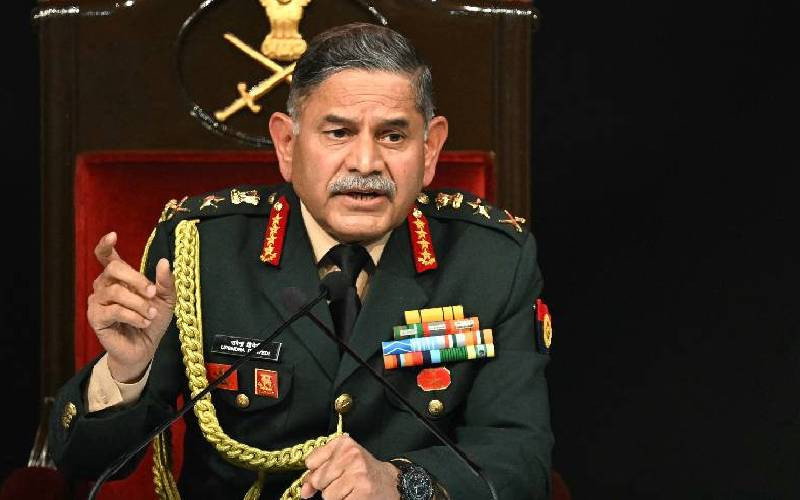
India's Chief of the Army Staff General Upendra Dwivedi during an annual press conference in New Delhi, on January 13, 2026. [AFP]
It is exactly one year and a few days post the Operation Sindhoor launched by Indian defense forces in retaliation of cross-border terrorism. The operation launched between May 6- 10, 2025 was a response to terrorist attacks on 22 April 2025 in Pahalgam in Jammu and Kashmir that claimed 26 lives. This attack was linked to two non-state actors - Lashkar -e- Taiba (LET) and Jaish-e -Mohammed (JeM) operating in Pakistan. This commentary reflects on future lessons for India’s defense posture in light of this operation.
One is the need to reflect on future trajectories of warfare and calibrate appropriately. An analysis of India's armed forces response to this attack indicated precision, reliance on kinetic and non- kinetic responses, including information warfare. Operation Sindoor reflected the ‘New Normal’ approach of India that it would retaliate against any acts of cross-border terrorism, irrespective of nuclear blackmail by its adversary. It was an implementation of zero tolerance against terrorism. It was a key message that India would engage in pre-emptive defense in pursuit of her sovereignty and would directly strike targets and infrastructure linked to terrorism threats. A decision from the Cabinet Committee on Security (CCS) on 23 April 2025 held in abeyance the Indus Waters Treaty of 1960 with a call for Pakistan to denounce claimed support for cross border terrorism.
Two, is the need to control the information narrative at the dual level of domestic and international audiences. The media in this regard is a key ally given that diverse framing can be offered in the age of misinformation and disinformation that we live in. Disinformation was particularly evident in the four-day escalation. This largely fits into the constant need to shape the strategic narrative domain. This would include consistent and persuasive framing on the state's position in responding to cross-border counter-terrorism.
Third, is the need to continuously learn and adapt to future warfare technologies. This operation and the counter-response demonstrated opportunities and threats that can emerge from drone technologies. Whereas this minimized physical combat, they remain strategic elements for surveillance and defense responses. This is in recognition with experiences, including in Africa where non-state actors, particularly insurgent groups such as Al-Shabaab and Boko Haram have been applying drones for surveillance and attacks. For future conflicts across a range of state and non-state actors, this portend that air defense systems have to be robust and equal to the task. India demonstrated the latter in this operation
A fourth lesson that India has been embracing over time is the value of public-private partnerships as it aspires for self-reliance in her defense needs. During a recent visit to India in February 2026 on a familiarisation visit of India’s defence establishment, I was honored to visit, among others a drone manufacturing startup – the new space Research and Technologies, based in Bengaluru- the Silicon Valley of India and a key partner that is supporting India’s defence need in a rapid changing world in this regard. Through this visit, I appreciated a fundamental lesson- that defense innovations and preparedness need to embrace the private sector. India’s defense establishment I learnt in my recent trip to India was innovated on defense innovation grants organized under the Innovations for Defense Excellence (IDEX) framework. This funding framework is forward looking as it enables a range of innovations to be incubated and scaled with relevance to national defense and security. These innovations are particularly valuable in the context of artificial intelligence, aerospace and cyber security, key facets that will shape future security postures.
Fifth, is a lesson that I also picked in conversations and presentations with senior defense officials during my recent visit to India. This relates to India’s quest for self- reliance of her defense needs under its indigenization program referenced under the 'Atmanirbhar Bharat’ vision. This again is a forward-looking approach that enables a future-ready defense establishment that is homegrown while cutting on foreign imports and external reliance. This is really also a lesson in adaptability as it enables the development of a robust industry defense at home and which adds further potential to her economic growth. This indigenization will, however, take into account the value of partnerships, joint ventures and rapid technological transfers in this regard. These, particularly, the evolving technological domains in the defense environments.
Six is a reflective lesson around wider adaptability, particularly in the context of emergency responses. Given the unpredictability of threats, innovations around emergency procurement in the defence establishment, which India has already embraced in the last decade, helps to future-proof rapid needs assessment. This emergency procurement helps to circumvent lags that may result from lengthy procurement processes.
Seven, but not least is the value of continuously reflecting on the jointness of operations across the armed forces. Whereas the Indian Airforce and the Indian Army worked seamlessly, according to commentators and defense analysts on this operation, they appreciated the need for continuous synergies across the defense forces. As has been observed across other armed forces, there is sometimes rivalry and or siloed approaches in responding to unravelling defense contexts. This would include enhancing and simulating joint training, operation preparedness and interoperability across relevant government agencies.
In conclusion, this commentary has appraised several lessons relevant for a future defense posture in the post-Operation Sindoor. It has reflected on evolving adaptability, the case of public- private sector investment, enhancing her indigenization defense program to robust synergies enhancement around the jointness of operations.
Dr John Mwangi, International Affairs Specialist







Subscribe to our newsletter and stay updated on the latest developments and special offers!








 join
join