×

The Standard e-Paper
Join Thousands Daily
 The Standard Group Plc is a
multi-media organization with investments in media platforms spanning newspaper
print operations, television, radio broadcasting, digital and online services. The
Standard Group is recognized as a leading multi-media house in Kenya with a key
influence in matters of national and international interest.
The Standard Group Plc is a
multi-media organization with investments in media platforms spanning newspaper
print operations, television, radio broadcasting, digital and online services. The
Standard Group is recognized as a leading multi-media house in Kenya with a key
influence in matters of national and international interest.

Audio By Vocalize
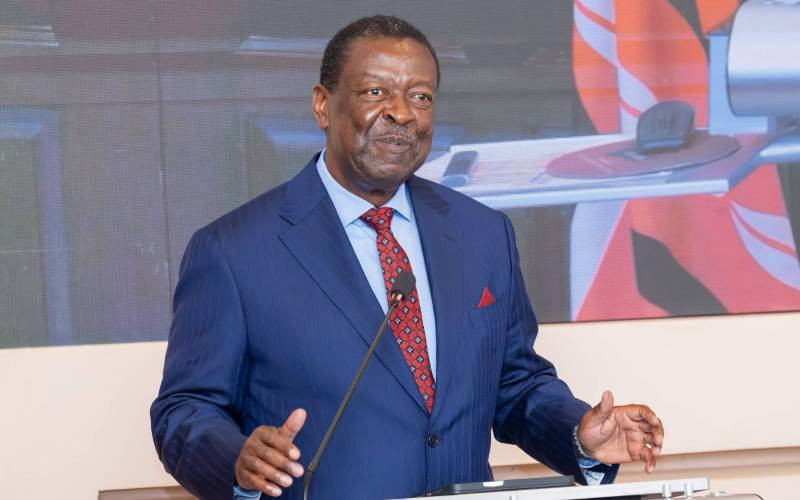
Prime Cabinet Secretary Musalia Mudavadi has reaffirmed Kenya’s commitment to regional peace and security, warning that escalating conflicts, violent extremism and competition among global powers are complicating stability efforts across the Horn of Africa, East Africa and the Great Lakes region.
Mudavadi said Kenya would continue leveraging diplomacy, strategic partnerships and regional institutions to address emerging security threats while protecting its national interests and supporting international peace initiatives.
“Peace is not simply the absence of conflict. It is the foundation upon which jobs, investment and national prosperity are built,” he said.
He was speaking at the National Defence College in Karen, Nairobi, during a lecture titled “The Role of Kenya’s Foreign Policy in Regional Peace and Security and the Contemporary Strategic Environment”.
The session brought together senior military officers, civil servants, private-sector leaders and participants from neighbouring countries undertaking Course No. 29 for 2026/2027.
Mudavadi said lasting peace required more than military preparedness, calling for strong institutions, economic development, national resilience and sustained regional cooperation.
“Through the EAC, IGAD, ICGLR and African Union, Kenya continues to advance dialogue, stability and collective security across our region,” he said, referring to the East African Community, Intergovernmental Authority on Development, International Conference on the Great Lakes Region and African Union.

He warned that despite progress in economic growth, democratic governance and regional integration, Africa continued to face protracted conflicts, governance shortcomings, socio-economic inequalities and the growing threat of non-state armed groups.
Eastern Africa, he noted, remained particularly vulnerable because of the conflict in Sudan, political tensions in South Sudan, insecurity in Somalia and instability in eastern Democratic Republic of Congo.
The threat posed by violent extremist groups, including Al-Shabaab, further complicated regional security efforts.
Mudavadi also cautioned that competition among traditional and emerging global powers for Africa’s natural resources, strategic partnerships and infrastructure investment could intensify existing political and economic tensions.
“Africa’s vast natural and mineral wealth, coupled with a dynamic and rapidly growing youthful population, positions the continent as the next frontier for global development and investment,” he said.
However, he warned that external competition could fuel conflict if partnerships were not transparent, inclusive and driven by African priorities.
The Prime Cabinet Secretary acknowledged that regional institutions remained important platforms for conflict prevention and integration but faced limitations arising from inadequate financial resources and political differences among member states.
He said the prolonged conflicts had also exposed weaknesses in international diplomacy and undermined confidence in global governance institutions, making coordinated and adaptable responses increasingly necessary.
Stay informed. Subscribe to our newsletter
Against this backdrop, Mudavadi outlined Kenya’s revised Foreign Policy 2024, anchored in Sessional Paper No. 1 of 2025, which seeks to position the country to respond more effectively to changing global dynamics.
The framework identifies eight priority areas: peace and security, economic and commercial, socio-cultural, diaspora, digital, environmental and climate, global health, and global governance and multilateral diplomacy.
“These focus areas reflect Kenya’s proactive approach to navigating the evolving global landscape, aiming to safeguard its sovereignty, promote economic prosperity, and enhance its influence on the international stage,” he said.
He stressed that Kenya’s diplomatic strategy must translate into tangible benefits for citizens, including safer communities, stronger economies, employment opportunities and protection of national development interests.
“We must therefore continue to invest in the partnerships, institutions and capabilities that enable us to anticipate threats, prevent conflict and support peaceful political settlements,” Mudavadi said.
He also called for a fairer and more representative global governance system capable of addressing contemporary security challenges.








Subscribe to our newsletter and stay updated on the latest developments and special offers!







 join
join