×

The Standard e-Paper
Kenya’s Boldest Voice
 The Standard Group Plc is a
multi-media organization with investments in media platforms spanning newspaper
print operations, television, radio broadcasting, digital and online services. The
Standard Group is recognized as a leading multi-media house in Kenya with a key
influence in matters of national and international interest.
The Standard Group Plc is a
multi-media organization with investments in media platforms spanning newspaper
print operations, television, radio broadcasting, digital and online services. The
Standard Group is recognized as a leading multi-media house in Kenya with a key
influence in matters of national and international interest.

Audio By Vocalize
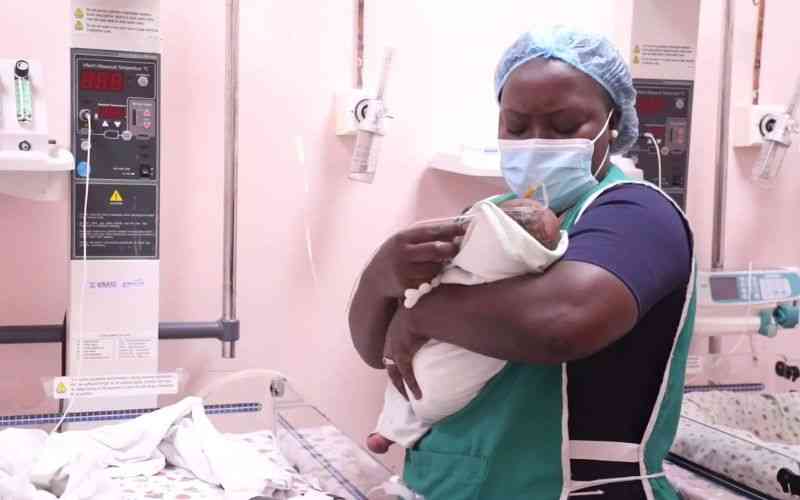
Peter Wafula took his wife to hospital when she was due to deliver. She was in pain, but there was no nurse to receive her.
At admission, she was directed to undergo a scan, but the hospital system took longer to approve the test. After waiting for about two hours, Wafula’s wife suddenly felt the baby coming.
He quickly unfolded curtains around the area, hoping she could deliver there, as other patients in the waiting bay rushed to help.
She was eventually taken to the maternity wing and booked in as an emergency.
“Though I am happy, and I celebrate, the experience was very bad,” says Wafula.
“Initially, I expected quick turn of events, have wife picked to deliver, and have scans wait. But waiting for a scan took longer. It was embarrassing to have my wife in pain, and want to deliver as everyone watched. I feared for her safety, and that of my baby,” he adds.
The Standard meets Wafula at Mbagathi Hospital, where his wife and newborn are closely monitored before discharge.
His experience is not in isolation.
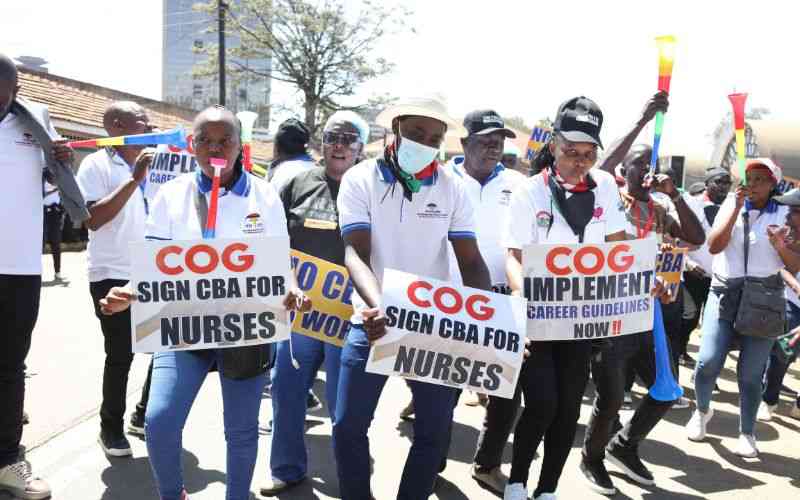
Across the country, as the nurses’ strike persists, pregnant women are facing delays and restricted admissions, with some forced to wait longer for care, seek help elsewhere or return to hospital only when labour has advanced and complications have set in.
Investigations by The Standard in some of Nairobi’s biggest hospitals and across the country reveal growing fears that the prolonged nurses’ and clinical officers’ strike could further endanger mothers and newborns, with health workers warning of the risk of preventable deaths.
Hospitals are limiting admissions to emergencies because of the shortage of nurses.
At Mbagathi Hospital, for example, admissions have dropped significantly.
On Tuesday night, there was no admission despite the facility delivering about 30 women daily under normal operations.
At 8.06pm, a 19-year-old woman due for delivery arrived at the facility accompanied by two caregivers.
Stay informed. Subscribe to our newsletter
She had swollen legs, high blood pressure and transverse fetal lie, where the baby was lying sideways across the uterus. She was referred to Kenyatta National Hospital (KNH).
The Standard followed up on the woman. She arrived at KNH at about 10.30pm but was only admitted at midnight after the intervention of her husband.
“Experience here is scary. I have just watched a woman deliver on her own at the maternity entrance,” says her husband, who requested anonymity.
“I fear for the safety of my wife. I do not want her to suffer such an experience because she is too young, so I made sure she is booked in and given a bed.”
At the national referral hospital, the woman underwent a scan and was placed under pregnancy monitoring.
An insider said only emergencies were being admitted because the facility was full to capacity.
The Standard witnessed a number of pregnant women in labour being turned away.
Back at Mbagathi, 21-year-old Christine Naro delivered on arrival at the maternity wing.
Her case was an emergency referral from Kagemi Hospital.
“I delivered at the waiting bay. I thank God nurses caught my attention, and supported my safe delivery. I developed tears that I am nursing,” says Naro.
The Standard met several women who had delivered at the facility after being booked as emergencies, as well as mothers whose sick or premature babies were receiving specialised care at the newborn unit.
An insider said the wing was overstretched, with locum nurses unable to provide the required level of care.
Margaret* emerged from the newborn unit overwhelmed. She had just lost her baby.
The pain was raw.
She was in tears, together with her husband, who was also unable to share details of their experience.
Margaret told The Standard that she had been admitted as an emergency referral and delivered through Caesarean section.
“The encounter is traumatising. For now I cannot talk, please allow me to heal first,” she says. “But I trust there was laxity in having my baby attended to. She died.”
The Standard learnt that the baby died on the sixth day after delivery.
“I safely delivered my baby, but it hurts to leave here empty-handed,” she says, as she is taken back to the post-natal ward and consoled by other women.

A healthcare provider at the facility broke down while describing how mothers were walking out of hospital without their babies.
The provider alleged that doctors were being forced to work with nurses and student nurses with limited experience and skills in newborn care because of the persistent nurses’ strike.
Doctors at the unit, according to the source, were under pressure to train students while simultaneously racing against time to save critically ill and premature newborns.
“Babies are so vulnerable. They either sleep, or get care they want to survive, or they die,” says the provider.
“Babies die who do not deserve to die. Mothers go home broken and families broken because a nurse was not at work. We cannot normalise mothers going home without babies,” regrets the source.
The insider gave an example of doctors writing prescriptions but being forced to follow up and directly guide students on how to administer medication to newborns.
With the strike, the county was expected to contract nurses but instead brought in students from colleges, who the source said lacked experience and skills in handling small and sick babies.
The provider said watching babies die had become devastating.
“You are left to wonder if you should just close this unit, instead of saying you're helping, but perhaps causing more harm,” observes the provider.
The Standard came across learners from various colleges in Nairobi providing care at the unit and other hospital departments.
“I experience babies dying all the time. This is what hits me. I know they don't need to die. They die in conditions that should not kill them,” regrets the source.
At the unit, the insider explained that a baby’s survival could depend on who was providing care.
A nurse, for example, should be able to quickly identify when a baby stops breathing and know what action to take.
However, with students filling the gap, doctors were increasingly spending time training them instead of focusing solely on saving lives.
During a visit to the unit, The Standard found two nurses caring for 65 babies, against the required six.
Anne Agnes said the nurses’ strike had limited her baby’s access to healthcare professionals at the newborn unit.
At times, she claimed, staff took longer to attend to her daughter, who was born at 27 weeks and was three weeks old. The baby had developed breathing problems because her lungs were not fully developed.
“My baby is three weeks old. I get shocked when a nurse asks me which medication to give my baby,” alleges Agnes.
“I simply do not know. They call doctors on the phone for guidance. This at times stresses me because I fear for my baby,” she says.
“How would you not get mistakes, errors, when students are the ones handling babies in need of specialised care?” poses the provider.
Initially, students should work under supervision and be accompanied by a nurse at all times.
“If injecting, she should be shown, ‘we are injecting this way’, not told, ‘inject this one, I inject this one’. But with shortage, students are the main players,” alleges the provider.
“We are getting sicker babies being admitted, and then they are crowded. They are being taken care of by nurses who lack the capacity. It is a broad problem,” adds the source.
Several babies admitted to the facility had infections, were unable to feed, appeared very sick or had difficulty breathing.
The provider observed that many babies suffered infections following home deliveries. While some were rushed to hospital, others died at home.
Despite reports of disrupted services, the hospital medical superintendent, Dr Ericah Koima, said locum nurses and clinical officers had been contracted to bridge the gap.
The professionals, she said, were all qualified, including those working in maternity and the newborn unit.
“The fact we are not operating normally in terms of human resource, but at least we are able to give services,” says Dr Koima.
“We are strained because locum cannot provide full capacity of services. This is stop-gap measure because we cannot close the hospital,” she adds.
Even with the recruitment of locums, patient numbers have fallen.
“Every time there is a strike, people do not come to hospital. The turnout of patients is low, not because we are not able to handle, but they know there is a strike,” says Dr Koima.
Data shows that the number of patients served daily has fallen from about 1,000 to fewer than 500.
Under normal operations, the hospital delivers at least 30 mothers a day. That number has fallen to about 20.
During a visit to the facility, there were 67 babies at the NBU, five at the HDU and four at the NICU.
The strain is also being felt at Pumwani Maternity Hospital, where limited admissions are forcing pregnant women due for delivery to stay at home and only rush to hospital when they become emergencies.
Experts say this increases the risk of death for both mothers and babies.
At the hospital, women were seen staying around the facility in an attempt to beat the admission system and be booked as emergencies when labour was advanced.
At 5.30pm, several women walked out of the hospital, holding their babies.
As they left, more women gathered at the waiting bay near the hospital gates.
The Standard learnt that some women were staying around the hospital, waiting until delivery was imminent so they could be admitted as emergencies.
One of them was Brenda*, dressed in orange and wrapped in a leso. She arrived at the waiting bay at 6.15pm.
She was joined by a man who appeared to be her partner.
The man initially approached the hospital gates but was not allowed in.
While seated in the waiting area, he repeatedly looked towards the hospital gates while speaking on the phone.
His attempts to have Brenda admitted were unsuccessful after security guards stopped him.
At 6.30pm, he became restless and left in search of a private clinic that could provide delivery services.
Attempts by The Standard to speak to him were unsuccessful as he was in distress.
Restricted admissions have reduced deliveries at the facility, according to an insider.
Caesarean sections, for example, have dropped from about 25 to fewer than five.
“Only women at emergency stages are received. For example, we admit those with PPH, ruptured uterus and big babies unable to be pushed. The situation is bad. It is dire,” says a nurse.
The nurse said there were also cases of mothers delivering with the help of traditional birth attendants before developing complications.
Among babies, the facility was recording high admissions linked to infections.
“We discourage admission of normal labour because we only have three nurses at the labour ward. If we allow admissions, they shall be overwhelmed,” she adds.
Although the county has contracted locum nurses, they are not adequate to run the facility.
According to the insider, a ward normally requires at least five nurses, but only one locum nurse is available, leaving a significant gap.
The impact of delayed admission is also evident among women who manage to reach hospital.
Beatrice*, a woman in Ward 2, said she was rushed to hospital after she began bleeding.
As she walked along the corridors to be admitted, she delivered her baby.
The delivery left her with tears.
Nurses quickly picked her up and took her to the delivery room, where she received further care.
“I was bleeding on admission, only to learn I had tears. I am thankful that I survived, and my baby is healthy,” she tells The Standard while waiting to be discharged.
But as some women deliver at hospital entrances and waiting bays, others are increasingly turning to smaller facilities or home deliveries, raising concerns among specialists over the ability to manage complications.
Dr Geoffrey Kasembeli, a consultant obstetrician and gynaecologist in Trans Nzoia, said he received a 36-year-old woman on Thursday, September 3, 2026.
The woman, from Khalwenge village, had delivered with the help of a traditional birth attendant on August 29.
She was discharged but continued bleeding at home.
On September 2, she went to a private clinic, but the bleeding did not stop and her condition continued to deteriorate.
She was rushed to Kasembeli’s clinic as an emergency, but was already dead.
“I am receiving complicated maternal cases, but this one has traumatised me. Death at delivery is saddest thing,” Kasembeli tells The Standard.
Efforts to speak to the family were unsuccessful as they were still in shock over the loss.
Dr Kireki Omanwa, president of the Kenya Obstetrical and Gynaecological Society (KOGS), also encountered a case of maternal death at KNH.
The woman, he said, had been referred to KNH from a private clinic in Nairobi.
She had a history of low blood pressure, but by the time she arrived at the referral hospital, it was too late.
She died on admission, together with her unborn baby.
“I witnessed a sad encounter of a mother who came to KNH with no heartbeat. She and her baby died. We could do nothing to save the two lives,” says Omanwa.
He said the case was not isolated, warning that the situation could worsen as the nurses’ strike persists.
“We are in a very sad situation,” he says.
According to the specialist, it is immoral, unethical and wrong for mothers who have carried babies for nine months to reach hospitals at the most critical time only to be turned away because of the nurses’ strike.
Subjecting women to prolonged labour, he warned, could lead to preventable deaths.
“If a pregnant woman walks to a hospital bleeding, it is an emergency and with the strike, doctors alone might not do much to save her life,” says the expert.
Omanwa’s concerns come amid rising maternal and newborn deaths, with Ministry of Health data showing an increase in reported deaths.
Last month alone, at least 75 mothers died during childbirth, while 574 deaths have been reported since January. There were also 74 neonatal deaths last month, bringing the number reported since January to 878.
Experts say the actual number could be higher, particularly amid the ongoing nurses’ strike.
“The picture they provided is not a good picture. Deaths are more. Maternal deaths from communities are not being captured. Women are dying and being buried silently,” says Omanwa.
As the strike persists, Omanwa calls on the government and nurses to urgently resolve their differences.
“Striking basically means loss of more mothers. Are we surprised when we lose mothers? It is a shame to national and county governments,” he says.
He also criticised the recently launched Every Woman Every Newborn Everywhere (EWENE) Acceleration Plan 2026/28, saying that while the programme is aimed at addressing challenges affecting mothers and newborns, it cannot end maternal and newborn deaths if health workers remain on strike.







Subscribe to our newsletter and stay updated on the latest developments and special offers!







 join
join