×
App Icon
The Standard e-Paper
Kenya’s Boldest Voice
★★★★ - on Play Store
Download App

Fruit tree nursery boosts climate change response in West Pokot

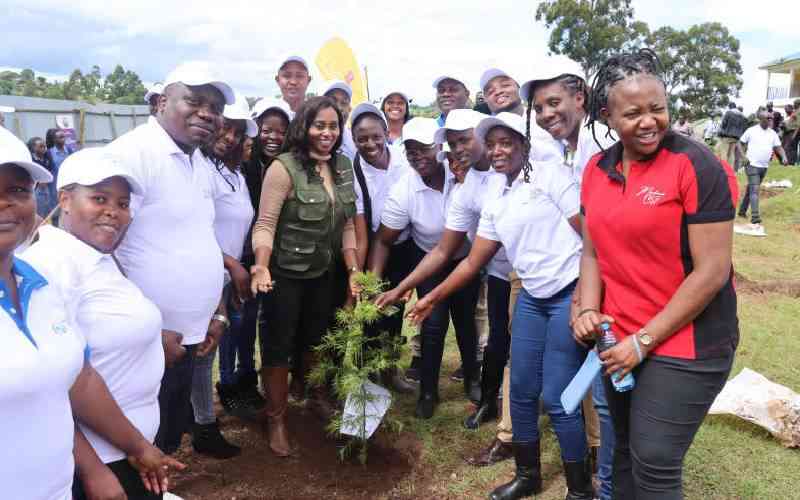
Health PS Mary Muthoni and employees of the Kenya Nuclear Regulatory Authority during the National Tree Planting at Aramaket ECD College in West Pokot County. [File, Standard]

The Aramaket High Value Fruit Tree Nursery in Kapenguria has emerged as a key pillar in West Pokot’s climate change response, producing hundreds of thousands of seedlings to support environmental restoration and food security.
Supported by the National Environment Trust Fund (Netfund), the nursery is currently raising more than 400,000 avocado seedlings, 180,000 assorted fruit tree seedlings, 84,000 coffee seedlings, 7,000 macadamia seedlings and 15,000 pyrethrum splits under the Restoration and Sustainable Management of the Cherangany Forest Ecosystems project.

On Wednesday, the Environment and Climate Change Principal Secretary Festus K. Ng’eno, together with an Italian delegation led by the Ambassador to Kenya, Vincenzo Del Monaco, toured the facility to assess progress, alongside West Pokot Governor Simon Kachapin.


The delegation also included Netfund Chief Executive Officer Samson Toniok and the outgoing Italian Deputy Ambassador to Kenya, Lorenza Gambacorta.

Kachapin said the nursery was helping farmers access quality seedlings at no cost.

“Our farmers receive these seedlings for free once they are ready for planting, as long as they prepare their land. This partnership is already bearing fruit by supporting food security and environmental conservation,” he said.

He noted that parts of West Pokot are prone to landslides and environmental degradation, making tree growing a priority.

“We are also contributing to the national target of planting 15 billion trees by 2032. This area is vulnerable, and tree growing is not optional — it is a necessity,” Kachapin said.

Ng’eno said the Aramaket project fits squarely into the national climate and environmental restoration agenda.

“Thirty per cent of the 15 billion trees we are targeting nationally will be fruit trees. We want to restore the environment while also improving household incomes and nutrition,” he said.

He added that the programme is community-focused and will be scaled up to reach more areas in the county and beyond.

“This is about working with communities. We are restoring degraded ecosystems, but we are also ensuring that people see direct economic benefits,” said  Ngeno.

Monaco said Italy was encouraged by the impact of the project and the consistency in its implementation.

“What we are seeing here is climate action in motion. This is Netfund’s commitment to sustainable development delivering real results at the community level,” he said.

He added that long-term success depends on strong partnerships. “We need political support, sustainability, alignment and full involvement of the local community. The coherence of this programme is very encouraging.”

During the visit, the delegation witnessed how high-value fruit tree production is being used to promote ecosystem restoration, strengthen climate resilience and improve livelihoods.

Local residents said the nursery has already changed lives.

Lilian Koskei, a resident of the area, said the project has provided employment opportunities to many families.

“This nursery has supported many households through jobs. People can now earn a living as they help protect the environment,” she said.

Another resident, Emily Chepchimba, said farmers have benefited greatly from access to quality seedlings.

“Many farmers could not afford good seedlings before. Now we are getting them here, and our farms are improving,” she said.

After the Aramaket tour, the delegation proceeded to Sigor sub-County, where they inspected the Weiwei Irrigation Scheme, another flagship project supported by the Italian Government.

County officials said the projects are expected to play a major role in boosting food security, restoring degraded ecosystems and building climate resilience across West Pokot.