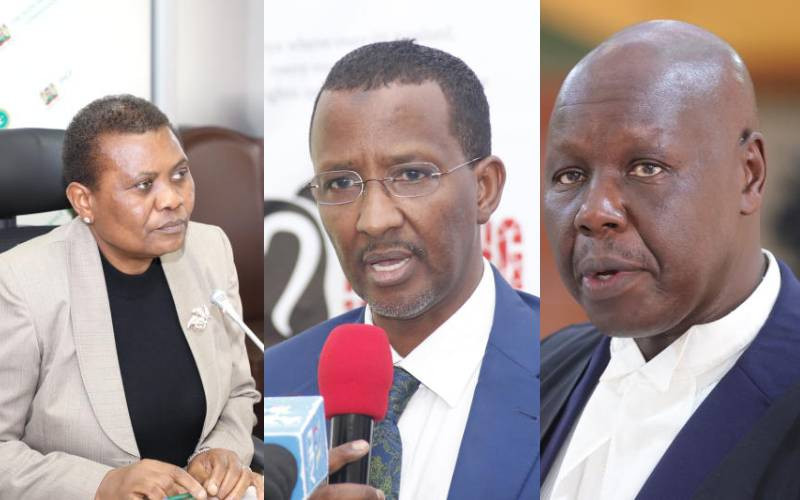
Questions have emerged over whether the Judicial Service Commission (JSC) complied with the constitutional two-thirds gender rule after releasing a list of fifteen (15) nominees to the Court of Appeal.
Of the nominees, four are women, and 11 are men.
But lawyers interviewed by _The Standard_ now say compliance should be assessed based on the full composition of the appellate court, not the latest nominations alone.
The Court of Appeal currently has 27 judges, comprising 11 women and 16 men. If President William Ruto appoints all 15 nominees, the court would have 42 judges, comprising 27 men and 15 women.
With the court required to have a total of 70 judges, legal experts say the current and projected composition meets the two-thirds gender requirement.
Advocate Eric Muriuki told The Standard that while the latest nominations fall slightly below the threshold, the JSC must balance gender considerations with other constitutional requirements, including competence and regional diversity.
“Its surprising [conversations about the threshold] because the JSC has only three men, so you wonder why that balance was not capable of being achieved there,” the advocate said.
He added that scrutiny of the JSC’s gender balance was surprising, noting that the commission itself is female-dominated. The JSC, chaired by Chief Justice Martha Koome, has 11 members and a secretary (nine women and three men).
Muriuki opined that the Court of Appeal plays a critical role in Kenya’s judicial system, serving as a law-making court whose decisions bind the High Court and magistrates’ courts nationwide.
He also cited a Supreme Court advisory opinion that described the two-thirds gender rule as “aspirational rather than absolute,” meaning it must be pursued progressively alongside other constitutional values.
From a shortlist of 35 candidates, only seven were women. Muriuki said selecting four women from that pool was notable, adding that some candidates did not perform well during interviews.
“They did the best they could and probably missed out because of the gender issue,” referring to unsuccessful candidates such as Justices Francis Gikonyo and Oscar Angote.
Another lawyer, Nerima Were, said more could be done to increase women’s representation on the appellate bench. She says that despite campaigns over the need to meet the threshold, the Judiciary has not done enough to address it like for instance, by calling for applications from women only.
Law Society of Kenya President Faith Odhiambo welcomed Thursday’s nominations, urging the nominees to serve with integrity and fidelity to the law.
Stay informed. Subscribe to our newsletter
“We believe that the Court is strengthened by their addition, and look forward to their contributions in enriching our Jurisprudence.”
LSK presidential hopeful Charles Kanjama also congratulated the nominees, describing the Court of Appeal as a critical pillar in Kenya’s justice system. “Their nomination is a testament to their individual merit, professional integrity, and years of dedicated service to the law.”
Lawyer Caxstone Kigata lauded the JSC for nominating judges from specialised High Court divisions and for selecting a significant number of candidates from outside the Judiciary. “The commission had to balance competing interests, including competence, gender, regional balance, and confidential reports,” he said.
Ndong Evance expressed surprise at the exclusion of Justices Gikonyo and Angote but said the list still included deserving candidates.
Responding to claims on X that Justice Robert Limo was excluded due to comments on corruption in the Judiciary, Ndong dismissed the assertion. “Looking at the five metric tests, merit, gender parity, regional balance, inclusivity of different aspects of the profession & maybe court classification, it must have been the hardest of time for the JSC,” said Ndong.