×

The Standard e-Paper
Fearless, Trusted News
 The Standard Group Plc is a
multi-media organization with investments in media platforms spanning newspaper
print operations, television, radio broadcasting, digital and online services. The
Standard Group is recognized as a leading multi-media house in Kenya with a key
influence in matters of national and international interest.
The Standard Group Plc is a
multi-media organization with investments in media platforms spanning newspaper
print operations, television, radio broadcasting, digital and online services. The
Standard Group is recognized as a leading multi-media house in Kenya with a key
influence in matters of national and international interest.

Audio By Vocalize
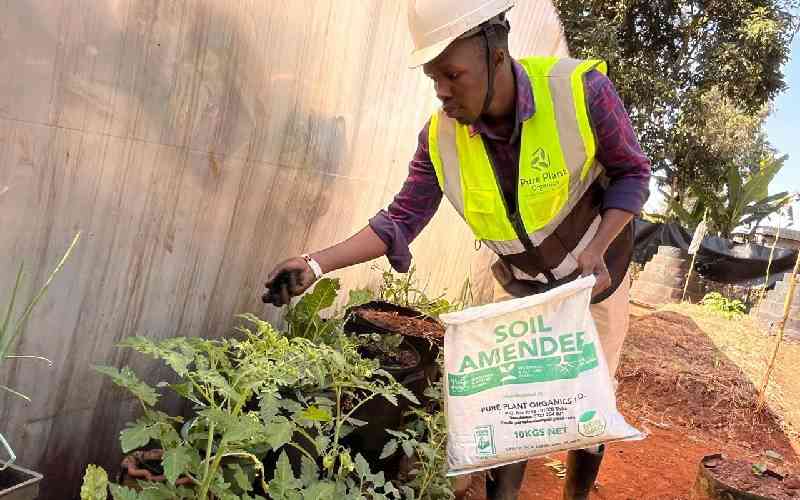
The afternoon sun is unforgiving in Kimunyu village, Ngenda Ward, Kiambu County.
Inside a gated compound, the heat settles over rows of sacks stacked against a wall. Their contents are black and fine, resembling charcoal. But there is no cooking fire here.
The material is destined for farms.
Dennis Muriithi, an engineer who turned to agriculture, walks among the sacks explaining how macadamia shells, rice husks, avocado waste and rejected herbs have ended up in his compound.
They came in as waste. They will leave as biochar, a soil amendment that Muriithi believes can help farmers deal with one of agriculture’s less visible problems: exhausted soils.
“We focus on restoring degraded soils by turning recycled organic waste into biochar,” says Muriithi, co-founder and chief executive of Pure Plant Organics.
The idea began taking shape when Muriithi and his co-founder worked as freelance agricultural extension service providers, helping farmers establish and manage farms.
Again and again, they encountered the same problem: soils that had lost their ability to support healthy crops.
Farmers were dealing with acidity, poor aeration and soils unable to retain enough water and nutrients.
Muriithi said the problem demanded more than simply adding more fertiliser. Biochar offered an alternative.
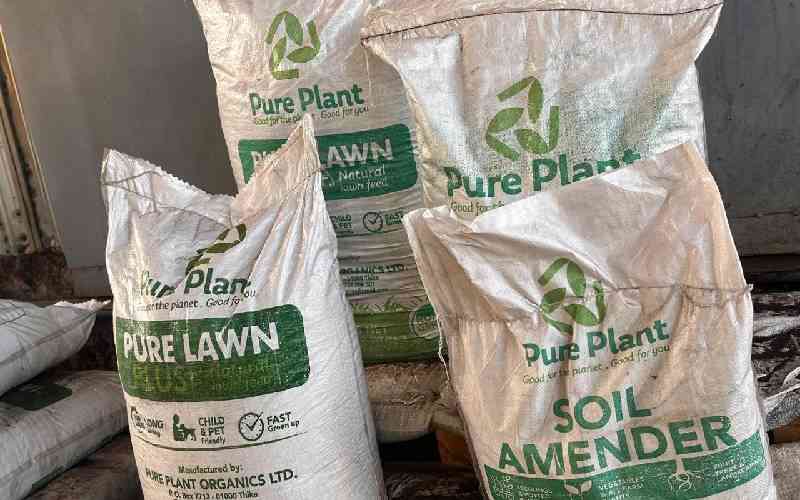
It is produced through pyrolysis, a process in which organic material is heated in an oxygen-limited environment. The resulting carbon-rich material is then applied to soil, where it can help improve its structure, water retention, nutrient retention and pH balance.
Pure Plant Organics works with farmers growing rice, avocado, horticultural crops and herbs, turning some of the waste from these farms into the raw material for its product.
Among the materials are rejected export crops such as rosemary and thyme that cannot enter export markets but can still serve another purpose.
“We are creating a closed loop where we manage post-harvest losses for farmers. Produce that would otherwise end up as waste becomes the exact input, they need to restore their soil,” Muriithi said.
The company sells biochar in 10-kilogramme packs for Sh700, 25kg at Sh1,300 and 50kg at Sh2,500. Small-scale farmers often purchase through groups, including women’s groups that receive training, while larger farms buy directly.
Stay informed. Subscribe to our newsletter
Muriithi says some farmers have reported yield increases of between 30 and 60 per cent after using the product, although the results vary depending on soil conditions and farming practices.
The company advises farmers to begin with soil testing rather than applying biochar blindly.
“We always encourage farmers to test their soil first so we understand its exact condition,” Muriithi says.
The results determine how much biochar should be applied and how frequently.
Muriithi noted that soil restoration is also about changing the way farmers think about what they put into their farms.
He argues that farmers can gradually reduce dependence on conventional fertilisers as they improve soil health and adopt organic practices.
“The future is organic,” he says.
But turning the idea into a viable business was not easy.
Biochar production requires processing equipment and capital, resources that the young entrepreneurs initially struggled to secure.
Their fortunes changed after Pure Plant Organics participated in the AYuTe Africa Challenge, an initiative of Heifer International that supports youth-led agricultural businesses using technology and innovation.
The support enabled the company to improve its production capacity and acquire equipment, including a dryer and crusher, while strengthening its systems and expanding its reach.
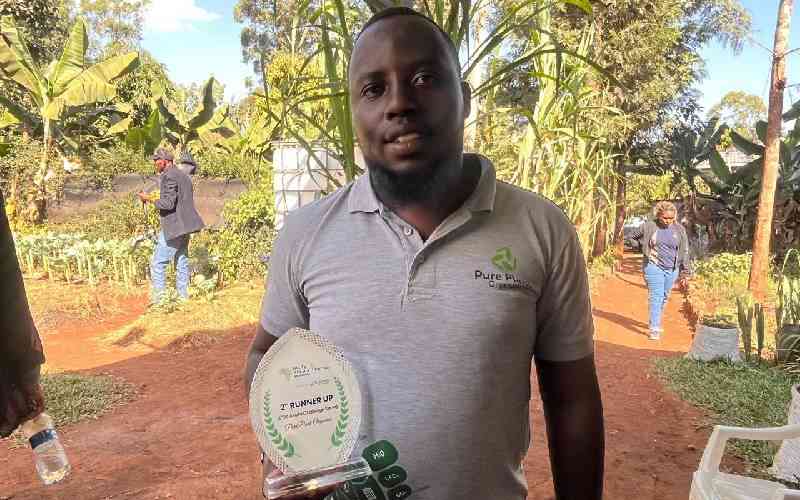
“Before the support, the company could manage only one production turn a day. Today, it can manage 10 turns a day or more,” Muriithi says.
The increased capacity has allowed the company to reach more farmers.
Pure Plant Organics said it has now served more than 3,000 farmers and created employment for 15 young people involved in waste aggregation, processing and other operations.
The business is part of a wider effort to make agriculture attractive to young people by treating farming not simply as subsistence, but as a field for technology, innovation and enterprise.
Muriithi adds that the journey has also been a return to a lesson he heard as a young student, when an agriculture teacher told his class that the next generation of billionaires would be farmers.
Years later, after studying engineering and working with farmers, he found himself drawn back to the same sector, this time looking at what agriculture leaves behind.
“Our business is about more than selling biochar; I see soil restoration as part of a wider effort to strengthen food security and make agriculture more sustainable,” he says.
In Kimunyu, that ambition is visible in the sacks of black material waiting to leave the compound.
What began as discarded agricultural material is being given another life, returning to the soil from which it came.
“No matter how small, start. Be confident in what you are doing. And this might lead to something big in the future. Let us promote agriculture, invest in our soils. And by investing in our soils, we are investing in our future,” Muriithi said.





Subscribe to our newsletter and stay updated on the latest developments and special offers!








 join
join