×

The Standard e-Paper
Join Thousands Daily
 The Standard Group Plc is a
multi-media organization with investments in media platforms spanning newspaper
print operations, television, radio broadcasting, digital and online services. The
Standard Group is recognized as a leading multi-media house in Kenya with a key
influence in matters of national and international interest.

Audio By Vocalize
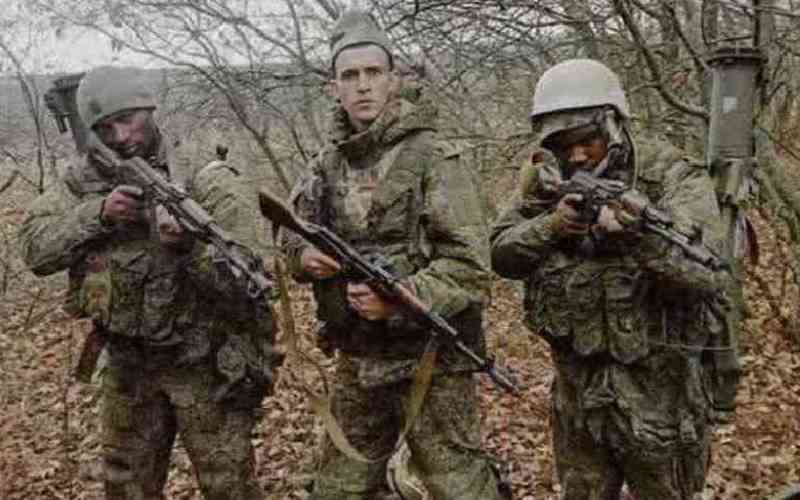
Some Interim data has established that at least 502 Africans nationals from 29 countries who had been enlisted in the Russian Military have died, with the fate of 2500 other Africans involved in the Russian-Ukraine conflict not confirmed.
Ukrainian Military Data records reviewed by Journalists for Justice (JFJ) combined with additional cases through interviews and independent reporting identify at least 3,034 African nationals from 40 countries were enlisted in Russia armed forces since October 2022.
According to the report, Kenya accounts for the largest documented contingent, with 841 identified cases, followed by Egypt with 407, Cameroon with 383, Ghana with 337, Nigeria with 214, and Uganda, with smaller cohorts identified across North, West, East, Central, and Southern Africa.
“These figures do not establish the full scale of African recruitment; Russia has never published a complete accounting of foreign enlistment and the true number is likely higher, Ukraine told the European Parliament in March 2026 that Russia had enlisted at least 27,000 foreign nationals in total since the start of the war,” states the JFJ Report.
The largest recorded death tolls were from Cameroon with 104 deaths; Ghana, 85; Egypt, 81; Kenya, 76; Nigeria, 24; Gambia, 22; Mali, 15; Algeria, 14; South Africa,10; Senegal,8; Burundi,7; Sudan,7 and Zimbabwe with 6 deaths.
While Côte d’Ivoire,5; Sierra Leone,5; Morocco,4; Guinea,3; Ethiopia,3; Democratic Republic of Congo,3; Togo,3; Uganda,3; Benin,2; Botswana,2; Zambia,2; Tanzania,2; Central African Republic,2; Gabon,1 and Chad with 1 death.
According to the report, the earliest documented African cases involved Zambian and Tanzanian nationals recruited by the Wagner Group from Russian Prisons in 2022, with continental civil recruitment beginning in 2023, predominantly through Egyptian and Cameroonian networks; by 2024, Ghana and Gambia were drawn in, with Kenya and South Africa joining in 2025.
JFJ documented recruits who were promised work as plant mechanics, security guards, drivers, cooks, logistical workers, factory workers and cultural festival participants, in country contracts reviewed by JFJ, including contracts issued by the Kenya Agency Global Face Human Resources Limited.
However, the report did not identify the Russian military as the employer and did not disclose the military service contract recruits would later be required to sign in Russia while in the Global Face contracts the only visible sign pointing towards Russia was the use of Russian roubles as the currency for wages and fees.
“In WhatsApp communications obtained by JFJ, a recruiter explicitly assured a Kenyan candidate that foreigners would not participate in military action and would only provide security, in multiple cases documented by JFJ, recruits did not learn that they had been enlisted into the Russian military until they had already arrived at military facilities inside Russia,” states the report.
The Report reveals that Russian consular authorities issued tourist and business visas to recruits in some cases within 36 to 48 hours of first contact with a recruiter, despite applicant profiles inconsistent with ordinary tourism or business travel.
On arrival in Russia, recruits were moved into formal state systems, with military service contracts signed with the Ministry of Defence and executed by named military officials, including Major I.S. Tekuchev, head of Moscow’s military service recruitment station and Captain I.R. Arsentyeva, head of the selection Point for Military Service under contract in Veliky Novgorod.
A 2024 Presidential decree offered a path to Russian citizenship for foreign nationals who signed military service contracts, while the Russian embassy in Kenya denied issuing the tourist visas used by Kenyan recruits, but JFJ holds passport copies documenting their issuance.
Stay informed. Subscribe to our newsletter
The financial architecture of the recruitment system turned the recruit into a revenue source before he became a soldier with a contract reviewed by JFJ between a Kenyan recruit and Global Face Human Resources Limited setting an agency service fee of 1 million to 1.4 million roubles, approximately US$11,700 to US$16,500, payable by automatic deduction from the recruit’s Russian bank account within 35 days of signing with the employer.
“That fee represented between 58 and 66 per cent of the one-time signing bonus. Globe Face sent at least 500 Kenyan men to Russia on that basis the company may have earned more than US$8.25 million in agency fees between May 2025 and February 2026 alone,” states the report.
The JFJ report revealed that in Kenya, additional pre-departure cash payments to informal brokers ranged from Sh50,000 to Sh200,000 approximately US$390 to US$1,550 in Ghana, Sierra Leone and Cameroon, recruits reported paying brokers between US$5,000 and US$ 7,000 to facilitate travel.
Multiple Kenyan recruits reported that intermediaries withdrew 1 million roubles from their accounts almost immediately after arrival, before the recruits could meaningfully access funds. In at least one documented case, recruits were required to sign powers of attorney granting intermediaries access to their bank accounts with several of them reporting unauthorised withdrawals.
On arrival recruits signed contracts presented only in Russian Cyrillic without translation and under time pressure, with these contracts requiring recruits to undersign a list of 18 sections of Chapter 33 of the Criminal Code of the Russian Federation.
“The Penalties referenced included imprisonment of up to 10 years for desertion, absence without leave, evasion of military service duties and voluntary surrender; these consequences were not disclosed in writing before recruits travelled to Russia,” states the report.
Passports were confiscated upon or shortly after arrival at military facilities; international financial sanctions against Russian banks blocked or severely restricted swift transfers to African countries, preventing recruits from sending earnings home and removing one of the primary incentives for their original decision to travel.
The JFJ report states some 2023 some early African recruits received up to six weeks of training by 2025 Kenyan recruits received as little as three days of weapons and explosives training before deployment to the frontline with the shortest documented interval from contract signing to frontline deployment five days.
A JFJ survey of the families of 57 Kenyan recruits found that the average time from arrival to death, hospitalisation or being declared missing was 44 days, with JFJ having confirmed the deaths of at least 76 Kenyan nationals.
“In Kenya, a licensed recruitment agency conducted mass recruitment events at Kenyatta International Convention located within sight of Parliament of Kenya, the Office of the President, the Supreme Court and the Office of the Governor of Nairobi City County,” states the report.
The report reveals that the National Industrial Training Authority assessed candidates for Russian job opportunities with JFJ confirmed that between October and December 2025 at least 110 Kenyans were trafficked to Russia in groups as large as 22.
These groups passed through Jomo Kenyatta International Airport past counter trafficking, criminal investigation, intelligence and immigration officials carrying brand-new passports containing Russian tourist visas.
Government officials from the Directorate of Immigration Services, the Directorate of Criminal Investigations, the Anti-Narcotics Unit and the National Employment Authority were identified in the National Assembly as having facilitated the trafficking.
“Kenya’s Foreign Affairs Minister did not visit Moscow until March 2026, months after the alarm was first raised. Kenya has not established a repatriation fund, leaving families to seek the return of the sick, the wounded, the detained and the dead in an institutional vacuum,” states the report.
Other governments also adopted language and positions that obscured responsibility, with Ghana’s Foreign Ministry describing the trafficking as youth enlistment following a technical session with Russia, with South Africa expressing gratitude towards Russia for returning its nationals without attributing responsibility of how they were recruited or deployed.
President William Ruto held talks with Russian President Vladimir Putin after the conclusion of the Russia-Africa Summit, where he thanked President Putin for confirming that Kenyans will no longer be enlisted into the Russian military.
Ruto said Kenya has been categorised as a non-source country for recruitment into the Russian military and that he had appointed a Defence Attaché at the Kenya Embassy in Moscow, who will liaise with the Russian Ministry of Defence in processing the return of Kenyans in Russia for military purposes.
“The Defence Attaché will work with the Russian Ministry of Defence to process compensation for Kenyans and to assist in their safe return home,” said Ruto.
Prime Cabinet Secretary Musalia Mudavadi, who appeared before a joint sitting of the Senate National Security and Senate Labour Committees, said that his office has documented 354 Kenyans involved in the conflict, while the petitioners representing the affected families said that they had documented 841 citizens.
He told the joint sitting, co-chaired by Isiolo Senator Fatuma Dullo and Murang’a Senator Joe Nyutu, that the Ministry of Foreign Affairs was dealing with figures that had been verified and that he was not disputing the figures given by the petitioners, but they were subject to verification.
“Russia is the size of half the African Continent; the war is happening thousands of kilometres from Moscow. The numbers of Kenyans that we can confirm are involved are 354 however, the numbers could be even more than the 841 figure given by the petitioners since most of them did not register with the embassy,” said Mudavadi.
He said that out of the 354 Kenyans he can account for, 62 of them have been repatriated so far, 84 were killed or missing in action, 77 were in the frontline, 54 were in unknown locations, 38 were in camp, 34 were hospitalised, 5 are prisoners of war, one was in detention while one had his contract completed.



Subscribe to our newsletter and stay updated on the latest developments and special offers!