The Standard Group Plc is a
multi-media organization with investments in media platforms spanning newspaper
print operations, television, radio broadcasting, digital and online services. The
Standard Group is recognized as a leading multi-media house in Kenya with a key
influence in matters of national and international interest.
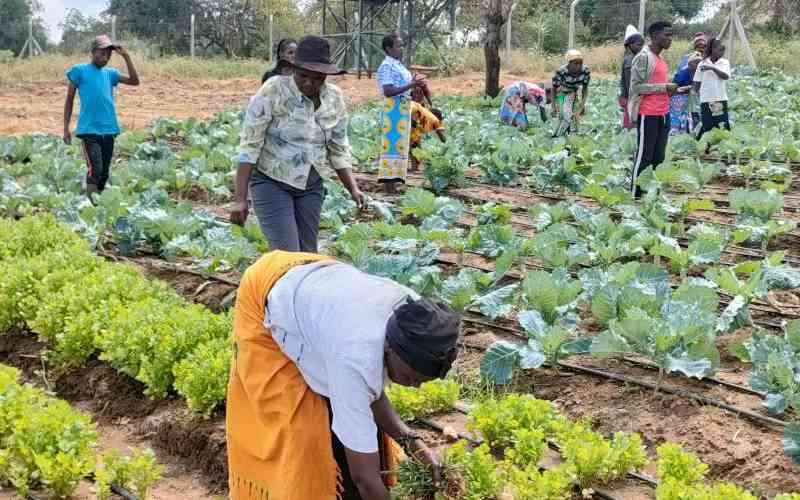
A group of people tend to vegetables in a demonstration farm that they use in learning to grow and manage vegetables in Ndui area of Mutomo in Kitui South and Kitui County (Nanjinia Wamuswa, Standard)
Demand for traditional vegetables is surging across Nyandarua County, fueled by a new initiative to popularise a vegetable-based porridge flour designed to combat malnutrition and lifestyle diseases.
The initiative, which promotes the Nyenice brand of flour, is a collaborative effort between the Community Participation in Climate Action and Development (COPICAD), GAIN-Kenya, and CARE.
The project aims to reduce the disease burden among children and the elderly by reintroducing nutrient-dense traditional greens into the local diet.
Health experts and nutritionists backing the project note that many ailments affecting these vulnerable groups stem from nutritional deficiencies.
These essential nutrients are readily available in traditional vegetables, many of which grow naturally in the wild but have been overlooked in recent years.
Speaking at a launch event in Kasuku village, nutritionist Leah Mbugua explained that the Nyenice formula was developed following intensive research.
"This porridge flour is made from wild, green leafy vegetables loaded with essential nutrients," Mbugua said.
"These minerals and vitamins improve immunity and enhance skin health. However, we advise consumers to continue taking any prescribed medications until a doctor directs otherwise."
The impact of the initiative is already being felt by residents. Teresiah Mwangi, 80, shared her experience of living with Osteoarthritis, a painful condition that affects the joints.
"I relied on heavy medication and supplements and had to use crutches to walk," Mwangi recounted.
"After incorporating this flour into a healthy diet, I was able to abandon my crutches and regain my mobility."
COPICAD Executive Director Thomas Muriithi linked the initiative to broader environmental conservation efforts, noting that a healthy ecosystem provides a natural pharmacy for the community.
"Our work to protect Lake Ol Bolossat through the planting of traditional trees has taught us that the environment provides exactly what our bodies need," Muriithi said.
"As we intensify conservation, we are also promoting the use of these wild vegetables to build a healthier, more resilient population."
Stay informed. Subscribe to our newsletter
The initiative marks a significant shift in the region's approach to food security, blending environmental restoration with modern nutritional science to improve public health.
The programme is part of a broader five-year commitment by CARE Kenya and GAIN, with an investment of over Sh8.5 million aimed at transforming local food systems.
To ensure the vegetables retain their potent nutritional value, COPICAD has implemented specialised processing techniques.
Farmers are trained in solar drying and enzyme deactivation-a process involving quick blanching in hot water followed by a salt-water soak-to prevent the nutrients from degrading before the vegetables are milled into flour.
This "green economy" model allows farmers to earn a living while simultaneously greening the county's forests.
By reducing post-harvest losses-which currently claim 30-40 per cent of Nyandarua's vegetable yield-the initiative ensures that nutrient-dense food remains available even during the off-season.
Support Independent Journalism
Stand With Bold Journalism.
Stand With The Standard.
Journalism can't be free because the truth demands investment.
At The Standard, we invest time, courage and skills to bring you accurate,
factual and impactful stories. Subscribe today and stand with us in the
pursuit of credible journalism.
 The Standard Group Plc is a
multi-media organization with investments in media platforms spanning newspaper
print operations, television, radio broadcasting, digital and online services. The
Standard Group is recognized as a leading multi-media house in Kenya with a key
influence in matters of national and international interest.
The Standard Group Plc is a
multi-media organization with investments in media platforms spanning newspaper
print operations, television, radio broadcasting, digital and online services. The
Standard Group is recognized as a leading multi-media house in Kenya with a key
influence in matters of national and international interest.














 join
join