×

The Standard e-Paper
Kenya’s Boldest Voice
 The Standard Group Plc is a
multi-media organization with investments in media platforms spanning newspaper
print operations, television, radio broadcasting, digital and online services. The
Standard Group is recognized as a leading multi-media house in Kenya with a key
influence in matters of national and international interest.
The Standard Group Plc is a
multi-media organization with investments in media platforms spanning newspaper
print operations, television, radio broadcasting, digital and online services. The
Standard Group is recognized as a leading multi-media house in Kenya with a key
influence in matters of national and international interest.

Audio By Vocalize
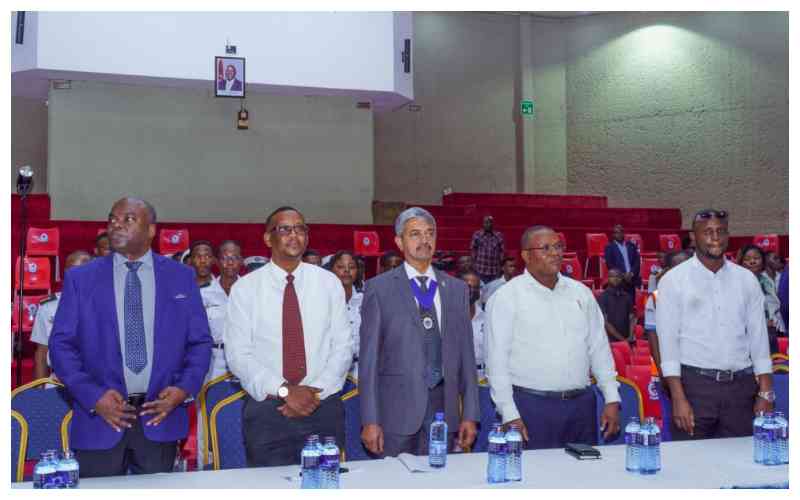
Shipping professionals have noted that the industry has always adapted to change, but warned that the current simultaneous geopolitical, technological and environmental changes pose a new challenge.
Gathered in Mombasa last week under the umbrella of the Institute of Chartered Shipbrokers (ICS), the professionals argued that the winners will not necessarily be the largest ports, but the most adaptable ones, urging East Africa to take advantage of training, partnerships and geographical location to build resilience.
“Shipping has always adapted to change. What is different today is that geopolitical, technological and environmental changes are happening simultaneously. The winners will not necessarily be the largest ports, but the most adaptable ones,” said visiting ICS International Chairman Krishnan Subramaniam.
“Ports do not create resilience. Infrastructure alone does not create resilience. Technology alone does not create resilience. People, partnerships and professionalism create resilience. That has always been the philosophy of the ICS, and it is increasingly becoming the defining characteristic of successful maritime nations.”
Addressing several forums, Subramaniam noted that trade routes are becoming more dynamic while the Red Sea disruptions have demonstrated that shipping routes can change overnight.
He noted that diversion around the Cape of Good Hope increased voyage times and freight costs, and political tensions will continue to influence shipping patterns.
“East Africa should view this as an opportunity rather than merely a risk. Geography has become a competitive advantage again. Mombasa sits on one of the world's most strategic trade corridors,” he observed.
"If there is one message I would leave with this audience, it is this: uncertainty is no longer an exception in global shipping—it is the operating environment. East Africa should not prepare for the next disruption; it should build the capability to thrive through continuous disruption,” he said.
“By investing in people, strengthening international partnerships, embracing technology, and committing to lifelong professional learning, this region can become not just a gateway to Africa, but one of the world's most resilient maritime ecosystems,” he added.
Subramaniam was flanked by ICS East Africa chairman Elijah Mbaru, Bandari Maritime Academy chief executive Dr Eric Katana, Maritime and Management Institute of East Africa principal consultant Martin Soita and co-founder and chairman of Express Shipping and Logistics Silvester Kututa, among other industry leaders.
Mbaru said resilience has become an essential quality for maritime professionals, describing it as the ability to anticipate change, adapt quickly and lead confidently in a rapidly evolving industry.
"Resilience today is no longer just about surviving difficult times. It is about developing the knowledge, professional skills, ethical values and innovative mindset needed to remain effective regardless of changing circumstances," he said.
He noted that the maritime industry remains the backbone of global commerce, with more than 80 per cent of international trade by volume transported by sea.
According to Mbaru, East Africa was well positioned to benefit from the expansion of regional ports, improvements in transport corridors, regional integration and the growth of the blue economy, all of which are creating demand for skilled professionals in shipping, logistics, port operations and supply chain management.
He urged students pursuing maritime careers to go beyond academic qualifications by developing critical thinking, leadership, digital literacy, and adaptability.
Stay informed. Subscribe to our newsletter
"The industry is changing rapidly through artificial intelligence, automation, blockchain technology, smart ports, autonomous vessels and green shipping initiatives. Employers are looking for professionals who can thrive in this new environment," he said.
Subramaniam noted that trade routes are becoming more dynamic and Red Sea disruptions demonstrated that shipping routes can change overnight.
He observed that diversion around the Cape of Good Hope increased voyage times and freight costs, adding that political tensions will continue to influence shipping patterns and East Africa should view this as an opportunity rather than merely a risk.
“Geography has become a competitive advantage again. Mombasa sits on one of the world's most strategic trade corridors,” he noted.
Subramanian noted that East Africa occupies a unique and increasingly strategic position in global maritime trade.
From the ports of Mombasa and Dar es Salaam to the wider Indian Ocean trade routes, he observed, the region is becoming an increasingly important gateway connecting Africa with Asia, the Middle East, and Europe.
Subramaniam added that investments in ports, logistics infrastructure, transport corridors and regional integration continue to strengthen East Africa's role in international commerce.
“But infrastructure alone does not create a maritime hub. People do. The most valuable investment is in competent, ethical and professionally qualified people. Every successful port, shipping company, logistics provider and trading organisation ultimately depends on capable professionals making sound commercial decisions,” he added.
Subramaniam noted that supply chains are shifting from "lowest cost" to "most resilient", including decisions on whether to source from multiple regions and whether cargo will move through different ports.
“Global companies are now asking: Can I source from multiple regions? Can my cargo move through different ports? How quickly can I recover from disruption? Resilience has become more valuable than efficiency alone,” he argued.
He also noted that digital shipping is accelerating and the industry is becoming increasingly data-driven with the use of electronic bills of lading, artificial intelligence-assisted voyage planning, predictive maintenance, port community systems and real-time cargo visibility. According to him, ports globally will increasingly compete on data quality, not only physical infrastructure.
Subramaniam noted that green shipping will influence trade, with new International Maritime Organisation (IMO) decarbonisation measures being fast-tracked.
He noted that the new IMO measures will affect vessel selection, fuel choices, port infrastructure and carbon reporting, adding that ports prepared for greener shipping will attract future investment.
With the rapid changes taking place in the industry, Subramaniam noted that human capital becomes the competitive advantage.
He noted that technology changes rapidly and hence professional judgement remains essential, and it is where organisations like the ICS contribute internationally recognised education, continuous professional development, globally transferable competencies and ethics and professionalism.
“Infrastructure can be built in a few years. Professional capability takes decades to build. The most resilient maritime nations invest in both,” he argues. He said no single country can build maritime resilience alone.
“Shipping is, by definition, an international business. Partnerships therefore become strategic assets,” he stated.
He encouraged the building of institutional partnerships—not only commercial ones, but also between professional institutes, universities, regulators, ports and industry associations, adding that professional networks should continue to exchange knowledge long after conferences end.
He noted that the Middle East provides useful lessons, saying that the United Arab Emirates (UAE) invested simultaneously in ports, free zones, logistics, customs digitalisation, education and international partnerships.
“These elements developed together rather than independently. East Africa can adopt the same integrated approach,” he advised. He told East Africa to share intelligence, noting that shipping today requires information sharing to remain resilient.
Subramaniam urged the industry to routinely exchange information on security developments, cyber threats, port congestion, sanctions, regulatory changes and supply chain risks to enable better decision-making.
Subscribe to our newsletter and stay updated on the latest developments and special offers!


 Prefer the Standard on Google








 join
join