×

The Standard e-Paper
Kenya’s Boldest Voice
 The Standard Group Plc is a
multi-media organization with investments in media platforms spanning newspaper
print operations, television, radio broadcasting, digital and online services. The
Standard Group is recognized as a leading multi-media house in Kenya with a key
influence in matters of national and international interest.
The Standard Group Plc is a
multi-media organization with investments in media platforms spanning newspaper
print operations, television, radio broadcasting, digital and online services. The
Standard Group is recognized as a leading multi-media house in Kenya with a key
influence in matters of national and international interest.

Audio By Vocalize
It takes a keen eye to notice the small tweaks in President William Ruto’s policy statements, and we are not just talking about his pre-election pledges, but also about life-and-death issues, such as the environment and green energy.
A simple search for Dr Ruto’s stance on green energy and its nemesis, fossil fuels, quickly turns up a number of pledges he made at various local and international forums, where he passionately made the case for ditching fossil fuels.
The search leads to the President’s speech at the 2023 Africa Climate Summit, where he won a standing ovation with a powerful argument for why Africa should ditch fossil fuels. His speech probably had leading petroleum producers in Africa, such as Nigeria, blushing with embarrassment.
Africa, Ruto said, should emulate Kenya, which he claimed was well on its way to ditching fossil fuels and relying completely on renewable energy by 2030.
Earlier, Ruto had stood before the Pan-African Parliament Summit on Climate Policy and Equity in South Africa and told lawmakers that it was time for Africa to stop using fossil fuels and instead “use the continent’s abundant green energy to position itself as a green industrial hub”.
Three months later, the President was at it again, this time telling CNN that Kenya had slowed down investments in fossil fuels, a major step towards achieving the “100 per cent green” target by 2030.
And in his remarks at COP28, Ruto once again took to the global stage to urge the world to eliminate inefficient fossil-fuel production subsidies.
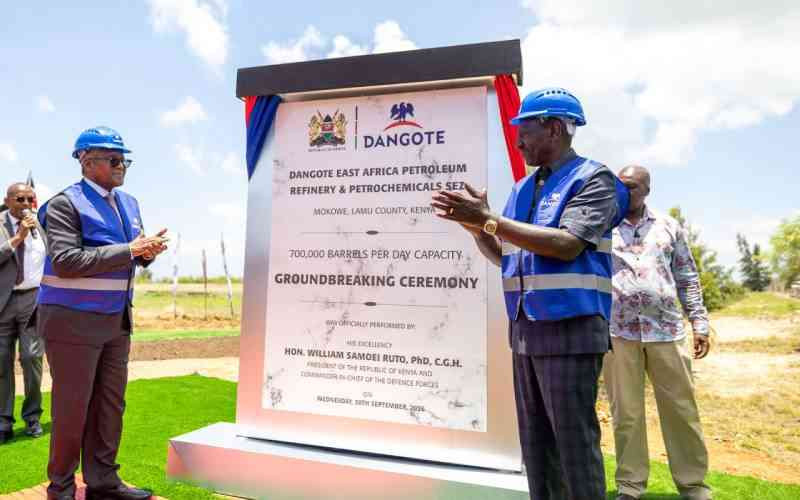
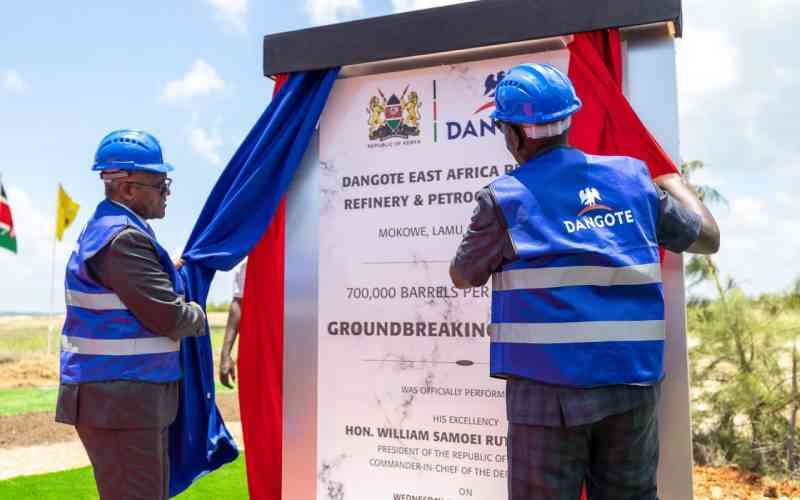
It is difficult to reconcile the two Rutos on the subject of fossil fuels: The Ruto who stands on international platforms and delivers speeches against fossil fuels, making even the devil and his fire-blowers frown, and the Ruto who, only this week, launched the construction of what he brags is one of the largest oil refineries in Africa.
One is tempted to ask: What has changed between 2023 and now? Has Kenya suddenly become green enough to accommodate more fossil fuels in its air? The last time we checked, the President was rallying Kenyans to plant 15 billion trees, partly to clean up our air. What is the logic of planting these trees only to put up a refinery that could pollute the air and take us back to where we started, or worse?
Several voices have come out against the planned oil refinery. But one voice that is conspicuously missing is that of environmentalists. One would have expected more robust conversations, including more discussions about the project’s environmental impact, and a point-by-point dissection of all the environmental impact reports on the oil refinery project.
Lamu is, after all, a UNESCO World Heritage Site and home to one of the oldest Swahili settlements in the world. Even a molehill on its shores is bound to send ripples across an island that has, for the last 700 years, protected its air from petroleum fumes.
If public participation was indeed conducted before the project was launched, what concerns did environmentalists raise, and have these been addressed?
Could it be that the “small” protests by villagers seeking compensation for a few palm trees and groundnuts that might be trampled by oil investors are a pre-emptive smokescreen for bigger environmental concerns about the project?
It does not help matters that the project is being spearheaded by a firm from a country that does not have a particularly clean record on clean energy, a country where citizens have been hanged in the past for questioning the environmental impact of oil production activities in their neighbourhoods.
In fact, one gets an eerie feeling that the ghost of Ken Saro-Wiwa, the Nigerian writer sentenced to hang in 1995 for campaigning against the environmental destruction associated with Nigeria’s oil industry, must have booked a flight to Lamu as soon as it got wind of a mega oil refinery being put up by one of his countrymen.
Stay informed. Subscribe to our newsletter
And when this particular investor says he is ready to take on anyone opposed to the project, the voiceless protests of Saro-Wiwa’s ghost grow more frantic.
The writer is a media and public communications consultant.
Subscribe to our newsletter and stay updated on the latest developments and special offers!


 Prefer the Standard on Google





 join
join