×

The Standard e-Paper
Smart Minds Choose Us
 The Standard Group Plc is a
multi-media organization with investments in media platforms spanning newspaper
print operations, television, radio broadcasting, digital and online services. The
Standard Group is recognized as a leading multi-media house in Kenya with a key
influence in matters of national and international interest.
The Standard Group Plc is a
multi-media organization with investments in media platforms spanning newspaper
print operations, television, radio broadcasting, digital and online services. The
Standard Group is recognized as a leading multi-media house in Kenya with a key
influence in matters of national and international interest.

Audio By Vocalize
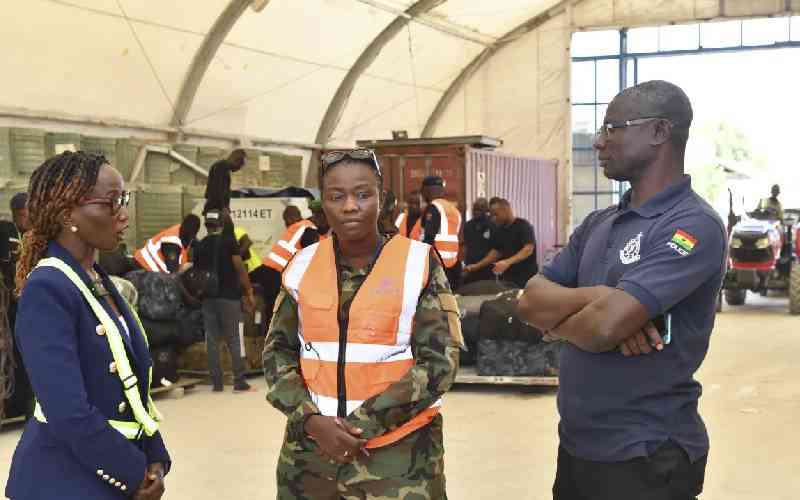
The peacekeeping mission in Somalia led by the African Union got a reprieve this week when the United States agreed to extend its term for a further one year.
The Donald Trump-led administration gave the United Nations a year to wind down logistical support for African Union peacekeepers, thus allowing the mission more time to seek alternatives while leaving its long-term future uncertain.
In what must have been a great relief to the Troop Contributing Countries (TCC), including Kenya, Washington said it was willing to support a 12-month drawdown of the UN Support Office in Somalia (UNSOS), followed immediately by its liquidation.
The new timeline is expected to begin in January, after the current UNSOS mandate expires at the end of December, according to diplomatic and Somali government sources.
Somalia, which has yet to put its house in order since the collapse of the central government in 1991, was already grappling on how to deal with the security situation within its borders.
The International Crisis Group (ICG) noted in its recent report that Somalia’s security forces were incapable of fully assuming all responsibilities carried out by AUSSOM.
The ICG report noted that Somali forces continued to rely on external support to conduct operations in hot spots in the country, including the Lower Shabelle region.
The report further pointed out that political disputes between the Federal Government and federal member states, particularly Jubbaland and Puntland, were hampering efforts to build a unified national military.
The ICG report warned that if UNSOS support came to an end, AUSSOM could struggle to maintain its operations at the current level and areas vacated by the peacekeepers could become vulnerable to attacks or attempts by Al Shabaab to retake territory.
The security think-tank body advised the Somali government and its international partners to urgently develop a new security plan before the UNSOS plan is fully phased out.
The body cautioned that lack of such a plan could create security gaps during the transition phase.
The ICG report, together with intelligence on the ground, may have swayed Washington to grant the mission one more year to put its house in order.
As the countdown to the December 31 deadline ticked, President Hassan Sheikh Mohamud, together with leaders from the TCCs, had met in Kampala in August to rationalise the next move.
Subsequently, the Somali leader had dispatched a diplomatic team to the Arab states to solicit financial support to give his nation support as it transitioned from UN and US support.
Somalia was also engaging some of the troop-contributing countries bilaterally to continue offering their soldiers as alternative sources of funding were sought.
Stay informed. Subscribe to our newsletter
Uganda, for example, was approached to provide about 2500 troops to protect the Aden Abdulle International Airport and the capital from an Al Shabaab assault.
Similarly, Kenya and Ethiopia were approached to keep their soldiers in Somalia and provide security in their respective sectors in Jubbaland and parts of South West state respectively.
The US withdrew its support to the UN mission in Somalia early this year, citing Somalia’s inability to stabilise despite huge amounts of money incurred by the mission.
UNSOS provides critical logistical support to the African Union Support and Stabilisation Mission in Somalia (AUSSOM), including food, water, fuel, medical services and transportation for troops.
The United States had told the African Union in July that it would oppose continued UN support for AUSSOM from the start of next year, amid growing frustration in Washington with Somalia’s government and the international role in its campaign against Al-Shabaab.
A US State Department spokesperson said Washington would no longer fund or support UNSOS, whose budget is about $500 million.
The AUSSOM drawdown processes and timelines are expected to be discussed during UN Security Council deliberations in December.
The additional year gives Somalia, the African Union and other partners more time to seek alternative financing and logistical arrangements for AUSSOM, but does not resolve the mission’s longer-term funding problems.
AUSSOM has faced a substantial funding gap. The United States last year blocked a proposal that would have allowed UN financing to cover about three-quarters of the mission’s annual budget of $190 million.
Many observers see the peacekeeping mission as a key pillar of Somalia’s state and which would rapidly face a serious risk of fragmentation without the force.
The African Union force is supporting Somalia’s security forces in their fight against Al-Shabaab, which retains control of parts of the countryside despite years of military operations.
Somalia has relied heavily on international and regional security assistance since the collapse of the central government in 1991, making the future of AUSSOM closely linked to efforts to strengthen the country’s security institutions.
Meanwhile, efforts to resolve the political dispute in the South West state have moved to Nairobi after a delegation made up of religious scholars, business people, women and youth held a press conference in Nairobi to report progress on their deliberations.
The state’s Council for Peace, Unity and Development is trying to arbitrate a ceasefire between the current leader Sheikh Aden Mohamed Nur Madobe and his predecessor Abdiaziz Hassan Mohamed Laftagareen.
The state, and especially its capital Baidoa, has been in a state of flux since Laftagareen was ousted three months ago and Madobe was elected through universal suffrage in August. Sporadic fighting has broken out in the state, forcing the federal government to deploy the Somali National Army to repulse forces allied to the ousted president.
Laftagareen, who fled to Nairobi following his ouster, has continued to mobilise his supporters while in exile, leading the administration in Baidoa to call for his repatriation to face the full force of law in Somalia.
The state’s Peace Council has prioritised a ceasefire as the first step to open dialogue between Madobe and Laftagareen. Whether this will succeed or not will depend on how the two leaders interpret the message borne by the Peace Council.
Subscribe to our newsletter and stay updated on the latest developments and special offers!


 Prefer the Standard on Google







 join
join