×

The Standard e-Paper
Kenya’s Boldest Voice
 The Standard Group Plc is a
multi-media organization with investments in media platforms spanning newspaper
print operations, television, radio broadcasting, digital and online services. The
Standard Group is recognized as a leading multi-media house in Kenya with a key
influence in matters of national and international interest.
The Standard Group Plc is a
multi-media organization with investments in media platforms spanning newspaper
print operations, television, radio broadcasting, digital and online services. The
Standard Group is recognized as a leading multi-media house in Kenya with a key
influence in matters of national and international interest.

Audio By Vocalize
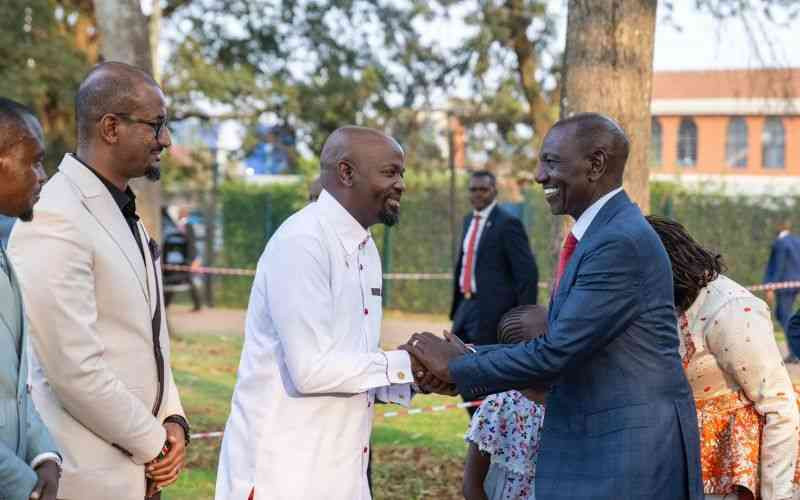
When leaders who hold public power repeatedly identify themselves as followers of Jesus, does the nation have a reasonable basis for expecting their leadership to look different?
The question is not whether Christians are perfect. They are not. Nor is it whether Christianity gives anyone a monopoly on goodness. It does not. The question is whether a public confession of following Christ creates a legitimate expectation of fruit.
If a leader repeatedly says, “I am a follower of Jesus,” is it unreasonable for citizens to ask what that confession means when the leader exercises power? Is it reasonable for a country to expect fruit alongside the confession? Yes. It is reasonable. In fact, it is unavoidable.
If Christ is genuinely shaping the leader, the nation is entitled to look for some evidence of that shaping in the leader’s manner. Truth should matter. Justice should matter. Integrity should matter. Human dignity should matter. Compassion should matter. Accountability should matter. These are not decorations around Christian leadership. They are part of its expected fruit.
The question, therefore, is not whether Christian leaders should be different for the sake of being different. It is whether following Jesus should make a difference in how they lead.
That difference should become visible in character. A Christian businessperson who refuses a bribe is a dividend. A public servant who treats office as stewardship rather than personal property is a dividend. A young person who chooses integrity when dishonesty would be profitable is a dividend. A politician who can disagree without contempt is a dividend. So is the parent who raises children with truth and responsibility, and the citizen who refuses to participate in the manufacture and circulation of lies. These may not appear in annual church reports, but they are precisely the kind of dividends a nation needs.
Authentic Christianity is not an accessory that can be put on and off. It is more like a chemical reaction: when the elements genuinely meet, something changes. The Christian confession and the Christian life cannot permanently be separated without raising questions about the authenticity of the confession. The nation is entitled to look for congruence.
Yet this congruence is conspicuously lacking. Many who publicly identify as people of faith appear less like converts of Christ and more like associates of Christ. Their political postures reveal only a shadowy connection to faith manners. An associate measures the name of Jesus in votes. Like a convertible car, their roof goes up and down with the weather.
The rhetoric of Jesus’ associates in present day Kenya is strikingly uncouth. Their words are often inflammatory—the kind that elicited from Jesus the words, “Get behind me, Satan.” One is left wondering: have they forgotten that they are Jesus-lovers, or were they Jesus-lovers at all in the first place? To invoke Christ while using language that dehumanises others is to create a painful contradiction between confession and conduct. Christian faith should not only change what we believe; it should change how we speak, how we confront, and even how we treat those with whom we profoundly differ.
The associates want the dividends of faith, but they do not want to give the dividends of faith to those they lead. They want the credibility, blessing and moral capital associated with identification with Christ. Yet when power comes into their hands, those they lead are denied the very fruits that faith should produce: justice, honesty, dignity, compassion, accountability and responsible stewardship. They forget that power does not suspend Christian obligations. If anything, power enlarges them.
Faith is not merely an investment from which the leader expects personal returns. It is an investment that should generate returns for others. The Christian leader cannot keep asking, “What will my faith do for me?” while neglecting the more demanding question, “What should my faith do through me for those entrusted to my leadership?”
When power arrives and responsibility disappears, the problem is not that faith has failed to produce dividends. It is that the person entrusted with power has failed to distribute them. Christian leadership must therefore be examined not only by what the leader receives from faith, but by what those under the leader's care receive because of that faith.
It should disturb to see Jesus assessed in vote-value units. What do Christian principles cost me in votes? What happens when standing for what is right makes me unpopular? The temptation becomes to lose a little faith in order to gain a few more votes. But Jesus sometimes asks the opposite: lose the votes and keep the faith.
People who do not profess faith in God often demonstrate remarkable courage, honesty, compassion and commitment to the common good. If people who do not profess faith in God can draw moral conduct from their humanity, how much more should those who profess faith in God be able to draw from the divine help they claim to have received? The greater the help we claim, the greater the responsibility to demonstrate its fruit.
The biblical story repeatedly shows us something important: when the disciples fail, the Master at some point steps in. When the storm becomes bigger than the disciples' faith, Jesus rises and speaks to the storm. When human beings fail to preserve the integrity of the Good News, God remains committed to His name. Scripture gives us the language of divine intervention: “For my name's sake.” The point is that the purposes of God are not hostage to the failures of His servants.
Stay informed. Subscribe to our newsletter
Mark's storm narrative is especially instructive. The disciples are terrified. Jesus gets up and speaks to the storm: “Peace! Be still.” “Hush!” Then, having addressed the storm, He turns to the disciples and asks, “Have you still no faith?” There is a sequence here worth noticing. Sometimes the Master has to hush the storm before He can deal with the disciples.
This political season requires the church leaders to put on the robes of their “Hush” agency. This is a call to recover the moral authority of the pulpit. Pastors should be able to ask the uncomfortable questions: Where is the truth? Where is justice? Where is dignity? Where is restraint? Where is accountability? Where is compassion? Where are the manners of the faith?
The fig tree was cursed despite its green leaves—it was attractive but fruitless, deceptively lush and succulent. Fruitlessness is not a trivial matter in the economy of God. The pastor must not be so carried away by the launching of roads that he fails to see the tears of the woman whose innocent son was shot dead in the crossfire of a political rally. The pastor must not be so dazzled by the ribbon-cutting that he loses sight of the blood behind the ribbon. The pulpit exists especially to “hush” injustices.
Pastoral authority must check its appetite for political proximity. Prophetic responsibility is heavy, and Kenya’s political influencers will do all they can to tamper with its scales and make it a lightweight. They fear “Thus says the Lord!” and would rather hear “Thus says the party leader!” But the pulpit loses its weight when it begins to measure truth by political proximity. The pastor must remain close enough to power to speak truth to it, but never so close that proximity silences the truth. Such is a dividend the Church pays to the nation.
The question, then, is not whether Christians should participate in politics. They should. Nor is the question whether Christians should hold public office. They can and do. The deeper question is what happens to the manner of politics when people who confess Christ enter it. Does their presence deepen truth? Does it strengthen accountability? Does it elevate dignity? Does it restrain cruelty? Does it make stewardship visible? Does it remind those who exercise power that power is entrusted and ultimately accountable to God?
Christian leadership should leave behind moral residue—character that outlives the leader, integrity that survives the speech, justice that endures beyond the election, and young people, families and institutions made more responsible, whole and trustworthy. We should count the honest transactions, the reconciled families, the young people who chose responsibility, the bribes refused, the vulnerable protected, the public servants who resisted corruption, and the Christians who carried the manners of Christ into the public square. The Church's great public dividend is a people whose faith can withstand power without being corrupted by it.
This is why the pastor must sometimes stand between the storm and the disciples and say, “Hush.” Hush the hatred, the lies, the arrogance and the greed. Then sound the question to the disciples in the public square: “Where is your faith?” If the pursuit of political power requires the abandonment of truth, dignity, justice, compassion and integrity, then the Gospel must not become collateral damage in the pursuit of the vote.
This is the Hush season for pastors— a season to call leaders and God's people back to the manners of the faith. Spectating and withholding prophetic responsibility is sin. Confronting political sins is faithfulness. The money offered to the pastor is to hire her to the lead role in the political chorus. But to lead the praise choir of the king means you cannot join in the lament of father who lost an only son to an evil bullet. You must choose your song.
A faith that cannot govern our manners will struggle to transform our nation. Christian leadership must eventually pay dividends. But those dividends are not merely what faith gives the leader. They are what faithful leadership gives to those entrusted to its care. And when the disciples forget their manners, the Master must still be heard.
Subscribe to our newsletter and stay updated on the latest developments and special offers!

 Prefer the Standard on Google








 join
join