×

The Standard e-Paper
Fearless, Trusted News
 The Standard Group Plc is a
multi-media organization with investments in media platforms spanning newspaper
print operations, television, radio broadcasting, digital and online services. The
Standard Group is recognized as a leading multi-media house in Kenya with a key
influence in matters of national and international interest.
The Standard Group Plc is a
multi-media organization with investments in media platforms spanning newspaper
print operations, television, radio broadcasting, digital and online services. The
Standard Group is recognized as a leading multi-media house in Kenya with a key
influence in matters of national and international interest.

Audio By Vocalize
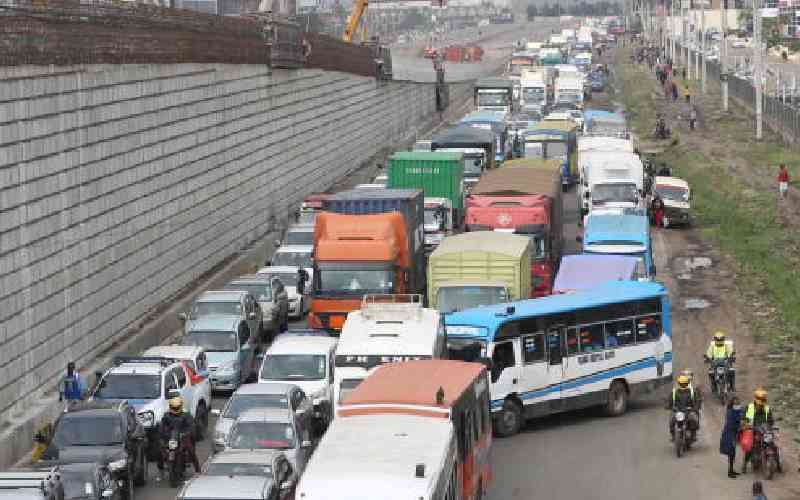
Motorists stuck in a traffic jam along Mombasa Road. [Elvis Ogina, Standard]
At a time when prime time news reads and sounds like a new episode from the Afro-cinema, the simmering tension between Kenya’s public service vehicles, commonly known as matatu, and motorcycle taxis, commonly known as boda boda, has been temporarily forgotten.
But the fact that both sides seem to have called a temporary truce (one largely brokered by political expediency) only postpones an opportunity for Kenya’s transport sector to hold a rather uncomfortable conversation-who between the matatu and the boda boda is king of the road? The uncomfortable truth is that the matatu is living on borrowed time in Kenya’s public transport history.
History repeats itself and anyone who fails history’s lessons stands a slim chance of winning the future. And history teaches us that matatu owners calling out boda boda’s lawlessness is a classic case of the kettle calling the pot black.
To understand this, one only needs to sit down with an old man or woman who used public transport in Nairobi in the '60s. Then you shall hear dramatic stories about the standoff between buses and the ‘matatu’- a name coined from the three, ten-cent coins that the vehicles charged for all stages in Nairobi.
From these old men and women’s tales, we learn that there was sanity in the public transport sector back then; that drivers of public service buses that dominated the city streets did not travel at the speed of light but stuck to the speed limit clearly indicated at the back.
They did not pick and drop passengers at any place called ‘Shukisha hapo’ (drop me here) but only at designated bus stops. There was sanity until the matatu came into being. Like the boda boda they are now accusing of lawlessness, the first matatu in Nairobi were a law unto themselves, and for a very good reason-that no law had been envisioned for public transport vehicles of their size.
Soon, the ‘small vehicles’ scurrying around town randomly picking and dropping passengers, became an irritating nuisance, not just for the neo-colonial city fathers used to order, but for the drivers of the big buses who would arrive at designated bus stops on schedule only to find them empty—a matatu had appeared from nowhere, picked up the few waiting passengers and scurried away.
Soon, the matter found its way to the State House, where the matatu owners sought the support of President Jomo Kenyatta, arguing that the battle between them and bus owners was a battle between Africans trying their hand in the public transport business and colonial relics hellbent on keeping Africans out of the lucrative sector.
The old man agreed, threw the public sector transport rule book at his minister’s face, and ordered that the ‘small vehicles’ be allowed to operate in the public transport sector alongside the buses. Almost overnight, matatu had pulled a coup over the bus. The rest, as they say, is history.
The matatu had its way for a long time, until the boda boda, and incidentally, Jomo’s son, Uhuru Kenyatta, happened. In 2009, in his heydays as Kenya’s Finance minister, Uhuru slashed taxes for low-engine capacity motorcycles, effectively making them more affordable for many.
Today, it is a defensible argument that there could be more boda boda in Nairobi than matatu. Some will argue that there could be more boda boda in some parts of town than there are residents.
President William Ruto occasionally dips into this large reservoir of 'political capital', as he did in August 2025, ordering the release of thousands of boda boda detained by the police for scurrying on the streets like cockroaches.
Suddenly outnumbered and outsmarted, the matatu now finds itself facing the demons it conjured in the public transport sector in the '60s and '70s - impunity and raw, State-sanctioned power.
What to do now for the beleaguered matatu sector? The wisest thing would be to either shape up or ship out because, as things stand right now, the days of the matatu on Kenya’s roads are numbered. The next investor in the public transport sector should focus on other modes of transport, such as electric trains, drones, self-driving cars, and public service helicopters.
Stay informed. Subscribe to our newsletter
Mr Muchiri is a journalist

Subscribe to our newsletter and stay updated on the latest developments and special offers!








 join
join