×

The Standard e-Paper
Join Thousands Daily
 The Standard Group Plc is a
multi-media organization with investments in media platforms spanning newspaper
print operations, television, radio broadcasting, digital and online services. The
Standard Group is recognized as a leading multi-media house in Kenya with a key
influence in matters of national and international interest.
The Standard Group Plc is a
multi-media organization with investments in media platforms spanning newspaper
print operations, television, radio broadcasting, digital and online services. The
Standard Group is recognized as a leading multi-media house in Kenya with a key
influence in matters of national and international interest.

Audio By Vocalize

A police officer kicks a tear gas canister during protests against the Finance Bill 2024 in Nairobi on June 25, 2024. [AFP]
The promise of millions of shillings for victims of police brutality and violence related to violence has offered a rare moment of hope after years of pursuit for justice.
The draft reparations guidelines released by the Kenya National Commission on Human Rights (KNCHR) signal one of the most structured attempts by the state to acknowledge victims of human rights violations.
The framework proposes compensation running into millions for those killed, injured, sexually violated or forcibly disappeared, alongside psychosocial support and other non-monetary remedies.
The framework proposes compensation running into millions for those killed, injured, sexually violated or forcibly disappeared, alongside psychosocial support and other non-monetary remedies.
The guidelines were released on Monday last week and the commission gave a 7-day window for the public to send in their submissions before they are adopted.
The move by the state gives hope to survivors and families of victims of state violence, who for years have fought for recognition and compensation, most of whom opted to seek justice through the slow and expensive court process without success.
Compensation has largely depended on individual court rulings, leaving many victims out, especially those unable to access legal support or produce the kind of evidence courts demand.
However, even before the first payments are made, there are questions emerging whether the Kenyan government will deliver meaningful reparations or it will end up being another case of symbolic justice.
The push for reparations has been building over decades, driven by victims, families and human rights organisations.
For years, the pursuit for justice by survivors of torture in past regimes and victims of police brutality has been met with violence, denials and frustrations.
However, the Gen Z protest of 204-2025 changed the tune because it was a result of the protests that President William Ruto announced plans to compensate victims.
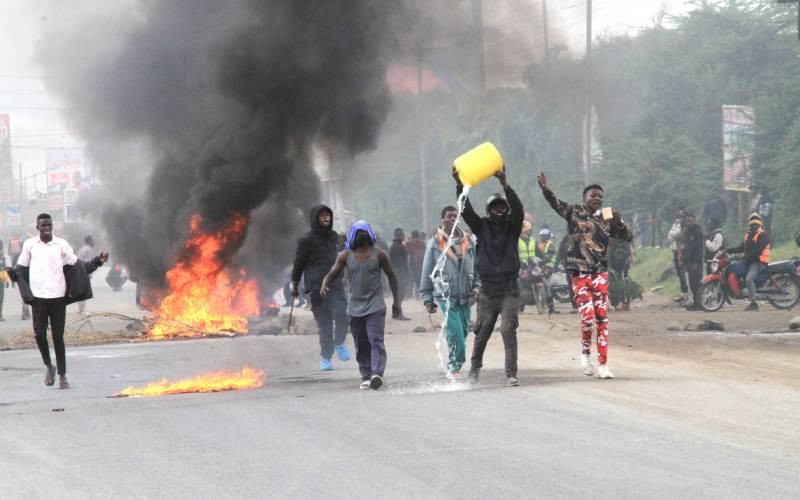
The demonstrations, largely led by young people, pushed for attention to police conduct and state accountability during protests. The protests were marked by deaths, injuries and enforced disappearances.
The compensation conversation was also pushed by the former ODM leader, the ate Raila Odinga, in their MoU with the UDA, where Ruto was compelled to compensate all the victims of the protests.
Stay informed. Subscribe to our newsletter
Consequently, the KNCHR was tasked with the duty to formulate a reparations framework.
Human rights players are now raising concerns over funding gaps, political interference and continued abuses.
Kamau Ngugi, Executive Director of the Defenders Coalition, said while the reparations framework is grounded in law, its success will depend entirely on political will and resources.
He noted that under the Constitution, every violation must be followed by justice, which can take different forms, including accountability and reparations.
“The fact that the Constitution of Kenya has a whole chapter on the Bill of Rights, it basically commits the states to deliver on its promises, particularly when it comes to human rights,” Ngugi said, cautioning that reparations must be understood as part of a broader justice process.
“And it means that violations are taken very seriously, and every violation must be accompanied by justice. And justice could be accountability, so that the people who are responsible are held to account, or it can also include reparations, and all of them are allowed in the Constitution,” he added.
He welcomed the move to develop guidelines, saying they could bring clarity to how victims are compensated, but just like other rights defenders, he raised concerns that the current framework risks placing too much emphasis on financial compensation without equal weight on accountability.
“Of course, ideally, we should never have in the first place. But when it has occurred… the proposed framework should be able to support in guiding how much or who can qualify for any support and what is the equivalent.”
However, he pointed out that the continued violations and use of goons by political actors to terrorise Kenyans signals a lack of sincerity in the reparation process
“The bad part is that even when this process is going on, it is supposed to be a demonstration of commitment to non-repetition, a genuine commitment to offer reparations and accountability as a show that we are not planning to do that again,” he said.
“But in our case, killings and serious human rights violations are still being committed by law enforcement agencies. Even where they are being committed by state actors and state actors, the state has refused to provide necessary redress,” Ngugi said.
He regretted that the culture of ‘goonism’ in Kenya’s political arena, mostly used to infiltrate or terrorise peaceful protests, creates fears of repeated violations and undermines the spirit of reparations.
A section of politicians in the opposition claimed that some of those goons have the endorsement of the political actors, some of whom are in government, with claims that some of them are security agencies without uniforms.
“It means there is a fear that these are just pronouncements that are not backed by political views,” Ngugi said.
“We don't see a pattern of change in how public protests are managed and how human rights-based approaches are applied by law enforcement agencies who continue to commit serious violations against the people,” he added.
So far, there has been no clear allocation for reparations, raising doubts about whether the process can be implemented at all.
Previously, opposition principal and former deputy president Rigathi Gachagua announced that the Sh2 billion previously set aside for compensation was just a ploy to hoodwink Kenyans and victims.
In the last signed supplementary budget, the Commission did not get any allocation to facilitate the process.
Hussein Khalid, a human rights activist and the executive director of Vocal Africa, said failure by the government to acknowledge the violations and commit to taking responsibility raises doubts about honesty.
“If that does not come out, is there any honesty when it comes to implementing or ratifying all these recommendations that are on the table? Many families just want the apology, not even the money; to acknowledge that a wrong was done against them,” Khalid noted.
He stated that most families may never recover from the aftermath of the violations meted out against their relatives, some of whom were breadwinners.
He also raised concerns about the source of funds for the process. The government had previously announced that there was a Sh2 billion allocation for compensation.
“We even ask ourselves, where is this money coming from? It's like there was money lying around doing nothing, and now the President just decided to use it to pay the victims. KNCHR has to ask those questions. Is it a budget vote? Was there a supplementary budget somewhere? Sh2 billion is no little money,” Khalid posed.
Ngugi noted that reparations are not just about initial payouts and that they require sustained investment in healthcare, counselling and administrative systems to support victims over time.
The absence of a clear financial commitment has therefore become a key measure of the State’s seriousness, with sector players warning that without financial backing, the process risks stalling before it begins.
“There has been a pronouncement of a commitment to reparation for victims of what they call demonstrations and other forms of violations that have been committed by state actors, but it has not been accompanied by the equivalent budgetary allocation. Where will they get the resources from?” Ngugi posed.
Ngugi also raised concerns over what he described as parallel processes that could undermine the credibility of the exercise, making reference to the appointment of the Panel of Experts on Compensation of Victims of Demonstrations and Public Protests by resident Ruto.
The team had been tasked to establish a compensation framework, but the High Court in Kirinyaga ruled that KNCHR is the only constitutionally mandated body to deal with compensation.
“But we also find that at the same level, the executive is hell-bent to have itself appointed a committee, which is a presidential committee that wants to deal with the compensation.”
“That already brings tensions in which you're focusing on political appointees to deal with very, very serious issues that should ideally be either dealt with by the commission or the court of law,” Ngugi argued, adding that such developments cause fear among the citizens about the genuineness of the process.
Internationally, reparations are not treated as acts of goodwill and the United Nations Human Rights Council sets out clear principles that reparations must be adequate, effective and prompt, and must go beyond financial compensation.
That includes rehabilitation for victims, public acknowledgement of wrongdoing, and guarantees that such violations will not happen again.
UNHRC Guidelines indicate that, “Reparation should be proportional to the gravity of the violations and the harm suffered.”
“Restitution should, whenever possible, restore the victim to the original situation before the gross violations of international human rights law or serious violations of international humanitarian law occurred.”
What the UN’s body on human rights considers as appropriate restitution includes restoration of liberty, enjoyment of human rights, identity, family life and citizenship, return to one’s place of residence, restoration of employment and return of property, among others.
While the KNCHR framework incorporates some of these elements, critics argue that it risks becoming too focused on payouts, without equally strong emphasis on accountability and institutional reform.
The proposed compensation figures have also sparked debate on how different violations attract different levels of compensation.
However, KNCHR’s chairperson Claris Ogangah clarified that the proposed amounts are guided by previous court judgments and rulings on human rights violations.
However, the sector players called for a realistic and inclusive framework that will ensure all categories of victims are fully included.
“Some young people had a whole life ahead of them, and some professionals whose lives were cut short. Others cannot be able to carry out some of the activities because they were maimed,” Ngugi argued.
“A realistic framework will ensure that everybody feels that it's a form of justice, redress and people don't feel shortchanged,” he added.

Subscribe to our newsletter and stay updated on the latest developments and special offers!







 join
join