×

The Standard e-Paper
Smart Minds Choose Us
 The Standard Group Plc is a
multi-media organization with investments in media platforms spanning newspaper
print operations, television, radio broadcasting, digital and online services. The
Standard Group is recognized as a leading multi-media house in Kenya with a key
influence in matters of national and international interest.
The Standard Group Plc is a
multi-media organization with investments in media platforms spanning newspaper
print operations, television, radio broadcasting, digital and online services. The
Standard Group is recognized as a leading multi-media house in Kenya with a key
influence in matters of national and international interest.

Audio By Vocalize
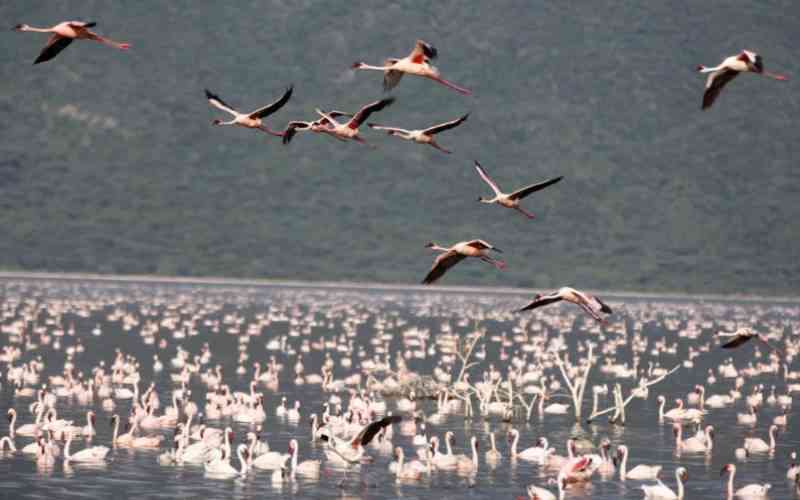
Flamingos at Lake Bogoria in Baringo, June 18, 2019. [File, Standard]
The unique features that led to the inscription of Kenya’s Rift Valley lakes into the World Heritage sites are under threat.
Experts have warned that the Kenya Lake System, which comprises Lakes Elementaita, Nakuru and Bogoria, is facing increasing threats as a result of climate change, pollution, encroachment and destruction of catchment areas.
The three lakes lie within the African-Eurasian flyway, which is used by millions of birds that migrate between their wintering and breeding grounds every year. The experts sounded the alarm during World Migratory Bird Day at Lake Bogoria.
“These lakes combined have very unique features. However, they face a lot of pressure. There continues to be uncertainty over the extent to which urbanisation, climate change, deforestation and invasive species are affecting these unique ecosystems,” Paul Gacheru, species and Sites manager at Nature Kenya, said.
The three lakes are alkaline and host hundreds of species of birds. They have been famous for the large congregations of flamingos, which are currently decreasing in numbers.
Currently, the Kenya Lake System has been classified as of ‘significant concern’ in the latest assessment cycle. According to Gacheru, the classification means that urgent conservation measures are needed to reverse the trends.
“When a site is listed as of Significant Concern, it means that the outstanding values that made it be inscribed are being threatened. It means that if nothing is done, those values will be eroded, and something needs to be done to urgently address those concerns,” he said.
The latest assessment indicates that Lake Nakuru is impacted by poorly managed waste and stormwater discharges from a rapidly growing Nakuru City. Lake Elementaita, on the other hand, has been compromised by the encroachment of hotel and tourism facilities. Both Lake Nakuru and Elementaita are also threatened by electricity power lines that threaten the inter-lake migration flyway used by birds.
Lake Bogoria is impacted by invasive Mathenge.
All three soda lakes have continued to experience increasing water levels. This means that the natural salty water is being diluted, altering the lake water chemistry, resulting in a decline of a bacteria which is the food source for the lesser flamingos.
In Lakes Nakuru and Bogoria, siltation also remains a key threat. This is because of soil erosion and deforestation from the catchment areas.
“These lakes are like basins, and when the catchment area is degraded, the soil is swept into the lakes, displacing the water. The basins become shallower, but floods are experienced in the surrounding areas because of the spill,” Gacheru noted.
Besides the warning from environmental experts, the National Wildlife Census 2025 Technical Report also revealed a worrying collapse in waterbird populations across Kenya’s critical wetland systems, especially those in the Rift Valley.
Stay informed. Subscribe to our newsletter
The census, which monitored trends in waterbird abundance and species richness from 2023 to 2025, signalled a severe decline in the health of several globally significant sites.
Lake Elementaita, a designated Ramsar site, presented the most dramatic findings, as documented in the report. The lake, which recorded the highest count in 2023 with 208,712 individuals, saw that population collapse to a mere 5,360 birds by 2025. The catastrophic decline, the report reveals, is driven by the near-total disappearance of intra-African migrant birds, a category dominated by the Lesser Flamingo, which plummeted from over 202,000 individuals to just 1,476 over the three years.
“The 2023 to 2025 assessment reveals both sharp declines in overall numbers and fluctuating patterns of species richness. In terms of abundance, Lake Elementaita recorded the highest count in 2023 with 208,712 individuals, but this number collapsed to 7,411 in 2024 and further to 5,360 in 2025, suggesting severe ecological disruption,” part of the Census report reads.
Other iconic and globally recognised lakes within the Rift Valley also exhibited distress. Lake Nakuru experienced a steady decline from 22,533 water birds in 2023 to 15,543 in 2025. Similarly, Lake Naivasha's waterbird population was nearly halved, falling from 15,985 to 7,497. Lake Bogoria displayed fluctuations, peaking in 2024 at 54,711 before sharply dropping to 21,903 individuals in 2025.
Despite the drastic reduction in bird abundance, some lakes have been recording an increase in species richness. Lake Elementaita recorded 63 species in 2023, 57 in 2024, and an impressive 88 in 2025, indicating the persistence of habitat diversity.

Subscribe to our newsletter and stay updated on the latest developments and special offers!










 join
join