×

The Standard e-Paper
Smart Minds Choose Us
 The Standard Group Plc is a
multi-media organization with investments in media platforms spanning newspaper
print operations, television, radio broadcasting, digital and online services. The
Standard Group is recognized as a leading multi-media house in Kenya with a key
influence in matters of national and international interest.
The Standard Group Plc is a
multi-media organization with investments in media platforms spanning newspaper
print operations, television, radio broadcasting, digital and online services. The
Standard Group is recognized as a leading multi-media house in Kenya with a key
influence in matters of national and international interest.

Audio By Vocalize
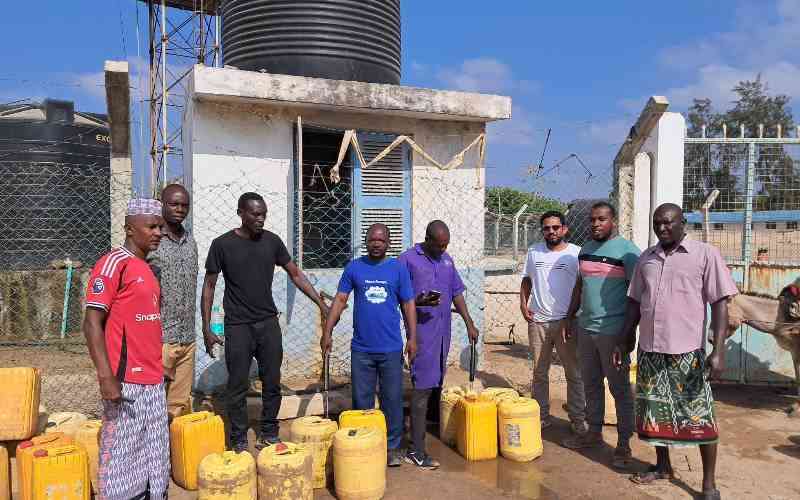
Men's day, fetching water respecting the culture not to mix with women. [Juliet Omelo, Standard]
For years, the search for water defined daily life in Kiunga, a remote settlement along Kenya’s northern coastline in Lamu County.
Women and children often walked several kilometres under harsh conditions in search of safe drinking water, turning what should be a basic necessity into a daily struggle for survival.
Today, that reality is beginning to change following the establishment of the Kiunga Solar Desalination Plant, a project that is transforming livelihoods and restoring hope in the community.
Located near the Somali border, Kiunga has long faced chronic water shortages driven by prolonged drought and naturally saline underground water.
For many families, accessing clean water meant travelling long distances through insecure and isolated areas.
“Before the desalination plant was established, getting water was one of the hardest tasks in our daily life,” said Amina Mohamed, a refugee living in Kiunga.
“As a refugee woman, I had to walk long distances looking for water, sometimes several times a day. It was exhausting and unsafe, especially for women. Today, we can access clean water closer to our homes. It has restored dignity for many families and made life easier for women like me,” she added.
The introduction of the Kiunga Solar Desalination Plant has marked a turning point for the community. Unlike conventional desalination systems that rely on seawater, the facility treats saline groundwater extracted from local wells, using solar energy to convert it into safe drinking water.
For residents like Abuu Bwana, a person living with disability, the project has restored independence that was once out of reach.
“Living with a disability made it extremely difficult for me to travel long distances to fetch water. In the past, I depended heavily on others to help me. With the desalination plant in Kiunga, water is now accessible within the community. This project has given people like me independence and improved our quality of life,” he said.
The impact is also being felt in schools, where water scarcity once disrupted learning for many children.
“As a student displaced from Boni Forest, I used to walk many kilometres looking for water before going to school,” said Abdul Hassan, a Class 7 pupil.
“Sometimes I would arrive late or miss classes altogether. Now water is available nearby, and I can focus on my studies without worrying about where to find water,” he noted.
Beyond improving access to clean water, the project has also strengthened social cohesion in this fragile border region, which hosts diverse groups including local residents, refugees, cross-border communities and internally displaced persons.
Stay informed. Subscribe to our newsletter
“When the county government brought us together to discuss how water should be shared, it was an important moment for our community.
People from different groups sat together and agreed on a fair rationing system. Today, everyone understands when and how to access water. This agreement has reduced tension and helped bring peace among communities,” said community elder Atik Mohamed.
A Kenya Defence Forces officer stationed in Kiunga noted that improved access to water has also enhanced security and cooperation in the area.
“Access to water used to be a major source of tension in this region, especially in a fragile border environment where communities, refugees and security agencies all depend on the same limited resources,” the officer said.
“Since the establishment of the desalination plant and the agreed water rationing system, we have seen a significant improvement in trust between the community and security officers. When people share a resource in an organized and fair way, it strengthens cooperation and information sharing and helps improve stability in the area,” he added.
The Kiunga desalination initiative combines renewable energy with inclusive governance, demonstrating how essential services can contribute to peacebuilding in fragile environments.
The peace integration component was led by Shee Kupi Shee, Director of Disaster Management and Peace Building, under the guidance of Chief Officer Khadija Fumo and with strategic support from Chief of Staff Abdulnasir Mohamed in the Governor’s Office.
The project has also gained international recognition, winning the Best Community Impact Project Award at the Water Transversality Global Awards organised by the India Water Foundation in New Delhi.
The award was received on behalf of Lamu County by Mary Mutuku, Deputy Head of Mission at the Kenya Embassy in India.
For the people of Kiunga, however, the most meaningful impact is felt in everyday life.
What was once an unusable underground resource has become a reliable source of clean water,improving health, supporting education, restoring dignity and strengthening peace in one of Kenya’s most vulnerable coastal communities.

Subscribe to our newsletter and stay updated on the latest developments and special offers!










 join
join