×

The Standard e-Paper
Kenya’s Boldest Voice
 The Standard Group Plc is a
multi-media organization with investments in media platforms spanning newspaper
print operations, television, radio broadcasting, digital and online services. The
Standard Group is recognized as a leading multi-media house in Kenya with a key
influence in matters of national and international interest.
The Standard Group Plc is a
multi-media organization with investments in media platforms spanning newspaper
print operations, television, radio broadcasting, digital and online services. The
Standard Group is recognized as a leading multi-media house in Kenya with a key
influence in matters of national and international interest.

Audio By Vocalize
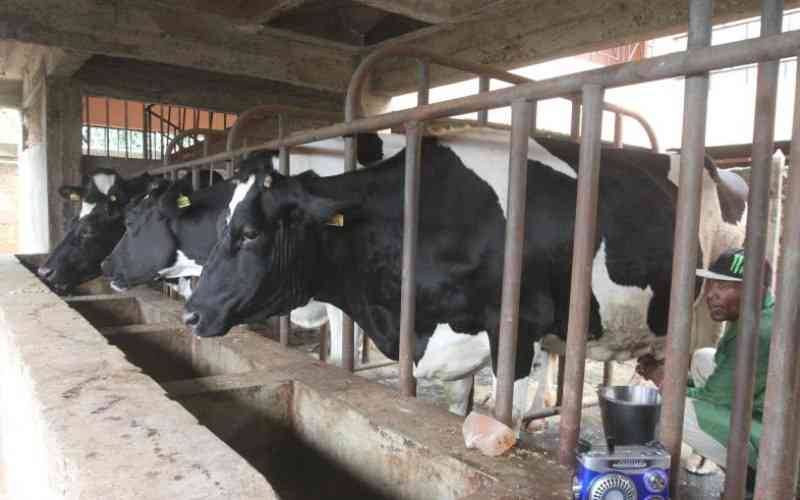
Dairy cows feeding. [File, Standard]
Kenya’s milk shortage is putting renewed focus on livestock feed, with inadequate rainfall reducing pasture and fodder availability in some dairy-producing areas and cutting the amount of milk delivered to processors.
Agriculture and Livestock Development Cabinet Secretary Mutahi Kagwe told the Senate during a committee sitting that inadequate rainfall had affected pasture and animal feed, resulting in lower milk production.
Formal milk deliveries to processors fell from 84.4 million litres in June to 81.3 million litres in July a 3.7 per cent decline, with preliminary indications showing supply constraints continued into August.
The shortage has also been felt by consumers, with some retailers rationing fresh milk sale as processors struggle to secure adequate raw milk.
But for dairy farmers, the problem begins long before milk reaches the supermarket shelf — in the feeding trough.
When rains fail, pasture dries up, fodder becomes scarce and the cost of maintaining productive animals rises.
Reduced access to quality feed can lower milk yields, leaving farmers facing both declining production and higher costs.
Alex Gathii, founder and managing director of Tanolope Consultancy Ltd and Tanolope Dairy Academy, says the current shortage exposes a wider weakness in Kenya’s dairy sector — poor fodder planning and inadequate conservation.
“We have fodder shortage, we have poor fodder, we have poor fodder planning. We don't do fodder plants, we don't do feed plants as farmers in Kenya. When it rains, there is a lot of fodder and that leads to a lot of milk, then when it is dry there is a lack in the market,” Gathii said.
He said farmers should conserve feed when it is abundant through practices such as maize silage and hay baling instead of allowing seasonal changes to dictate milk production.
“Fodder conservation, fodder security in this country, feed security in this country is worsening. That's a major gap in the market and in the industry,” he said.
Gathii said maize presents a particular challenge because it is used for both human consumption and livestock feed.
“Right now, maize is a competing feed for humans and for livestock. You may find that a few farmers are converting their maize to maize silage, others are now selling their maize to the government for storage and also offloading it to the market,” he said.
He also called for greater local production of feed ingredients such as sunflower and cotton to provide raw materials for animal-feed manufacturers and reduce pressure from costly inputs.
Stay informed. Subscribe to our newsletter
But producing more fodder is only part of the solution. Gathii said farmers must also pay attention to the nutritional quality and balance of what they feed their animals.
“Protein to produce milk is important, but if you provide a lot of protein with no corresponding energy, or give a cow more energy with no corresponding protein, you don't get enough milk or profitable milk,” he said.
He said farmers should harvest fodder at the correct stage because overgrown material can have lower nutritional value.
Gathii categorised livestock feeds broadly into fillers, grasses and legumes, and basal feeds. Rice straw, wheat straw and overgrown fodder, he said, provide bulk but have limited nutritional value, while legumes such as lucerne and desmodium, together with grasses such as Kikuyu and star grass, can form important components of livestock diets.
For basal feed, he cited quality maize silage, fodder sorghum and improved Napier varieties.
“If you're growing maize in one acre, you should get between 15 and 20 tonnes of high-quality maize silage, and make sure that you produce that silage at the lowest cost possible,” Gathii said.
MooFodder Supermarket chief executive officer Githaiga Ngarry Kihara is promoting Trichanthera gigantea, a leafy fodder plant originally from Colombia, as one possible option for farmers facing prolonged dry spells.
Speaking during the Central Kenya National Show in Nyeri County, Kihara said the crop can provide an alternative source of protein as it is drought resistant and can survive long periods with limited water.
“The proteins which we have already done analysis at KALRO Laboratories in Moguga, as well as laboratories in Limuru, we are able to achieve up to 23.7 per cent food proteins,” Kihara said.
He said the reported protein content could help farmers supplement other feeds and potentially reduce production costs.
The plant is mainly propagated through stem cuttings rather than seeds, according to Kihara.
“Trichantera is very easy to propagate because you don’t need seeds. You take a stem cutting with a node, plant it directly in moist soil under shade or a shade net, and it will develop roots. The seeds have dormancy and sometimes do not germinate, so we prefer using the stems,” Kihara said.
A farmer can take a stem cutting containing a node and plant it in moist soil under shade or a shade net. Kihara said the young plant develops roots before being transferred to the field.
He recommends a planting hole measuring about two feet by two feet by two feet, with topsoil mixed with one or two buckets of manure.
The first harvest, he said, comes after about eight months. Subsequent mature branches can be harvested approximately every two months, providing a recurring supply of fresh fodder.
The leaves can be fed directly to livestock either by cutting the branches or removing the leaves individually.







Subscribe to our newsletter and stay updated on the latest developments and special offers!








 join
join