×

The Standard e-Paper
Fearless, Trusted News
 The Standard Group Plc is a
multi-media organization with investments in media platforms spanning newspaper
print operations, television, radio broadcasting, digital and online services. The
Standard Group is recognized as a leading multi-media house in Kenya with a key
influence in matters of national and international interest.
The Standard Group Plc is a
multi-media organization with investments in media platforms spanning newspaper
print operations, television, radio broadcasting, digital and online services. The
Standard Group is recognized as a leading multi-media house in Kenya with a key
influence in matters of national and international interest.

Audio By Vocalize
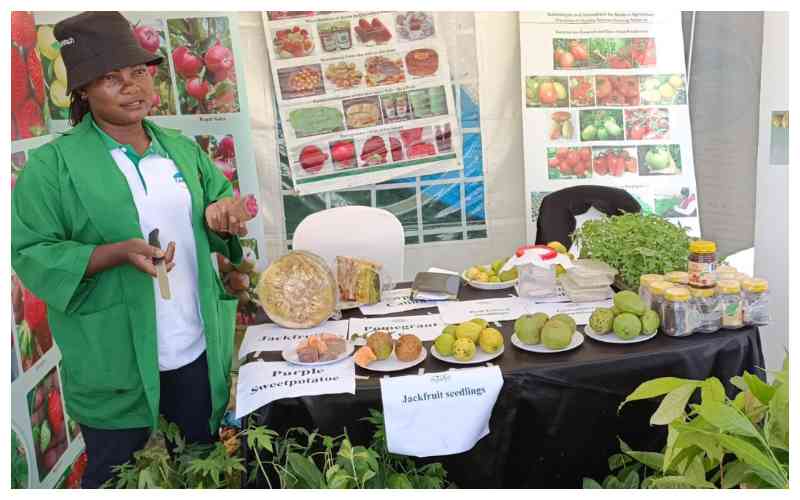
It was a bustling day for Esther Muyoka and her team from the Kenya Agricultural and Livestock Research Organisation (Kalro), Muguga, as curious visitors flocked to their exhibition stand to explore a colourful display of underutilised fruits such as guavas, jackfruits and gooseberries.
Throughout the event, the Kalro team shared insights on the value of integrating these often-overlooked crops into farming systems. They highlighted how underutilised fruits have the potential to boost food and nutrition security, diversify farm production while open up new income-generating opportunities for farmers.
The stand attracted strong interest from visitors eager to start their own farms. Muyoka sold numerous planting materials, with orange-fleshed and purple sweet potato vines proving to be popular. Many visitors also sampled the jackfruit on display, praising its rich sweetness and unique flavour. Impressed by its potential, several visitors expressed a keen interest in cultivating the fruit themselves.
Kenya is home to nearly 100 underutilised fruit species, many of which hold immense potential for both farmers and consumers. Among the most promising are gooseberry, guava, jackfruit, tree tomato, pomegranate, custard apple, soursop and tamarind fruits that could play a key role in strengthening the country’s food systems and rural livelihoods.
Vincent Ochieng, a scientist at the Food Crops Research Centre and seed manager at Kalro Muguga, says the centre has been researching on 20 key fruits which were identified based on their market potential, ability to thrive under harsh climatic conditions and opportunities for value addition.
According to him, underutilised fruits present significant opportunities for employment creation, climate adaptation and economic growth.
“Underutilised fruits can support cottage industries, especially in rural areas, by creating businesses around fruit processing and value addition. Such enterprises can generate income for farmers, create jobs for young people and contribute to county and national economic growth,” Ochieng says.
He was speaking at the second KALRO Scientific Conference and Innovation Expo held at Kalro headquarters, Nairobi, under the theme, ‘Innovating towards Resilient Agri-food Systems for Climate Action, Food Security and Sustainable Livelihoods.’
He shares that one of the most successful fruit they researched on was gooseberry. Through research and promotion, Kalro has moved gooseberry from research plots to commercial production. Today, farmers in counties such as Trans Nzoia, Uasin Gishu and Kakamega are growing gooseberries commercially.
Ochieng says, Kalro has established market linkages through which growers supply fruits to aggregation centres, where they are then processed into various value-added products.
“We train farmers and entrepreneurs on processing techniques, enabling them to produce high-value products that are now available in supermarkets and other retail outlets,” he says.
Gooseberry alone can be processed into more than 10 products, including juice, cakes, pickles, raisins, wine, dried fruits, jams and sauces.
Ochieng says most underutilised fruits are rich in antioxidants, vitamins and minerals. Guava, for example, contains high levels of vitamin C, fibre, magnesium and potassium. Guava leaves can also be processed into products such as guava tea, providing additional health benefits.
These fruits are also climate-smart because many are drought tolerant and can thrive in regions that receive little rainfall.
He explains, these varieties originate from wild populations collected from forests and different ecological regions. “Through research, we have selected the best lines based on productivity, resilience, adaptability and market potential,” Ochieng explains.
Stay informed. Subscribe to our newsletter
He shares, for gooseberry alone, researchers have collected and evaluated more than 100 lines from various regions including Bungoma, Mount Elgon, Western Kenya, Coast and Mount Kenya. These lines have undergone rigorous research and evaluation to identify the best-performing varieties for farmers.
He discloses, Kalro has sufficient seed stocks capable of producing millions of seedlings for distribution to schools, institutions and farmers across the country.
Ochieng cites inadequate funding, limited awareness and insufficient promotion as key challenges holding back the development and adoption of underutilised fruits.
Historically, many of these fruits were commonly consumed by communities and wildlife. However, deforestation, habitat destruction and changing lifestyles have reduced their visibility.
He says, funding is required to establish cottage industries, increase awareness among young people and integrate these fruits into programmes such as school feeding initiatives. Schools could easily establish orchards because many of these fruits mature quickly.






Subscribe to our newsletter and stay updated on the latest developments and special offers!







 join
join