×

The Standard e-Paper
Stay Informed, Even Offline
 The Standard Group Plc is a
multi-media organization with investments in media platforms spanning newspaper
print operations, television, radio broadcasting, digital and online services. The
Standard Group is recognized as a leading multi-media house in Kenya with a key
influence in matters of national and international interest.
The Standard Group Plc is a
multi-media organization with investments in media platforms spanning newspaper
print operations, television, radio broadcasting, digital and online services. The
Standard Group is recognized as a leading multi-media house in Kenya with a key
influence in matters of national and international interest.

Audio By Vocalize
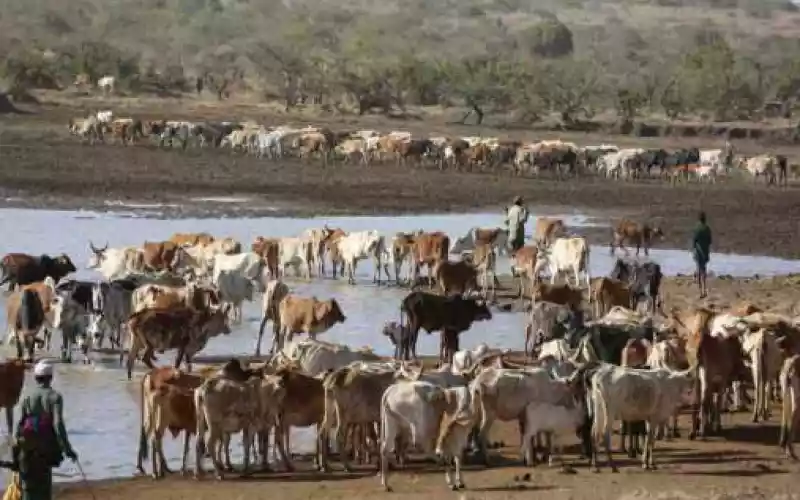
Ateker communities in Kenya, Uganda, South Sudan, and Ethiopia have called for a resource-sharing framework to allow them access to water and pasture without having to follow maps.
For generations, pastoralists across the Ateker region have moved with their livestock in search of grazing land and water, following the seasons rather than borders.
But today, those traditional movements are increasingly colliding with national borders, climate shocks, insecurity and shrinking natural resources.
Pastoralists from Kenya, Uganda, South Sudan and Ethiopia are now demanding a regional framework that would allow communities to share water and pasture across borders while reducing conflict and protecting fragile ecosystems.
The proposal emerged during a series of high-level dialogue sessions held as part of the 11th Karamoja Cultural Event in Moroto, Uganda, bringing together pastoralists, government officials, peace actors and development partners.
For the communities, the message was simple: resources that have always been shared across borders can no longer be managed through isolated national approaches.
Ewesit Lowasa, a pastoralist from Turkana, Kenya, says any regional framework must confront one of the most visible environmental threats facing pastoral communities: the spread of invasive Prosopis.
The thorny plant has taken over large sections of grazing land, consuming groundwater, choking pasture and reducing the amount of land available to livestock.
But for Lowasa, Prosopis is more than an environmental problem.
Along parts of the Turkana-Jie border, he says, dense Prosopis thickets have become hiding places for raiders and obstacles for security personnel pursuing stolen livestock.
“Authorities often face difficulties while pursuing raiders who conceal themselves behind the dense Prosopis bushes. Even when some raiders are arrested, others manage to drive away stolen animals to locations where they cannot be recovered,” Lowasa said.
Lowasa wants governments to treat Prosopis control as part of a broader regional strategy encompassing pasture, water, environmental restoration, and security.
Gloria Lokol, a pastoralist from Nakapiripirit in Uganda, believes the answer cannot be limited to livestock. Communities must also be supported to develop alternative livelihoods that can withstand increasingly unpredictable weather conditions.
She called for investment in climate-smart agriculture, environmental conservation and small-scale food production, including kitchen gardens.
Lokol said civil society organisations could help communities understand the benefits of agriculture and gradually encourage households to diversify their food and income sources.
Stay informed. Subscribe to our newsletter
“Pastoralists largely suffer due to weather-related challenges, yet they continue to aggravate conditions for drought by cutting down trees for charcoal burning, moving large herds on bare land and depleting vegetation through overgrazing. There must be means of regenerating pasture through agricultural interventions and climate-smart practices,” she said.
Her argument highlights a difficult contradiction facing pastoral communities: the same environmental pressures that make pastoralism increasingly difficult can also encourage practices that further degrade the land.
Pastoralist representatives from South Sudan and Ethiopia backed the proposal, arguing that drought-resilience programmes should no longer be designed solely within national boundaries.
The pastoralist communities want governments to invest jointly in water infrastructure, pasture restoration, environmental conservation and livelihoods in areas used by mobile pastoralists even where those areas fall outside their own territories.
The proposal reflects the reality of the Ateker region, where pastoral communities share ecosystems, migration routes, cultural traditions and livestock markets despite being separated by international borders.
“When drought strikes one side of the border, pastoralists often have little choice but to move towards the other side in search of survival. Without agreed mechanisms for managing such movements, what begins as a search for water can quickly become a security or diplomatic problem, Lokol said.
Uganda's Minister for Karamoja Affairs, John Baptist Lokii, said culture and traditional approaches had played an important role in transforming the Karacuna from a community associated with raiding into advocates for peace.
He praised Uganda's security agencies for their efforts to remove illegal firearms from communities, saying that disarmament had created new opportunities for peace, cross-border trade, tourism and development.
But participants at the dialogue argued that security alone cannot guarantee lasting peace. For pastoral communities, peace must also mean access to water, pasture, markets, livelihoods and opportunities for young people.
Presidential Special Envoy for Peace in the Ateker region, John Munyes, said governments were already taking steps towards creating lasting regional mechanisms for pastoralist communities living along international borders.
At the centre of this effort is the Ateker Leaders Council, which is being developed as a platform for regional cooperation.
Munyes said the council would work closely with institutions, including the African Union (AU) and the Intergovernmental Authority on Development (IGAD), as well as development partners operating across the region.
The aim is to mobilise resources and harmonise interventions that address pastoralist livelihoods, peace, and cross-border cooperation.
“The leadership of Kenya at the national and county levels is keen on ensuring that pastoralist communities are properly served,” Munyes said.
Munyes said the emerging regional framework would also recognise traditional mechanisms of conflict resolution, allowing indigenous approaches to complement formal government structures.
Ichor Imana, an adviser to the Governor of Turkana and a peace ambassador, believes culture can provide a powerful bridge where conventional diplomacy sometimes struggles.
He said cultural festivals pioneered in Karamoja have evolved beyond celebrations of music, dance and heritage.
They have become spaces where communities and leaders can openly discuss sensitive cross-border issues.
Imana cited the recent release of Turkana herders by Ugandan authorities as an example of the importance of maintaining strong relationships between neighbouring communities and governments.
He said the Turkana leadership was keen to use culture as a diplomatic tool to strengthen relations between Kenya, Uganda, South Sudan and Ethiopia, the four countries linked by the shared Ateker identity.
For development partners, the Moroto festival was also an opportunity to test approaches that could be replicated elsewhere.
Nicholas Omwolo, Project Manager of the EU-funded SPREAD programme, said TUPADO had facilitated the participation of civil society groups from Lokichoggio, Turkana North and Kibish sub-counties.
The groups attended the festival to learn from the cross-border dialogue and identify approaches that could be adapted along the Kenya-South Sudan and Kenya-Ethiopia borders.
Omwolo said preparations for the second edition of Nadapal Peace, scheduled for September 19–21, were already at an advanced stage.
“The key takeaway from this festival for us remains the innovative structure of participants in the dialogue. Rural youth were given space to engage with rural youth from neighbouring countries, while urban youth held discussions with their urban counterparts. The finer separation enriched the dialogue sessions,” Omwolo said.
The communities are therefore calling for a framework that recognises the realities of their way of life while protecting natural resources and preventing competition over water and pasture from becoming a source of conflict.
Uganda Presidential Advisor on wealth creation and one of the lead organisers of the Karamoja Cultural Event, Dr David Pulkol, announced that Kotido will host the 12th edition of the festival in 2027.






Subscribe to our newsletter and stay updated on the latest developments and special offers!








 join
join