×

The Standard e-Paper
Fearless, Trusted News
 The Standard Group Plc is a
multi-media organization with investments in media platforms spanning newspaper
print operations, television, radio broadcasting, digital and online services. The
Standard Group is recognized as a leading multi-media house in Kenya with a key
influence in matters of national and international interest.
The Standard Group Plc is a
multi-media organization with investments in media platforms spanning newspaper
print operations, television, radio broadcasting, digital and online services. The
Standard Group is recognized as a leading multi-media house in Kenya with a key
influence in matters of national and international interest.

Audio By Vocalize
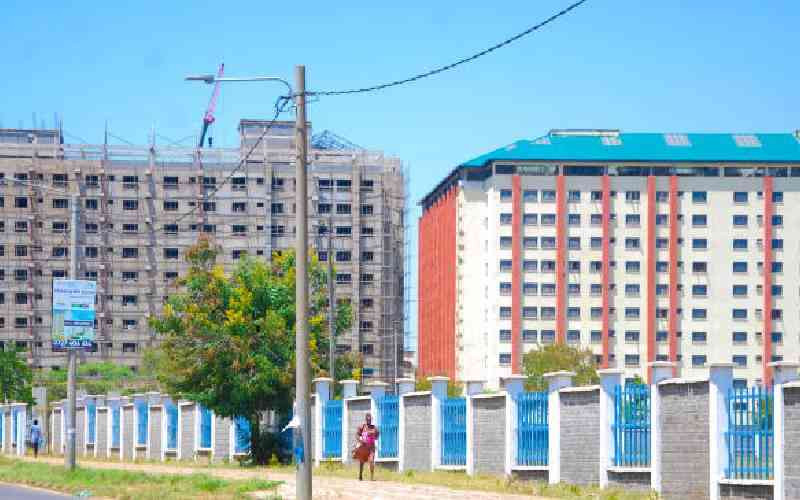
Kenya's most significant real estate opportunity is not solely dependent on capital, market sentiments, or a favourable interest rate cycle.
It sits, largely undisturbed, across the established suburbs of Nairobi and the urban corridors extending beyond them — in the form of family-held and institutional land that has appreciated quietly for decades, while the country around it has grown faster than the infrastructure serving it.
The real question is whether Kenya’s development industry possesses the capability to unlock this opportunity, not only in technical expertise, but in governance, execution, and partnership structures that can realise value in a manner truly commensurate with what these landowners deserve.
A legacy worth understanding
Land in Kenya carries a value that balance sheets can not capture. For the families who have held prime parcels across Karen, Runda, Kitisuru, Muthaiga, and the coast, these are not simply developable assets.
They are the physical record of a family's history accumulated across generations, often at significant personal cost, and held with a sense of stewardship that extends well beyond the current generation's interests.
This relationship between Kenyan families and their land is a strength, not an obstacle. The discipline of holding, resisting short-term pressure in favour of long-term preservation reflects a sophistication about value that many purely financial actors lack.
What is changing is not that conviction, but the landscape of opportunity surrounding it.
Kenya's urban population is expanding rapidly.
Demand for quality, well-built and governed master-planned homes in established residential addresses is high, and is structurally undersupplied.
A new generation of landowners — often acutely aware of what their land could yield — are asking a question their predecessors rarely had the tools or partners to properly answer: how does this asset generate its full potential, without compromising what makes it ours?
Where the gap lies
Across Sub-Saharan Africa, large landholdings represent the most significant untapped residential development opportunity on the continent.
Kenya sits at the centre of that picture. What has historically constrained the realisation of that opportunity is not ambition on the part of landowners; it is the absence of development partners with the institutional rigour and governance to match it.
Unlocking land at scale and doing so in a way that protects the landowner while delivering a successful development requires capabilities and alignment that remain in short supply in today’s market.
Stay informed. Subscribe to our newsletter
It demands governance structures that are clearly documented, enforceable, and transparent from the outset, not as an administrative exercise, but as the foundation of a productive long-term partnership.
It also requires development expertise grounded in real delivery experience: the ability to correctly underwrite a project across the full development cycle, from planning and infrastructure to construction, sales, and handover, informed by the hard lessons that only come from having successfully delivered comparable projects at scale.
The standard that the market now requires
Kenya's development industry is at an inflection point. The informal arrangements and generic approaches that characterised an earlier phase of the market are giving way to more institutional standards. Buyers are more discerning.
Financing is more structured. And landowners, who have watched the market evolve, are increasingly in a position to demand development partners who can demonstrate their capabilities.
What that looks like in practice is a development partner who arrives at the table with a site-specific master planning thesis, not a generic offer. One whose governance framework is documented and independently verifiable.
One whose track record across comparable projects provides evidence and confidence, rather than a promise. And one whose interests are genuinely aligned with the landowner's, through a joint venture structure that rewards both parties in proportion to the value created.
This is the standard that Kenya's land opportunity demands. It is also, increasingly, the standard that serious landowners are beginning to require of those who seek to work with them.
The opportunity ahead
The land is not the constraint. It has never been. Kenya holds some of Sub-Saharan Africa's most compelling residential development sites in locations that combine established infrastructure, genuine market demand, and location that underpins long-term value.
What the next chapter of Kenya's development story requires is the expertise and institutional seriousness to meet that opportunity with the quality of thinking it warrants.
For landowners who have held their parcels with patience and purpose, that next chapter represents a genuine inflection. The transition from land held to land developed, done well, is not a loss of inheritance. It is its most powerful realisation.
-The writer is the co-founder and Executive Director of Linden Africa







Subscribe to our newsletter and stay updated on the latest developments and special offers!








 join
join