×
App Icon
The Standard e-Paper
Stay Informed, Even Offline
★★★★ - on Play Store
Read on the App

When football's playbook becomes leadership strategy

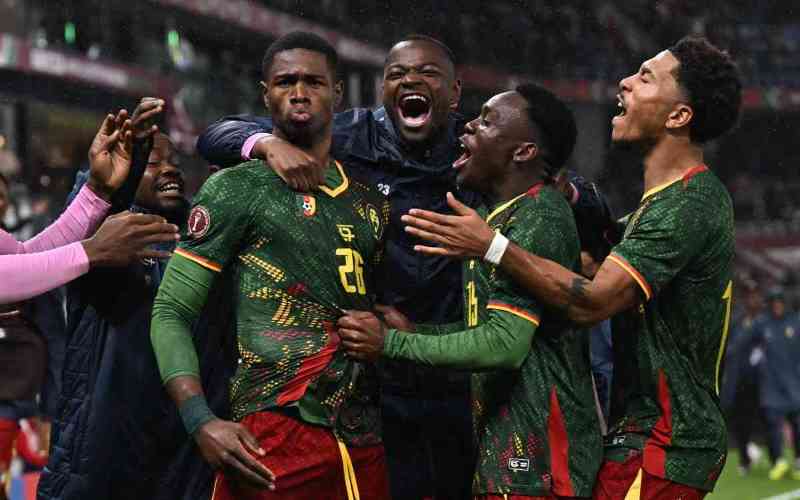
Cameroon's forward Christian Kofane celebrates scoring his team's second goal during an AFCON match at Al Medina Stadium in Rabat on January 4, 2026. [AFP]

There is this chewing gum that I used to buy for my nephew, and every pack had a photo of a soccer player on it.

Every time, he would open and stick the player on his bedroom wall until he had a full team. During the 2002 World Cup, he built the full lineup of the Brazilian team that lifted the trophy that year. 
What struck me was the repeated discipline, dedication and consistency.

As time went on, he stuck. I was surprised that he ended up creating a portrait of the 2002 Brazilian team that won the World Cup.


What appealed to me was the fact that the wall was built one at a time without us noticing, a decision that creates a full picture of the team before us, without our noticing.

That wall has been on my mind as we step into 2026. In the same way a team is made long before match day, an organisation’s team is shaped long before the success of the business. Just as a soccer team is built over time, organisations are built through constant strategic choices.

This week’s signal

Coherence is becoming the most valuable currency in leadership. Star players do not make the greatest teams in football. They are wonderful since the pieces fit.

They know the rhythm of the game, they read their opponents, and have faith in the system that guides them.

Just the same way, Brazil rolled in 2002 with that transparency. Each step was not accidental; each musician had an idea of how to do something, and each choice led to the conclusion.

That is the signal for 2026. What is needed is the distinction between leaders who are creating something and those who are merely responding. Most failures in 2025 were due to misaligned decisions, mixed messages, and teams lacking a clear point of direction.

This will be a year that rewards leaders who take steps in the right direction and communicate in a way that makes their people straight instead of being blown away.

 What it means for business

Customers can read confusion way before leaders can. Your customers are your fans. If you lose your fans, you lose business. Fans can identify when the formation is off.

Nurture their confidence, as once it is gone, talent, capital, and strategy are swiftly behind. You should not be scared of competition. It should refine you. A worthy competitor does not undermine your stance. Respect your worthy rival. In soccer, you don’t score with your hand nor cut deals with football authorities. That is not business, that is cheating.

Worthy rivals sharpen your discipline. Having the best scorer in the world cannot carry a team whose coordination is poor. In the same way in business, having the best employee with poor team coordination and formation will not lead to the organisation’s success.

What it means for policy

Treat last season as last season. The duty of policymakers as they enter the year is like a World Cup knockout match. Invest in robust systems, build communication, and prioritise current performance over past accomplishments to shine in 2026.

It’s important for policymakers in the 21st century to note that you cannot manage players with employee systems. You cannot retain talent with labour era thinking, and you cannot talk modern while behaving in the ancient way. So, what is the difference?

Just like in soccer, companies should prioritise investing in their players, training, coaching and acquisition of new stars for your teams. From the ancient era, institutions understood human value differently.

From the possession era of Moses and slavery, human value was a property where worth was defined by possession.

Then came the servitude era of post slavery societies and feudal systems, where worth came from submission and duty.

Then came the labour era of the industrial revolution, where worth was labour measured in time and volume, then the employment era of the late 20th century, of employee human value, where worth was tied to job description and tenure. Then came the talent era of the 21st century, where culture became a performance variable, not a moral one, and now, we are in the player era where human worth is defined by decisions, trust and outcomes.

Support, reward and promote your best players in 2026. Never glorify mediocrity.

What it means for people

As a corporate player, what’s your jersey number? Just imagine Lionel Messi introducing himself as a worker of Inter Miami CF, yet soccer is actually a full-time job.

Next time in those networking events, ask a CEO who do you play for?

If your organisation’s performance in 2025 was mediocre, don’t glorify it. View it from a soccer lens, treat it as a relegation.

In 2026, as a player, study your organisation’s team formation, know your jersey number and play as a unit.

Even though experience is key, don’t make it a virtue in 2026.

Have you seen a 90-year-old in the world soccer changing rooms? Strive to be the best player for your team in 2026. Happy New Year!

 Afterthought

The soccer sticker wall is about discipline, dedication and consistency. Embrace them in 2026. “Decisions are made on the radar screen, but the future is yours.”

-The writer is a human-centred strategist and leadership columnist