×
App Icon
The Standard e-Paper
Informed Minds Prefer The Standard
★★★★ - on Play Store
Download Now

How solar energy is transforming Africa's sustainable future

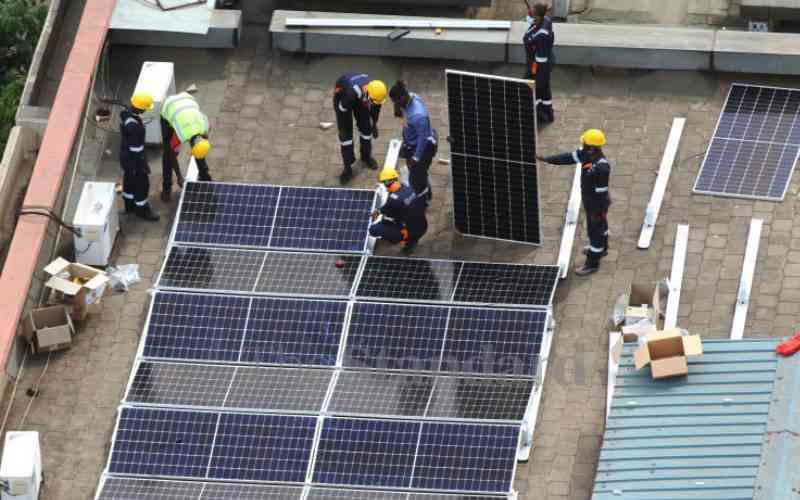
 Solar power generation installation. [File, Standard]

Africa, blessed with some of the world’s highest solar irradiation levels, is experiencing an unprecedented surge in solar market momentum.

From the vast deserts of the Sahel to the fertile plains of East Africa, investments are flowing, projects are scaling and opportunities are multiplying.
Yet, this is no mere flash in the pan; it’s a structured market evolution driven by policy alignment, technological innovation, and private-sector ingenuity.

As Kenya hosts the continent’s premier solar expo next month, we shall have a firsthand experience of how the continent’s renewable energy landscape is maturing into a robust ecosystem.


The inaugural event, Intersolar Africa 2026, scheduled to take place in Nairobi, comes at a pivotal moment when demand for energy has continued to expand.

Solar installations across sub-Saharan Africa have grown exponentially, with the International Renewable Energy Agency (IRENA) reporting over 10 gigawatts (GW) of cumulative capacity added in the past five years alone.

This isn’t just hype; it’s hard data reflecting a market that’s attracting billions in foreign direct investment (FDI). Kenya’s solar sector exemplifies this momentum.

The Lake Turkana Wind Farm may grab headlines for wind, but solar is the quiet powerhouse: off-grid solutions have electrified over 20 per cent of rural households through pay-as-you-go models pioneered by diverse service providers.

Kenya’s feed-in tariff reforms and the Kenya Off-Grid Solar Access Project (KOSAP) have created a fertile ground for mini-grids and standalone systems, drawing in investors from Europe and Asia.

Last year, FDI in Kenyan renewables hit $1.2 billion (Sh158.9 billion), a 40 per cent jump from 2023, according to the Kenya Investment Authority.

This local success story mirrors broader continental trends. South Africa’s Renewable Energy Independent Power Producer Procurement Programme (REIPPPP) has procured over 6 GW of solar since 2011, blending international best practices with African resilience.

Drawing from Germany’s Energiewende - where feed-in tariffs spurred a solar boom in the early 2000s - South Africa has adapted these models to address energy poverty and grid instability.

The result? Utility-scale projects like the 100 megawatt (MW) Kathu Solar Park, which not only generate clean power but also create thousands of local jobs. Zoom out further, and the investment pipeline is staggering.

The African Development Bank estimates that $100 billion annually is needed for the continent’s energy transition, with solar poised to capture a significant share.

Morocco’s Noor Complex, one of the world’s largest concentrated solar power plants, showcases how North African nations are leveraging public-private partnerships (PPPs) inspired by Dubai’s Mohammed bin Rashid Al Maktoum Solar Park.

These mega-projects aren’t isolated; they’re linked through regional power pools like the Southern African Power Pool (SAPP), enabling cross-border energy trade and stabilising markets. What fuels this momentum?

A confluence of factors. Falling photovoltaic (PV) module prices - down 89 per cent since 2010, per Bloomberg NEF - have democratised access. Battery storage advancements, borrowing from Tesla’s Gigafactory model but scaled for African contexts, are solving intermittency challenges.

In Nigeria, where gas flaring once symbolised wasted potential, solar hybrids are now integrating with existing infrastructure, as seen in the 10 MW Bavari Solar Plant. Yet, opportunities abound beyond generation.

The market ecosystem is expanding into financing, skills development, and supply chains. Green bonds and climate funds, such as the EU’s Global Gateway initiative, are channeling capital into African solar.

Germany’s KfW Development Bank, a veteran in renewable financing, partners with local institutions to de-risk projects, echoing successful models in India.

Digital platforms

For entrepreneurs, this means a boom in ancillary services: From digital platforms for energy trading in Ghana to vocational training centres in Tanzania producing certified solar technicians.

But challenges persist. Grid infrastructure lags in many regions, and regulatory harmonisation is uneven. But these are surmountable.

Rwanda’s rapid electrification, achieving 75 per cent access through solar mini-grids, demonstrates how agile policy can accelerate adoption.

International linkages are key: adopting ISO standards for PV systems ensures quality, while collaborations with the International Solar Alliance (ISA) bring global expertise to local implementation.

As we approach Intersolar Africa 2026, the message is clear: Africa’s solar market is not emerging, it’s accelerating.

With around 100 exhibitors expected, from cutting-edge module manufacturers to innovative financiers, the event will be the nexus for deal-making and knowledge exchange. Nairobi, a hub of African innovation, is the perfect stage to connect local stakeholders with global players.

Imagine a future where Africa’s solar potential, estimated at 10 terawatts (TW) by IRENA, powers industries, empowers communities and drives GDP growth. This isn’t speculation; it’s the trajectory we’re on. Investors, policymakers, and innovators must seize this momentum.

- The author is the Managing Director at Solar Promotion International