×
App Icon
The Standard e-Paper
Truth Without Fear
★★★★ - on Play Store
Download Now

Improving eggshell quality in your layers

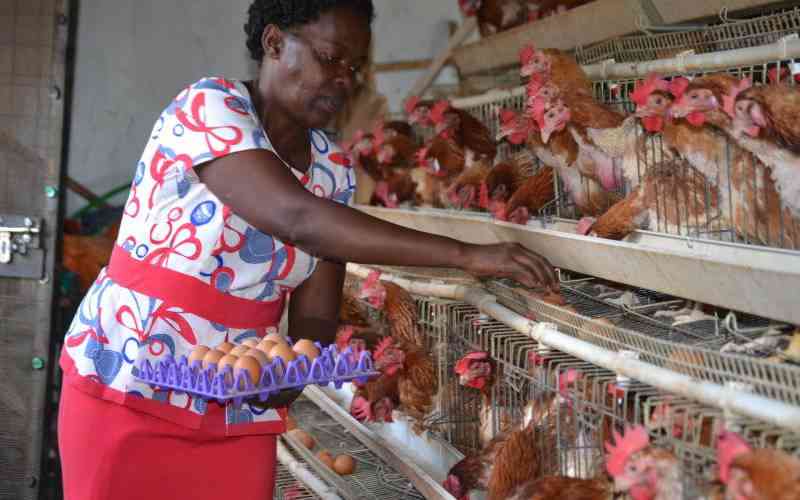
Mrs Kasendi Mutinda collects eggs at her chicken farm in Ngengeka village, Kitui county. The farmer rears over 500 layers which gives her 12 crates of eggs per day. She says demand for eggs is steady and unmet. She has also reared over 100 broilers with a kilo of meat going for Sh500.[FILE,Standard]

In both commercial and breeder poultry farming, almost half of the discarded eggs are due to shell quality problems.

Pale brown or white eggs (Kenya is a brown egg market) appear as an early sign of reduced shell quality in laying hens, often indicating incomplete cuticle deposition or inadequate calcium accumulation, typically linked to nutritional deficiencies, disease, or premature oviposition. Shell thickness and strength should be monitored throughout the flock’s life. Shell quality can be assessed using destructive tests such as breaking strength, shell weight, and shell thickness.


Here are some of the factors that affect eggshell quality and how they can be addressed.

Genetics and Health: Genetic variability has been identified as one of the determinants of eggshell quality. Different strains of birds have inherent differences in shell thickness and shell matrix composition. Pure commercial layer breeds have stronger shells compared to broiler breeds.


Studies show that 20-30 per cent of shell quality variation is genetic. Older birds produce larger eggs with proportionally thinner shells because the calcium deposition rate does not increase with egg size.

Bird Health: Diseases like infectious bronchitis (IBV) damage the oviduct lining, leading to wrinkled, misshapen and or thin white shells.

Other diseases like Egg Drop syndrome (EDS) may cause eggs to appear pale, thin, soft-shelled, or shell-less eggs due to disrupted shell gland function.

In severe cases of Newcastle (NCD) or Mycoplasma (MG) diseases, oviduct functions may be interfered with, leading to shell-less eggs, rough shell surface, and poor albumen quality.

The bright side of this phenomenon is that fully vaccinated birds during the growing period are protected against these ailments. There are vaccines against NCD, IBV, MG and EDS given during the growing phase of laying hens to minimise eggshell defects.

Nutritional Causes: It is important to judiciously select the most appropriate diet that will supply adequate amounts and proportions of the nutrients that a bird requires at every stage of its life.

It has been established that calcium deficiencies or feeding the wrong particle size of limestone in the diet can lead to poor eggshell formation. A coarse limestone size (>2mm) improves calcium availability for shell formation, while fine particles pass too quickly in the gut. An optimum balance of calcium to phosphorus at a ratio of 10:1 is needed for shell mineralisation. The feed must also be rich in vitamin D3, Zinc, Manganese, and copper for good eggshell quality. Deficiencies in these minerals will result in soft-shelled eggs and thin, fragile eggs, which are not good for the market or further incubation.

Egg Handling Factors: Other factors that may cause cracks on eggshells include eggs left too long in the nests. Egg collection frequencies of 3-5 times per day are recommended; this will reduce the risk of egg contamination and microcracks.

Uncomfortable transportation, rough handling, and poor collection systems cause hairline cracks, which may not be visible but may allow egg contamination, especially for incubation.

If you see a lot of cracked eggs in the egg storage area, make sure that the are enough nest boxes.

Note that excessive birds per nest may cause unnecessary cracks. A 4-5 birds per nest system is ideal. Egg collection should not be delayed; Experts recommend 5-6 egg collections per day in a breeding farm. Avoid rough handling of eggs; pack eggs carefully and never stack more than eight trays high.

As flocks age, eggshells become weak due to low calcium in the diet. Supplement calcium grits just before lights out in what is referred to as a “midnight snack.” Finally, improper storage temperatures, especially above 20 degrees Celsius, may cause water loss and weaken shell membranes.

Elevated temperatures above 30 degrees Celsius in poultry barns may reduce calcium absorption and cause an increase in panting, leading to respiratory alkalosis that reduces blood calcium available for calcification of an egg.

Do not provide excessive lighting period, as this will shorten calcification time, resulting in thin shells.

[Dr Messo is the company veterinarian, Kenchic; [email protected]]