×
App Icon
The Standard e-Paper
Smart Minds Choose Us
★★★★ - on Play Store
Download App

Tanzania families still looking for bodies 3 months after protests

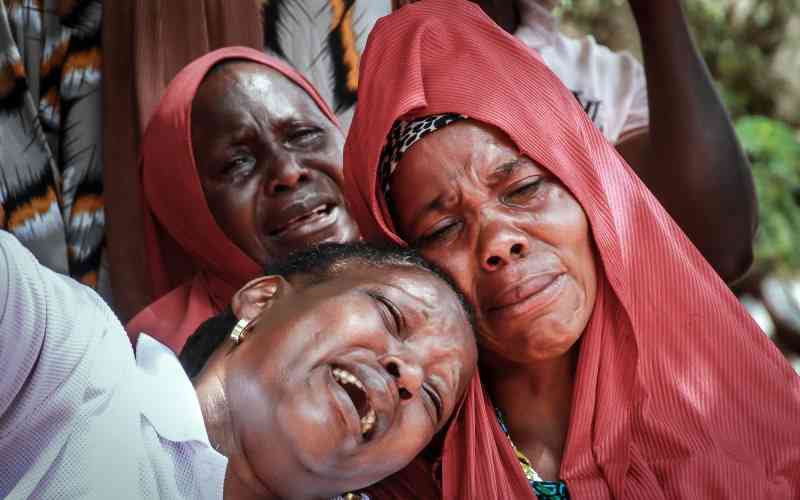
Mourners react as they gather around the coffin to pay their final respects to Michael Christian, Chairman of Youth for Nyamagana District of Tanzania’s opposition party Chadema, who was killed amid unrest following Tanzania’s presidential election, in Mwanza on November 6, 2025. [AFP]

Manenos Selanyika could only receive a symbolic burial. His family never found his body after the violent unrest of Tanzania's election three months ago.

The 40-year-old journalist was shot dead by security forces on October 30, neighbours told the family.
He had ventured out for food supplies amid protests that had engulfed Tanzania during the elections the previous day.

The neighbours told the family he was shot on Mbezi Africana Street on the outskirts of the country's biggest city, Dar es Salaam, but police would not let anyone retrieve the body.


"I don't want to twist words. It was the police (that shot him)," one of his relatives told AFP. Their name is being withheld to protect them from reprisals.

The family hunted through dozens of corpses at multiple hospitals in the following days, but to no avail.

After more than a week, they gave up and decided to hold a symbolic burial at Lambo village near Mount Kilimanjaro.

"We only had a marker to show that this is where his grave would be," the relative said.

Missing bodies

Hundreds of families are believed to be in the same position. The authorities are accused of dumping bodies in mass graves.

The protests were sparked by the banning of opposition candidates and a campaign of killings and abductions against critics of President Samia Suluhu Hassan.

She was declared the winner with 98 percent of the vote, but only after five days of violence in which an estimated 2,000 people were killed by security forces under cover of an internet blackout, according to the opposition.

The government has still not released an official toll and did not respond to questions from AFP for this article.

Sheila Gyumi (not her real name) lost her husband on election day after he went out to work as a motorbike courier.

"At that time, things didn't seem tense; everything looked calm," she told AFP. "Later, I saw the situation had changed, so I started calling him, but he didn't answer."

The family went to multiple police stations and all the major hospitals, but felt they were stonewalled at every turn.

"I feel very bad. My husband was someone who cared deeply about his family," she told AFP.

"I don't know where he is. There is bound to be pain, and there are bound to be questions from the child," she said, adding that she was now struggling to afford rent and schooling.

AFP has previously spoken with a doctor at a major hospital in Dar es Salaam who said hundreds of corpses were taken from its morgue by security forces to secret locations at the height of the unrest.

"We believe that maybe (Selanyika) is among those in a mass grave, as reported by the media, although the government denied it," said the journalist's relative.

"It's been three months. We don't think we will ever find (the body)," they added.

Fear

Many of those killed were innocent bystanders, say rights groups and witnesses, most too scared to talk for fear of reprisals.

"There has been fear for our safety, including the risk of arrest by security agencies," said another of Selanyika's relatives.

The government has vowed an investigation but has largely downplayed the unrest, with the president saying no excessive violence was used.

The Centre for Information Resilience, an independent digital investigation organisation, analysed 185 images and videos from the protests and found "the repeated use of live ammunition by security forces and plain-clothed armed men, resulting in casualties".

It "identified possible mass graves through satellite imagery and verified large piles of bodies" within user-generated content.

Foreign journalists were banned from covering the elections, while local reporters, who already face heavy censorship, were ordered not to cover the unrest.

At least one journalist, Godfrey Thomas of Millard Ayo TV, has been charged with treason for reporting on the protests.

"It was an extremely difficult period," said a veteran reporter, whose name is also being withheld.

The images on state TV were "completely disconnected from what was happening on the ground. Even the election results that were announced -- I don't know where they came from," he said.