×

The Standard e-Paper
Fearless, Trusted News
 The Standard Group Plc is a
multi-media organization with investments in media platforms spanning newspaper
print operations, television, radio broadcasting, digital and online services. The
Standard Group is recognized as a leading multi-media house in Kenya with a key
influence in matters of national and international interest.

Audio By Vocalize
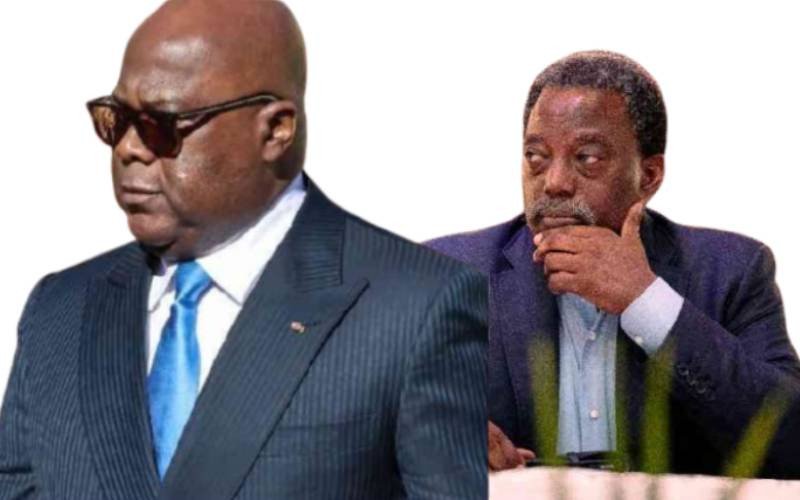
The Democratic Republic of the Congo (DRC) is on the brink of the precipice, with Former President Joseph Kabila now heading a rebel movement whose sole aim is to kick out President Felix Tshisekedi from power.
Congo DRC, which is the size of Western Europe and has huge deposits of valuable minerals, has faced turbulent times since Independence in 1960, with the country’s first Prime Minister, Patrice Lumumba, killed while in office over his nationalistic policies, despised by Europe.
President Laurent Kabila, who deposed the longest-serving President Mobutu Sese Seko from office in 1997, would later be shot by one of his bodyguards while chairing a cabinet meeting in 2001 and was pronounced dead after being rushed to Harare in Zimbabwe for medical attention.
The younger Kabila, who took over power following the killing of his father in 2001, ruled the country for 18 years and handed over power to Tshisekedi in 2019, after which they formed a coalition in which the former President sought to have his ally named Prime Minister and also to control parliament.
The former President would later fall out with Tshisekedi after their power-sharing deal collapsed and has been living in self-imposed exile since 2023 and only came back to the country early this year, setting up base at his Goma Residence with promises of seeking to have peace.
Kabila was in September 2025 sentenced to death for war crimes and treason charges in absentia over allegations of financing and supporting the M23, a rebel group that has taken control of the Eastern part of the DRC.
The former President was convicted by a military court of treason, crimes against humanity and war crimes, including murder, sexual assault, torture and insurrection, with the former President denying the charges but not appearing in court to defend himself.
“Unfortunately, our courts are being used as instruments of oppression; the charges levelled against me, the death sentence and the huge fine imposed against me are illogical; the courts are being used to settle some political scores,” said Kabila.
President Tshisekedi had last year accused Kabila of being the brains behind the M23, with the country’s Senators later stripping Kabila of his legal immunity, paving the way for his prosecution and sentencing, which seemed to escalate the tension between the two leaders.
The United Nations and several European Union nations accused Rwanda of backing the M23 and sending thousands of its soldiers into the DRC, with Rwanda denying the accusation, saying that it was only acting to stop the conflict from spilling over to its territory.
The United States of America, in May this year, imposed sweeping sanctions on Kabila, accusing him of backing the M23, providing financial support, and encouraging defections from the Congolese army, with the former President terming the measures unjustified and politically motivated.
The former President was recently named as the leader of the Front for the Refoundation of the Nation (FRN), whose main agenda is to coordinate resistance forces to end tyranny in the Democratic Republic of Congo and would pursue the goal by all means, including force.
The launch of FRN with Kabila as the leader is a clear indicator so far of Kabila's direct involvement in an armed movement a year after he was sentenced to death in absentia for treason after previously denying having any links to the M23 rebel group.
Kabila, in a speech made in his Goma residence, accused President Tshisekedi's government of disregarding proposals he had put forward last year, including some aimed at ending the conflict in eastern DR Congo and said he decided to guide citizens on how to rescue their country.
Stay informed. Subscribe to our newsletter
“The Tshisekedi administration stands accused of undermining constitutional rule, mismanaging the economy and failing to improve security; there have also been cases of arbitrary arrests of political opponents and military officers under this regime,” said Kabila.
Tshisekedi's second term ends in 2028 but in May this year he said that elections, which are due then, may not be held because of the conflict and also hinted that he may seek re-election for a third term if the people of Congo DRC want him to do that.
The country’s parliament has since passed a bill that could pave the way for a referendum that could remove the constitution's two-term limit, something that may pave the way for Tshisekedi to continue being in power, something that is said to have irked Kabila and his supporters.
The late Kabila overthrew Mobutu in May 1997 with the backing of Uganda and Rwanda, with the late Mobutu having been in power for 32 years and having amassed massive wealth; he fled to Morocco, where he died and was buried while in exile a few months later.
The senior Kabila turned on his former supporters, which were Rwanda and Uganda and allowed Hutu armies to regroup in eastern Congo, which resulted in a Rwandan-Ugandan joint invasion in 1998, forcing Angola, Namibia and Zimbabwe to come to the aid of the Kabila administration.
The intervention by Angola, Namibia and Zimbabwe Kabila’s temporarily halted the Rwandan and Ugandan troops advance against the Kabila forces with the conflict eventually coming following the July 1999 Lusaka peace accord signed by seven nations involved in the conflict.
Lumumba, who was elected Prime Minister for the Congo DRC in 1960, was executed with the assistance of Belgium and the United States in January 1961, barely six months after assuming office, with the two powerful nations said to be wary of his unfavourable policies to them.
“We are going to show the world what the Black man and woman can do when he works in freedom; we are going to make of the Congo the centre of the sun’s radiance for all of Africa. We are going to keep watch over the lands of our country so that they truly profit her children,” said Lumumba in 1960.
Subscribe to our newsletter and stay updated on the latest developments and special offers!


 Prefer the Standard on Google